

- BGG rank
- BGG #4,078
- BGG rating
- 7.1
Flames of War: The World War II Miniatures Game
- 2 players
- 120 min
- Complexity 3.3/5
- 2002
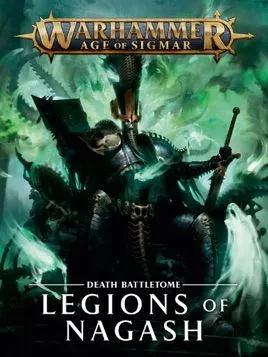
Expansion for Warhammer Age of Sigmar (Second Edition) Core Rules
2018
Rules assistance for Warhammer Age of Sigmar: Death Battletome – Legions of Nagash
Plain-language explanations of turns, card effects and disputed situations, with official source references and saved question history.
What would you like to know?
Answers come from the official rulebook, with the page to check.
Warhammer Age of Sigmar: Death Battletome – Legions of Nagash is an expansion for Warhammer Age of Sigmar (Second Edition) Core Rules released in 2018 for 2–4 players, 60–90 minutes per game, and ages 12 and up. Its main mechanics are Variable Player Powers, Dice Rolling, and Line of Sight.

A dread figure casts its shadow across the battlefield, a skeletal giant clad in osseous armour and wielding a skull-tipped staff that casts a sickening glow across the earth. A nimbus of shrieking spirits swirls around this nightmarish form. The avatar of undeath gestures with a fleshless hand, and the ground beneath it erupts as hordes of skeletons burst from shallow graves, falling upon their new master’s foes with rusted blades swinging. Nagash, the Great Necromancer, surveys the carnage with cold approval. Even as his enemies are torn apart, they rise again, slaughtering those they fought beside mere moments earlier. Such is the will of Nagash, and such is the fate he desires for all living things. In the 120-page hardback Battletome: Legions of Nagash, you’ll find: - The Lord of Undeath: a description of Nagash’s place in the grand scheme of the mortal realms, the undead creatures that serve him and an overview of the plans he has – elimination of all life and the expansion of his empire; - The Missing Souls: previously, an uneasy alliance – or at least a mutual respect – existed between Nagash and the God-King Sigmar; in this section, learn how that alliance fell apart; - The Realm of Death: a description of Shyish, a realm of endings and underworlds uncountable, and Nagash’s domain; - The Legions of Nagash: an overview of Nagash’s armies, and how Mortarchs are employed to lead them into grim battle; - A Legacy of Darkness: a timeline covering Nagash’s exploits dating back to the Age of Myth, with key events and battles leading to the present time; - Detailed background on the forces available to Nagash, including his Mortarchs, Soulblight Vampires, Nighthaunt Spirits, The Deathrattle Legions, Deathmages, and Deadwalkers; - A showcase of beautifully-painted Citadel miniatures, with an example army; - Painting your Legion: expert painting advice including stage by stage examples of painting bone, zombie flesh, rusted blades and banners, with special effects including adding gore, grime and dirt to your miniatures. Rules All the rules you need in order to get your Legions of Nagash army ready for the gaming table are here: - 33 Warscrolls, covering every miniature in the Legions of Nagash faction; - 6 sets of Allegiance Abilities – the Grand Host of Nagash, Legion of Sacrament, Legion of Blood, Legion of Night, Soulblight, and Death – each with their own unique Artefacts of Power, Command Traits, Battle Traits, and Command Ability; - 2 different Lores of the Dead – Lore of the Deathmages, and Lore of the Vampires; - 2 Battleplans, each featuring guidance on army compositions, objectives, specific Command Abilities for both sides, set-up and victory conditions; - Rules for setting up a Legions of Nagash warband for a Path to Glory campaign, including a Champion Rewards Table, Monster Followers Rewards Table, Followers Rewards Table, and Path to Glory warband roster; - Pitched Battle Profiles for every unit and miniature featured in this Battletome.
Warhammer Age of Sigmar: Death Battletome – Legions of Nagash supports 2–4 players according to the catalogue. This range comes from the publisher’s listed player count, so the game can be set up for any group size within it. Some setups, rules and scoring details may still vary by player count, so check your edition’s rulebook for the exact configuration.
The listed playing time for Warhammer Age of Sigmar: Death Battletome – Legions of Nagash is 60–90 minutes. This is the publisher’s estimate for a full game. The actual duration depends on the group, the player count and familiarity with the rules: first sessions usually run longer, while experienced groups often finish faster. Setup and teaching time are not included in this estimate.
The catalogue lists Warhammer Age of Sigmar: Death Battletome – Legions of Nagash for ages 12 and up. This is the publisher’s recommendation and reflects reading demands, rule complexity and small components rather than theme alone. Younger players can often join with help from an adult, so check the age guidance on your edition and consider your group’s experience with board games.
Warhammer Age of Sigmar: Death Battletome – Legions of Nagash belongs to these categories: Fantasy, Wargame, and Miniatures. Its main mechanics are Variable Player Powers, Dice Rolling, and Line of Sight. Categories describe the theme and setting of a game, while mechanics describe what players actually do on their turns. Each mechanic links to a catalogue hub with similar games, which helps when you want something comparable.
The catalogue lists Warhammer Age of Sigmar: Death Battletome – Legions of Nagash as an expansion for Warhammer Age of Sigmar (Second Edition) Core Rules. Expansions add new content, rules or scenarios to the base game and usually cannot be played on their own, so you need Warhammer Age of Sigmar (Second Edition) Core Rules to use it. Check that your edition of Warhammer Age of Sigmar (Second Edition) Core Rules is compatible, as some expansions were revised between editions.