

- BGG rank
- BGG #1,229
- BGG rating
- 8.4
Here I Stand: 500th Anniversary Edition
- 2–6 players
- 180–360 min
- Complexity 4.6/5
- 2017
2019
Rules assistance for Westphalia
Plain-language explanations of turns, card effects and disputed situations, with official source references and saved question history.
For 6 players
What would you like to know?
Answers come from the official rulebook, with the page to check.
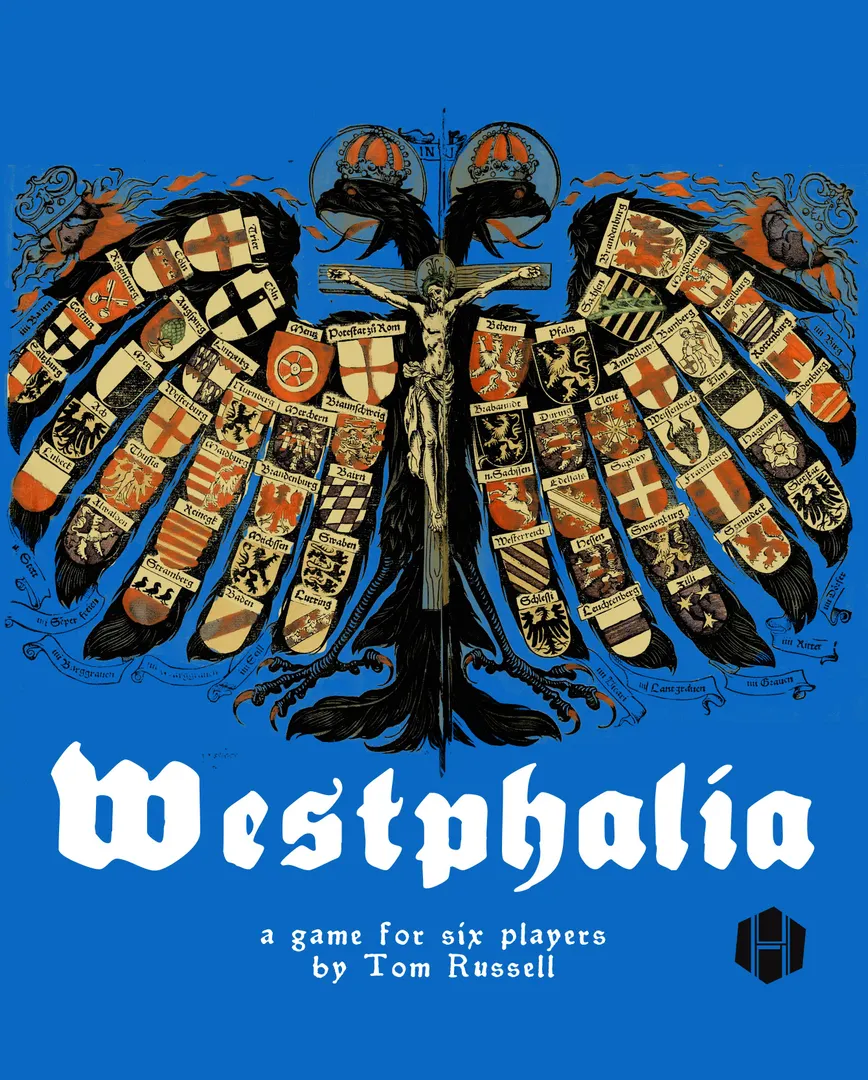
Westphalia is a board game released in 2019 for 6 players and 120 minutes per game. It was designed by Amabel Holland and its main mechanics are Variable Player Powers, Area Movement, and Dice Rolling.





Westphalia concerns the diplomatic negotiations and military campaigns that brought an end to the Thirty Years War and Eighty Years War. The question isn't a matter of who "wins" the war - that was decided a long time ago. Instead, each player seeks to arrive at a settlement that meets their own political, confessional, and economic goals. These goals are not mutually exclusive: if multiple players meet their victory conditions, they all win. The trick is, if all six players manage to meet their goals, then the game goes to a scoring round, and only one player wins. The result is a mix of cooperation and competition between six asymmetric factions (Austria, Bavaria, Spain, France, Sweden, and the Dutch Republic). The game unfolds in alternating Diplomacy Phases, in which anything and everything is up for negotiation, and Military Phases, in which tense cat-and-mouse chases give players the leverage they need in talks. There is no money in the game, only Debt, and you only ever seem to get more of it. At the end of the game, your Debt is reduced according to your accomplishments, and the remaining Debt is compared to faction-specific benchmarks to check for victory. Additionally, two factions must each ensure that two other specific factions meet their goals in order to meet their own: Austria must ensure victory for Bavaria and Spain, while France must do the same for Sweden and the Dutch Republic. This isn't mutual, however; once Bavaria gets what it wants, for example, it can hang Austria out to dry. This is a game for exactly six players: no more, no less. It cannot and does not scale to suit other player counts. —description from the publisher
Westphalia supports 6 players according to the catalogue. This is the publisher’s listed player count, so the game is designed for exactly that number of participants. Variants for other group sizes, if any, are described in the rulebook of your edition, so check it before setting up a different configuration.
The listed playing time for Westphalia is 120 minutes. This is the publisher’s estimate for a full game. The actual duration depends on the group, the player count and familiarity with the rules: first sessions usually run longer, while experienced groups often finish faster. Setup and teaching time are not included in this estimate.
Westphalia has a complexity rating of 3.1 out of 5 from BoardGameGeek players, which makes it a medium-weight game. The rating reflects how much rules knowledge, planning and decision-making a typical game demands. Expect a longer first teach for heavier games, and use a preparation guide before game night.
Westphalia belongs to these categories: Wargame, Print & Play, and Negotiation. Its main mechanics are Variable Player Powers, Area Movement, and Dice Rolling. Categories describe the theme and setting of a game, while mechanics describe what players actually do on their turns. Each mechanic links to a catalogue hub with similar games, which helps when you want something comparable.
The credited designers of Westphalia are: Amabel Holland. These credits come from the published game data and name the people responsible for the game’s design, not its illustrators or publishers. Designer pages on MeepleRules collect other titles by the same designers, which helps when you enjoy a game and want to find similar ones.
The catalogue lists Westphalia as a base game. It can be played on its own with the components in the box and does not require any other title. Expansions, if any exist, add new content or rules on top of it and are listed separately in the catalogue with a link back to this base game.