
- Puesto en BGG
- BGG #16.202
- Puntuación BGG
- 6,8
Ten Suns
- 1–6 jugadores
- 30–45 min
- Complejidad 2,3/5
- 2020
2018
Ayuda con las reglas de Black Souls
Explicaciones claras de turnos, efectos de cartas y situaciones dudosas, con referencias a fuentes oficiales e historial de preguntas guardado.
Para 1 jugador
¿Qué quieres saber?
Las respuestas salen del reglamento oficial, con la página para comprobarlo.
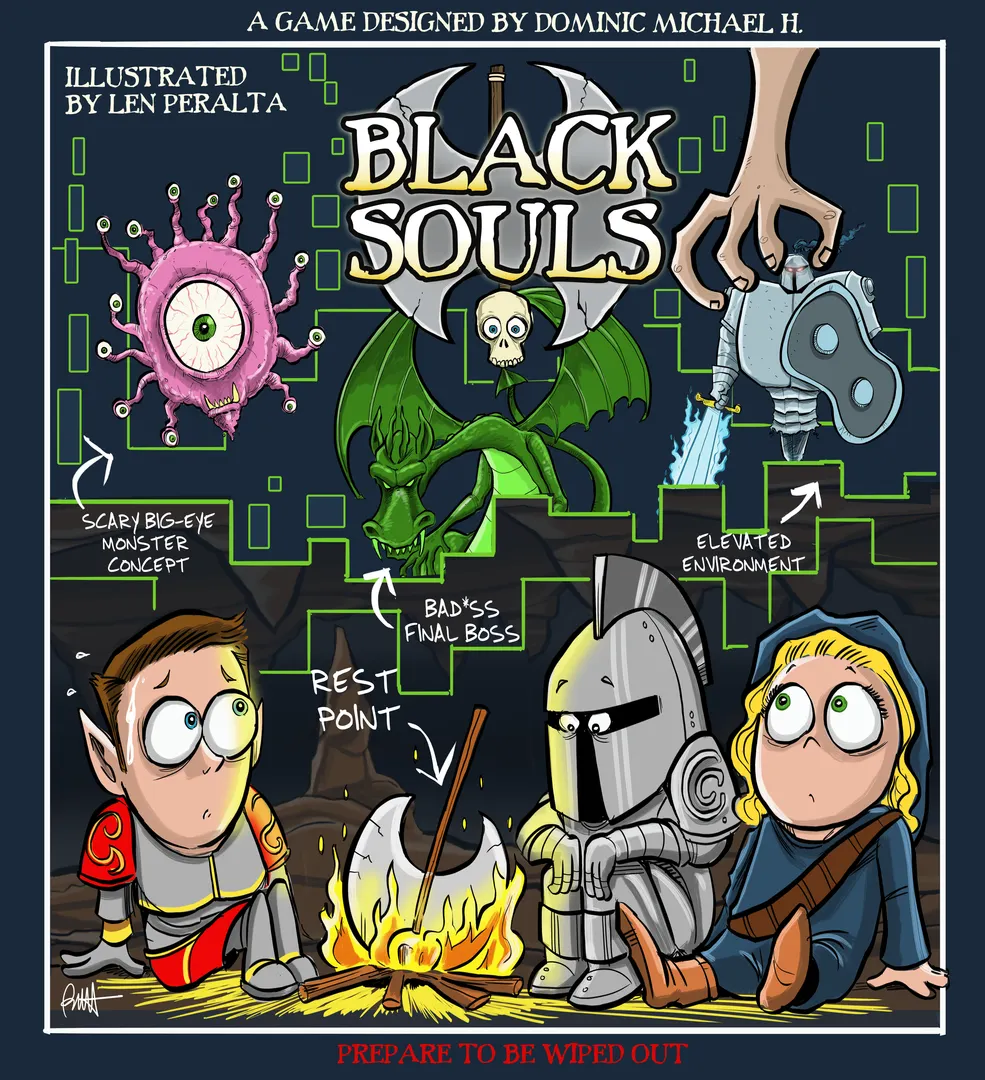
Black Souls es un juego de mesa publicado en 2018 para 1–6 jugadores, con partidas de 45 a 60 minutos y a partir de 10 años. Fue diseñado por Dominic Michael Huang y sus mecánicas principales son Set Collection, Auction / Bidding y Tile Placement.

En inglés
Designer Inc's latest video game title Black Souls has achieved international success! Hailed as one of the toughest digital games ever, it has attracted millions of hardcore gamers. The secret behind this huge success lies not in just making an extremely difficult game. Anyone can do that. The true challenge lies in balancing it to be as difficult as possible, but still fair enough that the very best players can survive to the end. Alas, the game studio is heavily short staffed and the management is looking to hire one more Game Designer for developing more content in Black Souls. You have been given a once-in-a-lifetime opportunity to be hired by Designer Inc as a level designer, an integral part of Black Souls' development team! As one of the finalist candidates, you must prove your designing skills under the judging eyes of your future employers in an 'Early Beta Access' trial to create a level that best reflects the spirit of Black Souls - a very difficult, yet fair game. A group of seasoned playtesters will be sent to try out your carefully designed level, and provide feedback on whether they like or dislike it at the end of the run. If the level is too easy, they would not feel challenged at all. If it is too hard, they would all be killed and find it unfair. Who will be the final candidate to be inducted into the ranks of Designer Inc? This is a uniquely themed game - A game about designing a game! How To Play: All players begin the game with the same mix of party, randomly generated from a deck of Party Cards. The game is split into two phases - The Design phase, followed by the Gameplay phase. Place all tiles (also known as Assets) into the drawbag, then randomly take out an amount of Assets equal to the number of players and place them in the middle of the play area. This will be known as the Asset Pool. (Minimum Assets drawn from bag is 3, even if it is only 2 players) Players then secretly select one of their 6 Bid Cards (valued 1 - 6) and reveal them at the same time. In descending order with highest bid value first, players take turns to pick an Asset from the Pool. Players must immediately place their newly acquired Assets onto their own individual player boards. They can choose to place the Asset on any of the 3 available levels. When placing on levels 1 and 3, the Asset must be placed in the leftmost empty space of that level. If the player decides to put it on level 2, the Asset must be placed in the rightmost empty space of that level. On each Bid Card, there is also a secondary effect that will occur. Much of the game's strategies revolve around cleverly using these effects at the right time. The value 1 card allows a player to place a Tavern on the newly acquired Asset, while the value 2 card allows a player to immediately add 1 party member with the type based on a card draw from the Party deck. Value 3 allows one to take back all his previously played Bid Cards, including that card itself. When value 3 is played, all other players must place their newly acquired Asset face-down! Value 4 allows one to add one more Asset from the drawbag to the Pool when it is his turn to pick, and value 5 allows one to swap the positions of two previously placed Assets. Value 6 allows a player to place a Shrine on the newly acquired Asset. On a tie (more than 1 player playing the same value Bid Card), both players go last! (Even if they both played a 6) On top of that, their Bid Cards' secondary effects do not trigger too! Value 3's secondary ability will always trigger, even if tied. All players do have a Hack skill they can each use twice per game, which allows them to avoid losing the effect of secondary abilities during ties as well as keeping their bid numbers instead of going last. Between the tied players, the play order follows the previous turn. If player A and B tied, and player B had her turn before A in the previous turn, she will continue to have her turn before A in this new turn. If players tie in the first turn of the game, the play order ascends from the youngest first. It is important to note that Assets belong to three types - Cave, Dungeon, and Outdoor. Players will gain bonus points if they can chain and connect more Assets of the same type together. After 12 turns of Design phase, all players' boards should be filled completely with 12 Assets each. The Gameplay phase will then begin. This is when all players' parties start from their leftmost Asset on the first level, and work their way forward until the last Asset on the rightmost space of level 3. All Assets in the game have 4 values - The first value shows how many fighters will die in that Asset, the second shows how many mages will die, the third shows how many healers will die and the fourth shows a rating of how difficult the Asset is. Players choose to resolve only ONE of the first three values. Clever decision making is important to minimize death across the various classes in each party. To win the game, you must ensure that your party survives throughout the entire level to the very end (yes, the same level you designed earlier) Then you will gain bonus points for your dungeon's difficulty, as well as for every 3 dead members. Hence, the best players are the ones who can design very difficult levels but still get their party to the end. It is VERY common for entire parties to be completely wiped out though - afterall, this is Black Souls!
Según el catálogo, Black Souls admite de 1 a 6 jugadores. Este intervalo corresponde al número de jugadores indicado por la editorial, así que el juego puede prepararse para cualquier grupo dentro de ese margen. La preparación, algunas reglas y la puntuación pueden variar según el número de jugadores; consulta la configuración exacta en el reglamento de tu edición.
La duración indicada para Black Souls es de 45 a 60 minutos, la estimación de la editorial para una partida completa. El tiempo real depende del grupo, del número de jugadores y del conocimiento de las reglas: las primeras partidas suelen alargarse y los grupos con experiencia terminan antes. La preparación y la explicación de las reglas no están incluidas.
El catálogo indica Black Souls a partir de 10 años. Es la recomendación de la editorial y refleja la lectura necesaria, la complejidad de las reglas y las piezas pequeñas, no solo el tema. Los más pequeños a menudo pueden jugar con ayuda de un adulto: comprueba la edad recomendada en tu edición y la experiencia de tu grupo.
Black Souls tiene una puntuación de complejidad de 2,0 sobre 5 según los jugadores de BoardGameGeek, lo que lo convierte en un juego algo ligero. La puntuación refleja cuánto conocimiento de reglas, planificación y toma de decisiones exige una partida típica. Los juegos exigentes requieren una explicación inicial más larga, así que conviene usar una guía de preparación.
Black Souls pertenece a estas categorías: Video Game Theme, Exploration y Adventure. Sus mecánicas principales son Set Collection, Auction / Bidding y Tile Placement. Las categorías describen el tema y la ambientación de un juego, mientras que las mecánicas describen lo que los jugadores hacen realmente en su turno. Cada mecánica lleva a una página del catálogo con juegos similares.
Los autores acreditados de Black Souls son: Dominic Michael Huang. Estos créditos proceden de los datos publicados del juego y nombran a las personas responsables de su diseño, no a ilustradores ni editoriales. Las páginas de autor de MeepleRules reúnen otros títulos de los mismos autores, algo útil cuando un juego te gusta y buscas otros parecidos.
El catálogo clasifica Black Souls como juego base. Se juega por sí solo con los componentes de la caja y no requiere ningún otro título. Las expansiones, si existen, añaden contenido o reglas nuevas y aparecen por separado en el catálogo con un enlace a este juego base.