

- Puesto en BGG
- BGG #2362
- Puntuación BGG
- 8,0
SPQR (Deluxe Edition)
- 1–4 jugadores
- 240 min
- Complejidad 3,9/5
- 2008
2008
Ayuda con las reglas de Chandragupta: Great Battles of the Mauryan Empire – India, 319-261 BC
Explicaciones claras de turnos, efectos de cartas y situaciones dudosas, con referencias a fuentes oficiales e historial de preguntas guardado.
Para 2 jugadores
¿Qué quieres saber?
Las respuestas salen del reglamento oficial, con la página para comprobarlo.
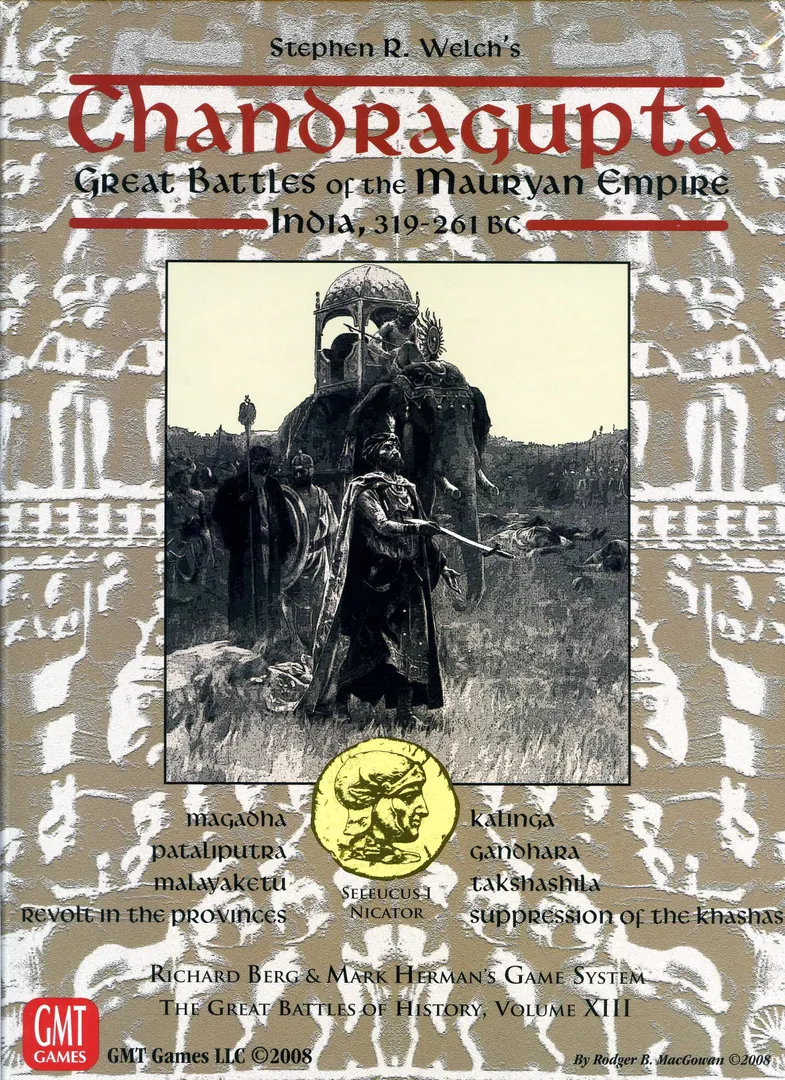
Chandragupta: Great Battles of the Mauryan Empire – India, 319-261 BC es un juego de mesa publicado en 2008 para 2 jugadores, con partidas de 240 minutos y a partir de 12 años. Fue diseñado por Richard H. Berg, Mark Herman, Alan J. Ray y Stephen R. Welch y sus mecánicas principales son Dice Rolling y Hexagon Grid.










En inglés
Chandragupta brings the art of war in ancient India to GMT’s “Great Battles of History” Series. Beginning with Chandragupta Maurya’s victories over the Nanda clan, the game follows the brief but rapid rise of the Mauryan dynasty, from Chandragupta’s expulsion of Seleucus from the Indus river valley to the conquest of the last independent kingdom on the subcontinent, Kalinga, by his grandson Ashoka. The Mauryan empire became the largest and most powerful in India’s history – a distinction that would remain unchallenged until the arrival of the Mughals some 1,700 years later. Chandragupta simulates the traditional “four-fold” division of the Indian military system, with the elephant corps reigning supreme, and the hordes of light infantry regarded as little more than fodder for chariots’ wheels and trampling pachyderms. Chariots still play a prominent role on the Indian battlefield of the era, but the cavalry, with its versatility and endurance, is a potent competitor. In Chandragupta, victory goes to the commander who can master the unique aspects of the differing Indian military “classes” – the professional, lifelong soldiers called Maulas, the mercenary levies, unpredictable tribal allies, and the militias of the powerful trade guilds. While Maulas and mercenaries are commanded under a single hierarchical command structure, the tribals and the trade guilds are led by independent chiefs. Units include cataphracted elephants, “heavy” four- (and sometimes eight-!) wheeled chariots, and even an “elCH” unit – yes, elephant-pulled chariots. Rules include Combined Chariot/Infantry and Elephant/Infantry lines, Dharmayudda or “just” warfare, Guild enmity, and Tribal loyalty. EL units can even breach camp walls and pull down city gates (if they don’t rampage first). Fans of GBoH will appreciate the exciting variety in Chandragupta’s scenarios, from huge set-piece battles on flat plains, to tribal suppressions, a night assault on a military camp, and street fighting in the city of Takshashila. Chandragupta is the 13th volume in the series. Battles: Pataliputra (319 BC) – Chandragupta’s mentor, the Brahmin Chanakya, brashly challenges the Nanda dynasty with a cadre of mercenaries. Maghada (317 BC) – Chandragupta again confronts the Nandas, who are this time led by the formidable general Bhadrasala. Mayalaketu (317 BC) – Chanakya attacks the turncoat general Mayalaketu and his rebel army in camp. Takshashila (316 BC) – the Thracian general Eudamus, allied to Indian king Ambhi, defends the city of Takshashila against Chandragupta’s assault. Gandhara (304 BC) – former officer of Alexander the Great, now “Master of Babylonia,” Seleucus I Nicator crosses the Indus river to invade Gandhara, and is confronted by the Mauryan army at the river’s banks. Revolt in the Provinces (275 BC) – Chandragupta’s grandson, Ashoka, brings a relief force to lift a rebel siege of Takshashila and rescue the aging Chanakya who is holed up in the city’s palace. Khashas (274 BC) – Chandragupta’s son, Bhindusara, puts down a confederation of the independent Khasha kings with an attack on their mountain strongholds. Kalinga (261 BC) – the most famous battle of the Mauryan era, Ashoka’s army attacks the kingdom of Kalinga in a huge – and bloody -- set-piece battle.
Según el catálogo, Chandragupta: Great Battles of the Mauryan Empire – India, 319-261 BC admite 2 jugadores. Es el número de jugadores indicado por la editorial, así que el juego está diseñado exactamente para esa cantidad de participantes. Las variantes para otros tamaños de grupo, si existen, se describen en el reglamento de tu edición; consúltalo antes de preparar otra configuración.
La duración indicada para Chandragupta: Great Battles of the Mauryan Empire – India, 319-261 BC es de 240 minutos, la estimación de la editorial para una partida completa. El tiempo real depende del grupo, del número de jugadores y del conocimiento de las reglas: las primeras partidas suelen alargarse y los grupos con experiencia terminan antes. La preparación y la explicación de las reglas no están incluidas.
El catálogo indica Chandragupta: Great Battles of the Mauryan Empire – India, 319-261 BC a partir de 12 años. Es la recomendación de la editorial y refleja la lectura necesaria, la complejidad de las reglas y las piezas pequeñas, no solo el tema. Los más pequeños a menudo pueden jugar con ayuda de un adulto: comprueba la edad recomendada en tu edición y la experiencia de tu grupo.
Chandragupta: Great Battles of the Mauryan Empire – India, 319-261 BC tiene una puntuación de complejidad de 3,8 sobre 5 según los jugadores de BoardGameGeek, lo que lo convierte en un juego exigente. La puntuación refleja cuánto conocimiento de reglas, planificación y toma de decisiones exige una partida típica. Los juegos exigentes requieren una explicación inicial más larga, así que conviene usar una guía de preparación.
Chandragupta: Great Battles of the Mauryan Empire – India, 319-261 BC pertenece a estas categorías: Wargame y Ancient. Sus mecánicas principales son Dice Rolling y Hexagon Grid. Las categorías describen el tema y la ambientación de un juego, mientras que las mecánicas describen lo que los jugadores hacen realmente en su turno. Cada mecánica lleva a una página del catálogo con juegos similares.
Los autores acreditados de Chandragupta: Great Battles of the Mauryan Empire – India, 319-261 BC son: Richard H. Berg, Mark Herman, Alan J. Ray y Stephen R. Welch. Estos créditos proceden de los datos publicados del juego y nombran a las personas responsables de su diseño, no a ilustradores ni editoriales. Las páginas de autor de MeepleRules reúnen otros títulos de los mismos autores, algo útil cuando un juego te gusta y buscas otros parecidos.
El catálogo clasifica Chandragupta: Great Battles of the Mauryan Empire – India, 319-261 BC como juego base. Se juega por sí solo con los componentes de la caja y no requiere ningún otro título. Las expansiones, si existen, añaden contenido o reglas nuevas y aparecen por separado en el catálogo con un enlace a este juego base.