

- Puesto en BGG
- BGG #572
- Puntuación BGG
- 8,1
Fire in the Lake
- 1–4 jugadores
- 180 min
- Complejidad 4,2/5
- 2014
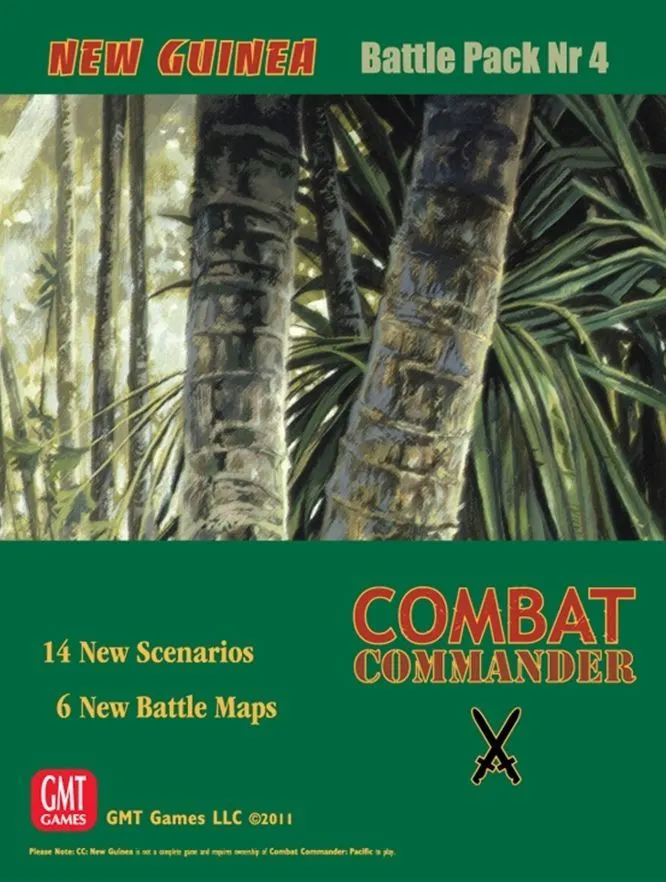
Ayuda con las reglas de Combat Commander: Battle Pack #4 – New Guinea
Explicaciones claras de turnos, efectos de cartas y situaciones dudosas, con referencias a fuentes oficiales e historial de preguntas guardado.
¿Qué quieres saber?
Las respuestas salen del reglamento oficial, con la página para comprobarlo.
Combat Commander: Battle Pack #4 – New Guinea es una expansión de Combat Commander: Pacific publicada en 2011 para 2 jugadores, con partidas de 180 minutos y a partir de 12 años. Fue diseñado por Mark Herman, John Foley, Bryan Collars, Volko Ruhnke, John H. Butterfield, Kai Jensen y Andy Maly y sus mecánicas principales son Variable Player Powers, Hexagon Grid y Simulation.




En inglés
Combat Commander: Battle Pack #4 - New Guinea is the fourth themed collection of scenarios for use with the Combat Commander series of games. The theme of this fourth Battle Pack shifts to the actions in New Guinea from January 1942 through July 1944, following the major campaign phases with characteristic actions. CC -New Guinea features fourteen new scenarios printed on cardstock as well as six new maps. Rules relevant to the characteristic fighting in the coastal jungle versus the highlands are included as needed for each scenario, without the need of an additional rule booklet. A number of unusual, creative special scenario rules cover the unique situations represented, including Air Supply, Barge Landing, Canebreak and Coastal Jungle, Emplaced M3 Tanks, Joint Allied Operations including the Papuan Infantry Battalion, Patrol Dogs, Swamp Holes and Swamp Forest. The new maps depict specific locations in New Guinea: the beachhead at the base of Mt Vulcan across from Rabaul, the village of Oivi, a high-mountain ridge overlooking Eora Creek, a strongpoint on the Soputa-Sanananda Road, the edge of the airstrip at Wau, and one of the crossings of the Driniumor River near the Afua Trail. The scenarios included in CC–New Guinea are: * M1 – “Rabaul Rousers” set at the base of Mt Vulcan on Simpson Bay across from the town of Rabaul, with a Japanese barge landing against Australian defenses at night, 23 January 1942; * M2 – “The Gloomy Forest” set at the village of Oivi, with Australians and Papuans of Maroubra Force facing the rapidly moving Yokohama Advance Party, 26 July 1942; * M3 – “Rebuked at Rabi”, set at Milne Bay, with an SNLF attack against Australian units, 3 September 1942; * M4 – “Templeton’s Crossing” set at a heavily-contested crossing of Eora Creek high in the Stanleys, 17 October 1942; * M5 – “Blind Man’s Bluff” set along one of the high ridges above the treacherous Eora Creek, with intermingled combatants, 28 October 1942; * M6 – “Breakout” set at Gorari after the fall of Kokoda to the Australians, with a desperate banzai action, 11 November 1942; * M7 – “The Butcher’s Bill” set on the Soputa-Sanananda Road, with US forces entering the conflict in horrific swamp forest, 10 December 1942; * M8 – “Closing Outer Camp” set at Buna station, with Australian units using M3 tanks to eradicate the defenders, 18 December 1942; * M9 – “Wau Me Worry” set at the Wau air strip (with active landing operations during the action), with Australian defenders facing a desperate attack, 31 January 1943; * M10 – “Bulolo River Bridge” set outside the outpost at Wau, with patrols of both sides (including Japanese Patrol Dogs) attempting to use the same bridge at cross-purposes, 30 January 1943; * M11 – “Shattered Bobdubi” set during the advance upon Salamua, with Australian units driving upon a Japanese base camp set in the kunai-covered heights of the interior, 30 June 1943; * M12 – “Scarlet Beach” set at the mouth of the Song River near Finschhafen, with a Japanese barge landing at night against combined Australian and US defenders, 17 October 1943; * M13 – “Bad Dreams” set on the Driniumor River, featuring the heroic stand of an unknown US BAR operator facing a hastily prepared Japanese night charge, 10 July 1944; and * M14 – “Encirclement of Troop C” set on the Driniumor River, featuring a Troop of US Cavalry trying to stave off being surrounded by Japanese units that had surprised them by walking casually into their positions, 21 July 1944. NOTE: CC–New Guinea is not a complete game and requires ownership of Combat Commander: Pacific to play. Designed by John Foley Developed by Kai Jensen Additional scenario designs in this fourth Pack are courtesy of John Butterfield, Bryan Collars, Mark Herman, Andrew Maly and Volko Ruhnke.
Según el catálogo, Combat Commander: Battle Pack #4 – New Guinea admite 2 jugadores. Es el número de jugadores indicado por la editorial, así que el juego está diseñado exactamente para esa cantidad de participantes. Las variantes para otros tamaños de grupo, si existen, se describen en el reglamento de tu edición; consúltalo antes de preparar otra configuración.
La duración indicada para Combat Commander: Battle Pack #4 – New Guinea es de 180 minutos, la estimación de la editorial para una partida completa. El tiempo real depende del grupo, del número de jugadores y del conocimiento de las reglas: las primeras partidas suelen alargarse y los grupos con experiencia terminan antes. La preparación y la explicación de las reglas no están incluidas.
El catálogo indica Combat Commander: Battle Pack #4 – New Guinea a partir de 12 años. Es la recomendación de la editorial y refleja la lectura necesaria, la complejidad de las reglas y las piezas pequeñas, no solo el tema. Los más pequeños a menudo pueden jugar con ayuda de un adulto: comprueba la edad recomendada en tu edición y la experiencia de tu grupo.
Combat Commander: Battle Pack #4 – New Guinea tiene una puntuación de complejidad de 3,0 sobre 5 según los jugadores de BoardGameGeek, lo que lo convierte en un juego de complejidad media. La puntuación refleja cuánto conocimiento de reglas, planificación y toma de decisiones exige una partida típica. Los juegos exigentes requieren una explicación inicial más larga, así que conviene usar una guía de preparación.
Combat Commander: Battle Pack #4 – New Guinea pertenece a estas categorías: Wargame, World War II y Expansion for Base-game. Sus mecánicas principales son Variable Player Powers, Hexagon Grid y Simulation. Las categorías describen el tema y la ambientación de un juego, mientras que las mecánicas describen lo que los jugadores hacen realmente en su turno. Cada mecánica lleva a una página del catálogo con juegos similares.
Los autores acreditados de Combat Commander: Battle Pack #4 – New Guinea son: Mark Herman, John Foley, Bryan Collars, Volko Ruhnke, John H. Butterfield, Kai Jensen y Andy Maly. Estos créditos proceden de los datos publicados del juego y nombran a las personas responsables de su diseño, no a ilustradores ni editoriales. Las páginas de autor de MeepleRules reúnen otros títulos de los mismos autores, algo útil cuando un juego te gusta y buscas otros parecidos.
El catálogo clasifica Combat Commander: Battle Pack #4 – New Guinea como expansión de Combat Commander: Pacific. Las expansiones añaden contenido, reglas o escenarios al juego base y normalmente no se pueden jugar solas, así que necesitas Combat Commander: Pacific para usarla. Comprueba que tu edición de Combat Commander: Pacific sea compatible, porque algunas expansiones se revisaron entre ediciones.