
- Puesto en BGG
- BGG #21.246
- Puntuación BGG
- 6,6
Lebanon '82: Operation Peace for Galilee
- 2 jugadores
- 90 min
- Complejidad 2,1/5
- 2012
2010
Ayuda con las reglas de DMZ: The Next Korean War
Explicaciones claras de turnos, efectos de cartas y situaciones dudosas, con referencias a fuentes oficiales e historial de preguntas guardado.
Para 1 jugador
¿Qué quieres saber?
Las respuestas salen del reglamento oficial, con la página para comprobarlo.
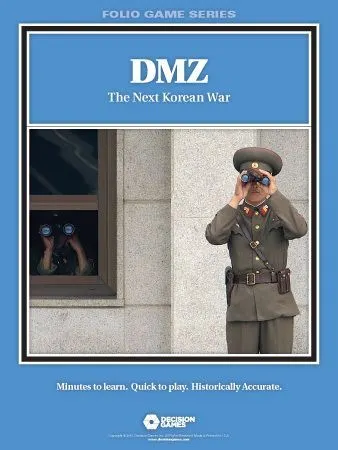
DMZ: The Next Korean War es un juego de mesa publicado en 2010 para 1–2 jugadores y con partidas de 60 a 120 minutos. Fue diseñado por Eric R. Harvey y sus mecánicas principales son Dice Rolling y Hexagon Grid.


En inglés
From the Decision Games' website: Technically speaking, the Korean War has remained active since the cease-fire agreement of 1953: the belligerents have never actually ratified a final peace accord. Since 1953, the Korean peninsula has remained devoid of open war, though only South Korea has prospered during that time. In contrast, North Korea has become isolated, bankrupt and confrontational. Indeed, as the North Korean economy continues to implode, and more starvation ensues, it's conceivable a desperate North Korea could resort to war to try to avoid its own final collapse. DMZ utilizes the new Fire & Movement combat system that's designed so players can augment their units with "support fire" during the course of the turns. From artillery to helicopter gunships, units can receive support to engage enemy positions and formations, allowing combat to develop at all levels. A single armor brigade, for example — perhaps with close air support — could be tasked to assault a lone enemy infantry corps defending an airbase. As that attack gets underway, that armor brigade may find itself under fire from rocket batteries; more support fire will be necessary to take the airbase, but assets are limited. In DMZ, the attritional design of the new Combat Results Table simulates the true nature of modern warfare. Units are typically two-sided formations that can incur casualties, accurately replicating the realities of combat and the high losses likely to be sustained by both sides during another Korean War. Winning a battle is thus a matter of maneuver, firepower and asset management. Re-implements: DMZ: The Battle for South Korea, late 1970s
Según el catálogo, DMZ: The Next Korean War admite de 1 a 2 jugadores. Este intervalo corresponde al número de jugadores indicado por la editorial, así que el juego puede prepararse para cualquier grupo dentro de ese margen. La preparación, algunas reglas y la puntuación pueden variar según el número de jugadores; consulta la configuración exacta en el reglamento de tu edición.
La duración indicada para DMZ: The Next Korean War es de 60 a 120 minutos, la estimación de la editorial para una partida completa. El tiempo real depende del grupo, del número de jugadores y del conocimiento de las reglas: las primeras partidas suelen alargarse y los grupos con experiencia terminan antes. La preparación y la explicación de las reglas no están incluidas.
DMZ: The Next Korean War tiene una puntuación de complejidad de 2,2 sobre 5 según los jugadores de BoardGameGeek, lo que lo convierte en un juego algo ligero. La puntuación refleja cuánto conocimiento de reglas, planificación y toma de decisiones exige una partida típica. Los juegos exigentes requieren una explicación inicial más larga, así que conviene usar una guía de preparación.
DMZ: The Next Korean War pertenece a estas categorías: Wargame y Modern Warfare. Sus mecánicas principales son Dice Rolling y Hexagon Grid. Las categorías describen el tema y la ambientación de un juego, mientras que las mecánicas describen lo que los jugadores hacen realmente en su turno. Cada mecánica lleva a una página del catálogo con juegos similares.
Los autores acreditados de DMZ: The Next Korean War son: Eric R. Harvey. Estos créditos proceden de los datos publicados del juego y nombran a las personas responsables de su diseño, no a ilustradores ni editoriales. Las páginas de autor de MeepleRules reúnen otros títulos de los mismos autores, algo útil cuando un juego te gusta y buscas otros parecidos.
El catálogo clasifica DMZ: The Next Korean War como juego base. Se juega por sí solo con los componentes de la caja y no requiere ningún otro título. Las expansiones, si existen, añaden contenido o reglas nuevas y aparecen por separado en el catálogo con un enlace a este juego base.