

- Puesto en BGG
- BGG #4479
- Puntuación BGG
- 7,2
Battle for Germany
- 2–4 jugadores
- 180 min
- Complejidad 2,1/5
- 1975
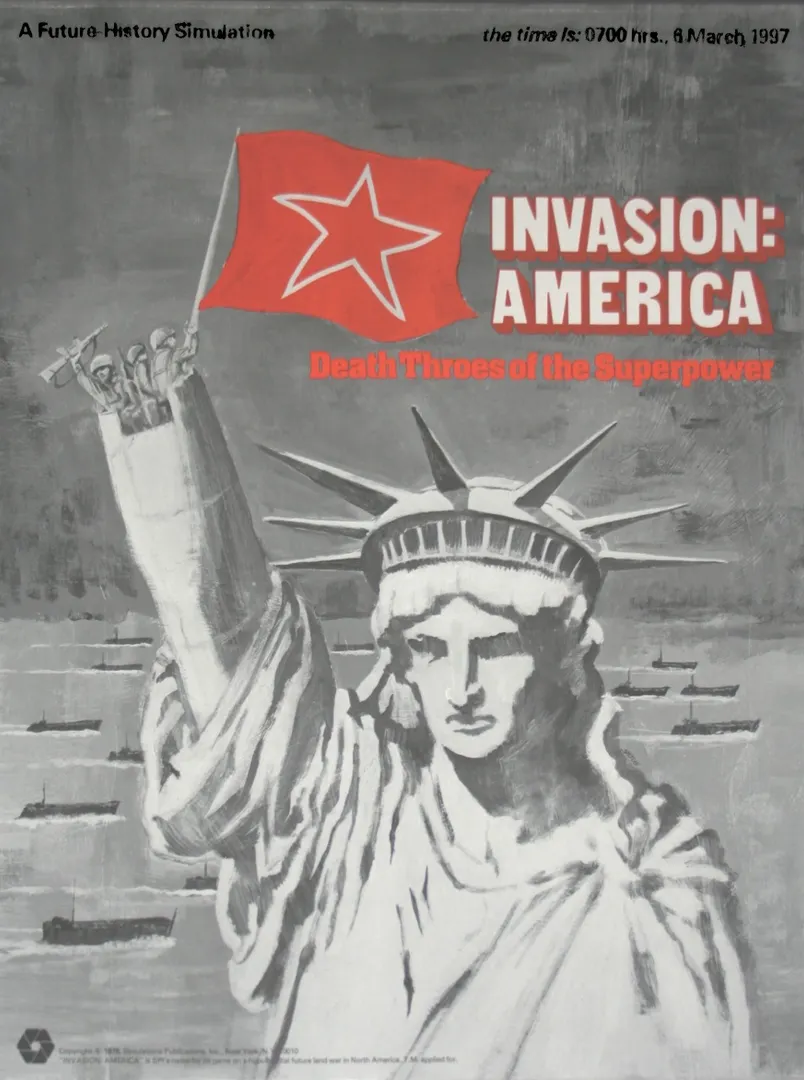
1976
Ayuda con las reglas de Invasion: America – Death Throes of the Superpower
Explicaciones claras de turnos, efectos de cartas y situaciones dudosas, con referencias a fuentes oficiales e historial de preguntas guardado.
Para 2 jugadores
¿Qué quieres saber?
Las respuestas salen del reglamento oficial, con la página para comprobarlo.
Invasion: America – Death Throes of the Superpower es un juego de mesa publicado en 1976 para 2–5 jugadores, con partidas de 240 minutos y a partir de 12 años. Fue diseñado por Jim Dunnigan y sus mecánicas principales son Hexagon Grid y Zone of Control.




En inglés
Invasion: America is a "mini-monster" wargame designed by Jim Dunnigan and published by SPI in 1976. It depicts a hypothetical corps-level invasion of North America by a coalition of three invaders: The European Socialist Coalition (ESC) staging their invasion from Cuba, the South American Union (SAU) invading from Columbia, and the Pan Asiatic League (PAL) invading along the Pacific coast. Defending North America is a coalition of the United States and Canada, with Central America and Mexico having been annexed earlier in the alternate history timeline. It can be played by 2, 3, or 4 players. The game is played on a 35 inch by 42 inch map of North America in which each 'hex' is approximately 130 kilometers (81 mi) from side to side. Distinctive color and symbology is used to represent which of the nine different terrain types dominates the hex. There is additional symbology for ports, supply sources, resource centers and amphibious landing zones. There are also map features along the hexsides including rivers, borders, and and other boundaries. Both movement and combat are affected by terrain. There are 400 (7 are blank) 1/2-inch cardboard pieces (unit counters) representing the land, air, and naval military and logistics units of each combatant. The unit counters have numerical combat and movement ratings. Land and Air units are double-sided with their actual combat values on one side, and a question mark on the other side to indicate the unit's "untried" status, making it the first game to have this feature. Units are initially deployed as untried, and only when they are committed to combat is their true strength revealed. On each turn players may move all, some or none of their units through a number of hexes equal to or less than its movement rating allows. After movement is completed units that are adjacent to enemy units may engage in combat. Combat strengths are totaled for all participating units on each side and the relative strengths are expressed as a simplified odds ratio. A 6-sided die is rolled and the appropriate odds column is consulted to determine the combat result. Combat may result in retreats and/or losses to attacker, defender or both. Invasion: America includes six different scenarios lasting 8 turns and a campaign game of 60 turns. Each turn of the game represents one month. Scenario instructions define each side's order of battle and initial deployment, their unit replacement rates and victory conditions. Victory is determined by control of urban, supply and resource hexes that yield victory points. Invasion: America was a popular game for SPI and led to a larger, more complicated sequel in 1978, Objective Moscow, in which it was the Soviet Union that was being invaded.
Según el catálogo, Invasion: America – Death Throes of the Superpower admite de 2 a 5 jugadores. Este intervalo corresponde al número de jugadores indicado por la editorial, así que el juego puede prepararse para cualquier grupo dentro de ese margen. La preparación, algunas reglas y la puntuación pueden variar según el número de jugadores; consulta la configuración exacta en el reglamento de tu edición.
La duración indicada para Invasion: America – Death Throes of the Superpower es de 240 minutos, la estimación de la editorial para una partida completa. El tiempo real depende del grupo, del número de jugadores y del conocimiento de las reglas: las primeras partidas suelen alargarse y los grupos con experiencia terminan antes. La preparación y la explicación de las reglas no están incluidas.
El catálogo indica Invasion: America – Death Throes of the Superpower a partir de 12 años. Es la recomendación de la editorial y refleja la lectura necesaria, la complejidad de las reglas y las piezas pequeñas, no solo el tema. Los más pequeños a menudo pueden jugar con ayuda de un adulto: comprueba la edad recomendada en tu edición y la experiencia de tu grupo.
Invasion: America – Death Throes of the Superpower tiene una puntuación de complejidad de 3,2 sobre 5 según los jugadores de BoardGameGeek, lo que lo convierte en un juego de complejidad media. La puntuación refleja cuánto conocimiento de reglas, planificación y toma de decisiones exige una partida típica. Los juegos exigentes requieren una explicación inicial más larga, así que conviene usar una guía de preparación.
Invasion: America – Death Throes of the Superpower pertenece a estas categorías: Wargame y Modern Warfare. Sus mecánicas principales son Hexagon Grid y Zone of Control. Las categorías describen el tema y la ambientación de un juego, mientras que las mecánicas describen lo que los jugadores hacen realmente en su turno. Cada mecánica lleva a una página del catálogo con juegos similares.
Los autores acreditados de Invasion: America – Death Throes of the Superpower son: Jim Dunnigan. Estos créditos proceden de los datos publicados del juego y nombran a las personas responsables de su diseño, no a ilustradores ni editoriales. Las páginas de autor de MeepleRules reúnen otros títulos de los mismos autores, algo útil cuando un juego te gusta y buscas otros parecidos.
El catálogo clasifica Invasion: America – Death Throes of the Superpower como juego base. Se juega por sí solo con los componentes de la caja y no requiere ningún otro título. Las expansiones, si existen, añaden contenido o reglas nuevas y aparecen por separado en el catálogo con un enlace a este juego base.