
- Puesto en BGG
- BGG #10.475
- Puntuación BGG
- 7,2
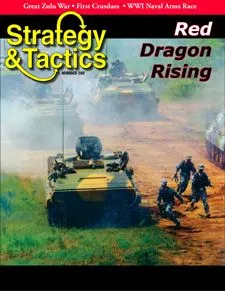
Red Dragon Rising: The Coming War With China
- 1–2 jugadores
- 180 min
- Complejidad 2,9/5
- 2008

2012
Ayuda con las reglas de Red Dragon / Green Crescent
Explicaciones claras de turnos, efectos de cartas y situaciones dudosas, con referencias a fuentes oficiales e historial de preguntas guardado.
¿Qué quieres saber?
Las respuestas salen del reglamento oficial, con la página para comprobarlo.
Red Dragon / Green Crescent es un juego de mesa publicado en 2012 para 1–2 jugadores, con partidas de 180 minutos y a partir de 14 años. Fue diseñado por Bruce Costello y sus mecánicas principales son Area Movement y Dice Rolling.




En inglés
Red Dragon/Green Crescent (RDGC) is a strategic-level, intermediate-complexity wargame, with operational undertones, covering hypothetical future conflicts around the southern and eastern peripheries of Asia. The timeframe is the near future, between 2013 and 2021. The game has been designed using the CSR Award winning system that first appeared in Strategy & Tactics no. 250. It’s adaptable for two player, multi-player and solitaire play. RDGC expands the original game into a two-mapper covering the Indian Ocean and Middle East, areas strategic to both the US and its allies and the Peoples Republic of China and its allies. In the game, Chinese forces that may be initially deployed into the Indian Ocean area are few, but they also have one solid ally at start: Myanmar. Besides Myanmar, there are other question marks for US planners. For instance, would Pakistan stand idly by if India allied with the US, given the existential threat they perceive of a US-Indian victory in a war with China? And what about Iran: if that country is ever to make a move to achieve dominance in the Persian Gulf, what better time than during a major war while its winners aren’t yet clear? There’s also the rest of the troubled Middle East (Egypt-Syria-Lebanon-Israel). That collective totality makes for a wonderfully varied gaming situation. Besides the main scenarios, there are numerous variants and options, adding new dimensions and giving literally hundreds of new possibilities for play. Most of the ground units in RDGC represent brigades (“brigade combat teams” or “BCT” for the US). The exceptions are the Singaporean, Malaysian, Taiwanese, Philippine, and Yemeni armies. There is additionally one new corps of marines for the PRC. Aircraft are mostly represented by mixed-type combat-wings, though only one aircraft type is shown on each counter. Long-range bombers have their own mono-type units that can’t combine operations with the other ‘tactical’ air wings. Ship units mostly represent mission-oriented groups of vessels such as SAGs, subrons or individual capital ships. Game turns represent varied amounts of “real time,” depending on the “operation” presently being conducted, from one to three days. An entire match encompasses the first month of the wars being examined. Scenarios include partial and two-map games, some centered on the Korean peninsula, others on the Indo-Pakistan area, and others taking in the entire, huge, arcing region from the Red Sea to Alaska.
Según el catálogo, Red Dragon / Green Crescent admite de 1 a 2 jugadores. Este intervalo corresponde al número de jugadores indicado por la editorial, así que el juego puede prepararse para cualquier grupo dentro de ese margen. La preparación, algunas reglas y la puntuación pueden variar según el número de jugadores; consulta la configuración exacta en el reglamento de tu edición.
La duración indicada para Red Dragon / Green Crescent es de 180 minutos, la estimación de la editorial para una partida completa. El tiempo real depende del grupo, del número de jugadores y del conocimiento de las reglas: las primeras partidas suelen alargarse y los grupos con experiencia terminan antes. La preparación y la explicación de las reglas no están incluidas.
El catálogo indica Red Dragon / Green Crescent a partir de 14 años. Es la recomendación de la editorial y refleja la lectura necesaria, la complejidad de las reglas y las piezas pequeñas, no solo el tema. Los más pequeños a menudo pueden jugar con ayuda de un adulto: comprueba la edad recomendada en tu edición y la experiencia de tu grupo.
Red Dragon / Green Crescent tiene una puntuación de complejidad de 2,3 sobre 5 según los jugadores de BoardGameGeek, lo que lo convierte en un juego algo ligero. La puntuación refleja cuánto conocimiento de reglas, planificación y toma de decisiones exige una partida típica. Los juegos exigentes requieren una explicación inicial más larga, así que conviene usar una guía de preparación.
Red Dragon / Green Crescent pertenece a estas categorías: Wargame y Modern Warfare. Sus mecánicas principales son Area Movement y Dice Rolling. Las categorías describen el tema y la ambientación de un juego, mientras que las mecánicas describen lo que los jugadores hacen realmente en su turno. Cada mecánica lleva a una página del catálogo con juegos similares.
Los autores acreditados de Red Dragon / Green Crescent son: Bruce Costello. Estos créditos proceden de los datos publicados del juego y nombran a las personas responsables de su diseño, no a ilustradores ni editoriales. Las páginas de autor de MeepleRules reúnen otros títulos de los mismos autores, algo útil cuando un juego te gusta y buscas otros parecidos.
El catálogo clasifica Red Dragon / Green Crescent como juego base. Se juega por sí solo con los componentes de la caja y no requiere ningún otro título. Las expansiones, si existen, añaden contenido o reglas nuevas y aparecen por separado en el catálogo con un enlace a este juego base.