
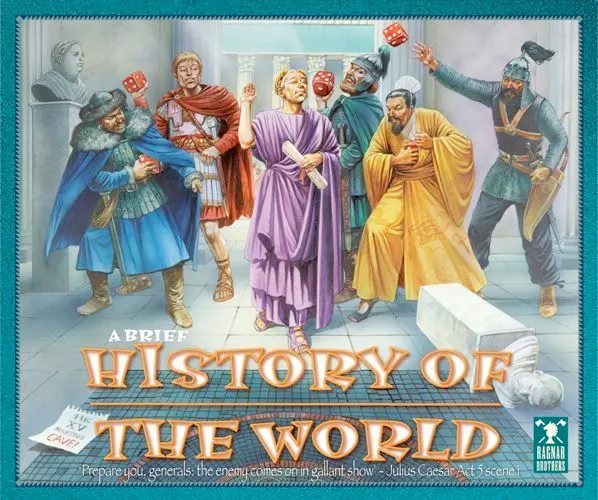
- Puesto en BGG
- BGG #3965
- Puntuación BGG
- 6,9
A Brief History of the World
- 3–6 jugadores
- 90–180 min
- Complejidad 2,9/5
- 2009
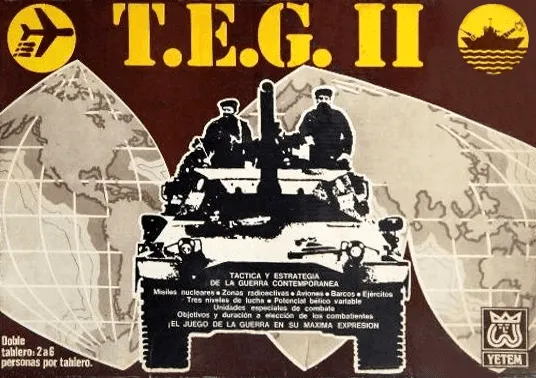
1982
Ayuda con las reglas de T.E.G. II
Explicaciones claras de turnos, efectos de cartas y situaciones dudosas, con referencias a fuentes oficiales e historial de preguntas guardado.
Para 2 jugadores
¿Qué quieres saber?
Las respuestas salen del reglamento oficial, con la página para comprobarlo.
T.E.G. II es un juego de mesa publicado en 1982 para 2–6 jugadores y con partidas de 120 minutos. Sus mecánicas principales son Area Movement, Area Majority / Influence y Simulation.




En inglés
T.E.G. II is a new game from Plan Táctico y Estratégico de la Guerra (T.E.G.), involving armies, ships, aircraft, and nuclear rockets. For those who never played the T.E.G. I, as for experts strategists, the new T.E.G. proposes a different way of playing, lots of action and rapid development. Each player represents one of the great powers of the world: U.S.A., U.S.S.R., China, Japan, Eastern Europe and Western Europe. At the beginning each player chooses, according to their strategic thinking, several military targets: Control, Intervention and Non-Intervention in the various regions of the world. Each target has a value in points. All targets are placed in the Objectives Table. After the incorporations are done comes the fighting. The fighting is between ships that occupie the same region, to which reinforcements can be added, brought in from neighboring regions. The battles are resolved without dice, using a Command of Battle. Apart from the armies, ships and planes, there are other elements of exceptional strength: the nuclear missile and the special unit. They are obtained when the player gets certain levels of war potential. At the end of the game, each player sums the points of the objectives achieved. The winner is the one who got the highest score.
Según el catálogo, T.E.G. II admite de 2 a 6 jugadores. Este intervalo corresponde al número de jugadores indicado por la editorial, así que el juego puede prepararse para cualquier grupo dentro de ese margen. La preparación, algunas reglas y la puntuación pueden variar según el número de jugadores; consulta la configuración exacta en el reglamento de tu edición.
La duración indicada para T.E.G. II es de 120 minutos, la estimación de la editorial para una partida completa. El tiempo real depende del grupo, del número de jugadores y del conocimiento de las reglas: las primeras partidas suelen alargarse y los grupos con experiencia terminan antes. La preparación y la explicación de las reglas no están incluidas.
T.E.G. II tiene una puntuación de complejidad de 2,7 sobre 5 según los jugadores de BoardGameGeek, lo que lo convierte en un juego algo ligero. La puntuación refleja cuánto conocimiento de reglas, planificación y toma de decisiones exige una partida típica. Los juegos exigentes requieren una explicación inicial más larga, así que conviene usar una guía de preparación.
T.E.G. II pertenece a estas categorías: Wargame y Modern Warfare. Sus mecánicas principales son Area Movement, Area Majority / Influence y Simulation. Las categorías describen el tema y la ambientación de un juego, mientras que las mecánicas describen lo que los jugadores hacen realmente en su turno. Cada mecánica lleva a una página del catálogo con juegos similares.
El catálogo clasifica T.E.G. II como juego base. Se juega por sí solo con los componentes de la caja y no requiere ningún otro título. Las expansiones, si existen, añaden contenido o reglas nuevas y aparecen por separado en el catálogo con un enlace a este juego base.