- Puntuación BGG
- 7,4
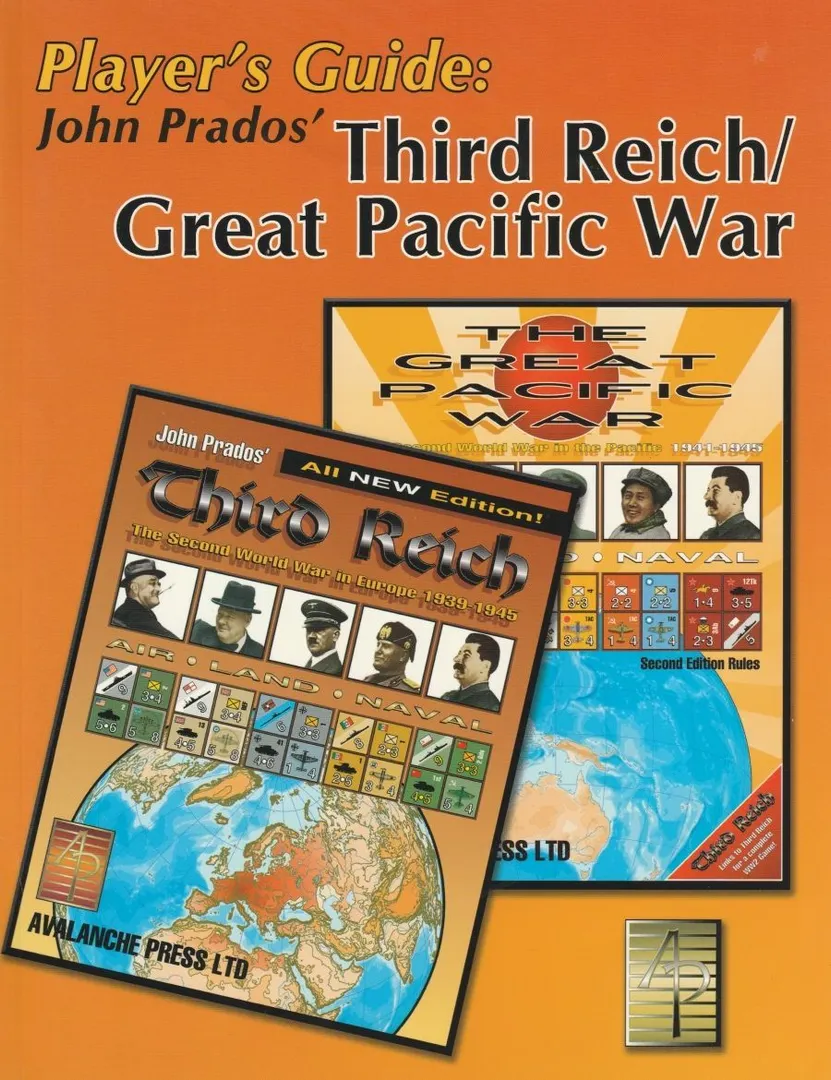
Third Reich/Great Pacific War Player's Guide
- 2–5 jugadores
- 360 min
- Complejidad 3,4/5
- 2004
2003
Ayuda con las reglas de The Great Pacific War: The Second World War in the Pacific 1937-1945
Explicaciones claras de turnos, efectos de cartas y situaciones dudosas, con referencias a fuentes oficiales e historial de preguntas guardado.
Para 2 jugadores
¿Qué quieres saber?
Las respuestas salen del reglamento oficial, con la página para comprobarlo.
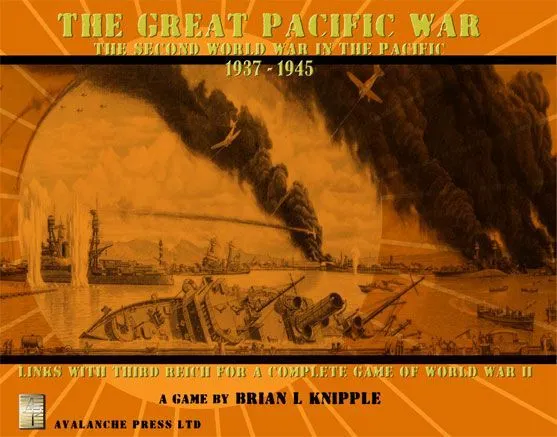
The Great Pacific War: The Second World War in the Pacific 1937-1945 es un juego de mesa publicado en 2003 para 2–5 jugadores, con partidas de 240 a 480 minutos y a partir de 12 años. Fue diseñado por Brian L. Knipple y sus mecánicas principales son Dice Rolling, Grid Movement y Hexagon Grid.
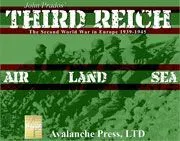



En inglés
Description from the publisher: Great Pacific War is Avalanche Press' strategic-level game of the War in the Pacific. The game covers the entire war from December 1941 through 1946 and includes the forces of all participants. Players are placed in the positions of the commanders of the Japanese, British, Soviet and American forces in World War Two. The system is the same one used in Avalanche Press' game, Third Reich. In addition to five scenarios covering all or part of the War in the Pacific, Great Pacific War includes rules to link it and Third Reich to play the Second World War, a simulation of the entire conflict with up to seven players. Included in the game are five scenarios for the Great Pacific War and three scenarios for the linked Second World War. One of the Great Pacific War scenarios covers a possible 1931 conflict between Japan and America as postulated by the British journalist Hector Bywater in his book of the same title. The facts: Game scale is 60 miles per hex covering the battlefield on three 34" x 22" maps. Units are represented at corps, fleet and air army level. Each turn represents three months of actual time. The game system is built around players drawing impulse "chits" to determine how they can activate their forces. The emphasis is on the interaction of military, political and economic factors (as in Third Reich). The game system from our Third Reich game allows players to control the military, political and economic destinies of their nations in a struggle to dominate the world. Land, air and sea forces battle across almost a third of the earth's surface as the two mightiest navies fight for control of the Pacific. Players manage their economies and build and operate their military forces within the capabilities of their nations' abilities. In Great Pacific War the Japanese player must decide initially whether war with America or the Soviet Union will be his or her strategy. JapanÍs lack of resources make a war with one or the other a necessity. Also possible is a war with Britain and her ally, The Netherlands, who together control the riches of India, Java and Borneo. This strategy has many risks, the greatest being that America will enter the war on Britain's side. Coloring all is the massive Japanese investment in China and the importance of those conquered territories to the Japanese economy. The American player must move a nation unprepared for war to a position of strength, while attempting to support the Nationalist Chinese in their conflict with the Japanese. In the linked game players have also to consider the effects of their actions on the global conflict. A Soviet player desperately defending Moscow in 1941 can little afford a Japanese attack on Vladivostok. Likewise a British player fighting Germany with only a seemingly soon-to-be-defeated Soviet Union as an ally, will not welcome a Japanese attack on his eastern possessions unless it brings America into the war. Historically Japan went to war to obtain the resources denied her by the Allies embargo of steel and oil and because German successes appeared to offer Japan the opportunity to join a victory almost already won. The question is whether you and your allies can do any better than your historical counterparts. Components: 3 34” x 22” maps 2 countersheets consisting of 560 counters 1 rulebook...separated into 2 booklets 2 scenario booklets 1 "Policial Maker Explanations" booklet 1 Off-Map Movement and Sea Zones Chart 11" x 17" 1 Chart with US Entry/Russian Winter Table/Mud Table 1 Chart with Sequence of Play/Alliance & Individual Victory Tables/Construction and Repair Costs 1 Terrain Effects Chart 1 Turn Impulse Track 1 Production Costs 9 Force Pool Charts(Netherlands,Britain,Soviet Union,Nationalist China,Communist China,United States(x2),Japan(x2)) Note: The maps are not mounted like those in JP's Third Reich were. This solves the problem of the maps not adjoining properly (as in Third Reich), but will upset those that like hard mounted maps. The game marries up with JP's Third Reich, but don't expect the maps to do so. When played together, action will be on separate maps to create a monster game of the entire Second World War.
Según el catálogo, The Great Pacific War: The Second World War in the Pacific 1937-1945 admite de 2 a 5 jugadores. Este intervalo corresponde al número de jugadores indicado por la editorial, así que el juego puede prepararse para cualquier grupo dentro de ese margen. La preparación, algunas reglas y la puntuación pueden variar según el número de jugadores; consulta la configuración exacta en el reglamento de tu edición.
La duración indicada para The Great Pacific War: The Second World War in the Pacific 1937-1945 es de 240 a 480 minutos, la estimación de la editorial para una partida completa. El tiempo real depende del grupo, del número de jugadores y del conocimiento de las reglas: las primeras partidas suelen alargarse y los grupos con experiencia terminan antes. La preparación y la explicación de las reglas no están incluidas.
El catálogo indica The Great Pacific War: The Second World War in the Pacific 1937-1945 a partir de 12 años. Es la recomendación de la editorial y refleja la lectura necesaria, la complejidad de las reglas y las piezas pequeñas, no solo el tema. Los más pequeños a menudo pueden jugar con ayuda de un adulto: comprueba la edad recomendada en tu edición y la experiencia de tu grupo.
The Great Pacific War: The Second World War in the Pacific 1937-1945 tiene una puntuación de complejidad de 4,0 sobre 5 según los jugadores de BoardGameGeek, lo que lo convierte en un juego exigente. La puntuación refleja cuánto conocimiento de reglas, planificación y toma de decisiones exige una partida típica. Los juegos exigentes requieren una explicación inicial más larga, así que conviene usar una guía de preparación.
The Great Pacific War: The Second World War in the Pacific 1937-1945 pertenece a estas categorías: Wargame y World War II. Sus mecánicas principales son Dice Rolling, Grid Movement y Hexagon Grid. Las categorías describen el tema y la ambientación de un juego, mientras que las mecánicas describen lo que los jugadores hacen realmente en su turno. Cada mecánica lleva a una página del catálogo con juegos similares.
Los autores acreditados de The Great Pacific War: The Second World War in the Pacific 1937-1945 son: Brian L. Knipple. Estos créditos proceden de los datos publicados del juego y nombran a las personas responsables de su diseño, no a ilustradores ni editoriales. Las páginas de autor de MeepleRules reúnen otros títulos de los mismos autores, algo útil cuando un juego te gusta y buscas otros parecidos.
El catálogo clasifica The Great Pacific War: The Second World War in the Pacific 1937-1945 como juego base. Se juega por sí solo con los componentes de la caja y no requiere ningún otro título. Las expansiones, si existen, añaden contenido o reglas nuevas y aparecen por separado en el catálogo con un enlace a este juego base.