
- Puntuación BGG
- 7,1
The Rival Networks: Game Shows & Documentaries
- 2 jugadores
- 30–45 min
- 2021
2021
Ayuda con las reglas de The Rival Networks
Explicaciones claras de turnos, efectos de cartas y situaciones dudosas, con referencias a fuentes oficiales e historial de preguntas guardado.
Para 2 jugadores
¿Qué quieres saber?
Las respuestas salen del reglamento oficial, con la página para comprobarlo.
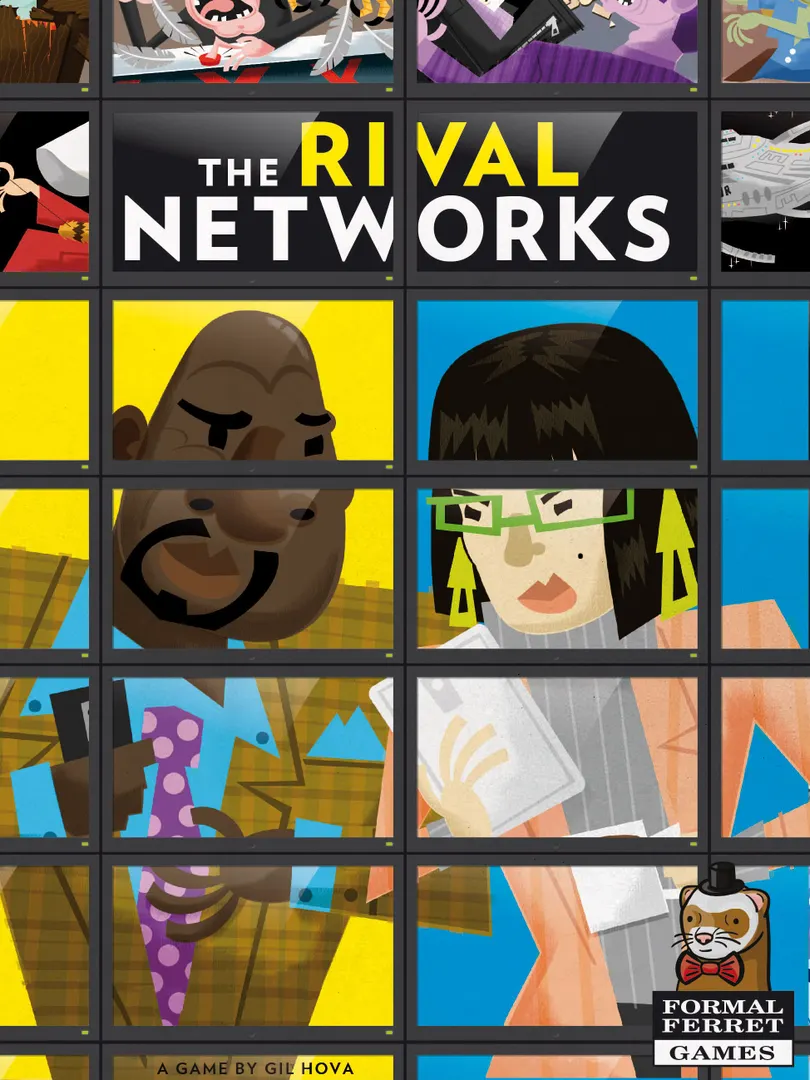
The Rival Networks es un juego de mesa publicado en 2021 para 2 jugadores, con partidas de 30 a 45 minutos y a partir de 14 años. Fue diseñado por Gil Hova y sus mecánicas principales son Set Collection, Area Majority / Influence y Open Drafting.







En inglés
The Rival Networks is a standalone two-player version of The Networks. Much of the original's gameplay is preserved, but streamlined so that it plays in 30-45 minutes. You and your opponent each have a display of 3 Timeslots, and at the start of the game, they show your starting 3 (terrible) Shows. There is also a Goal Card showing for the current Season, with 3 Goals available to hit (like winning a particular Timeslot, or having more Stars on your Shows than your opponent). On your turn, you will pick one new Show from a display of 3, and use it to replace one of your existing Shows, which moves to your Reruns. You'll score Ratings Points for the new Show, scoring higher ratings if you put the show in its correct timeslot. Next, you select one Star and one Ad from their corresponding display. Stars and Ads are displayed as pairs, so when you take one, you must take its matching pair. These go into your Green Room. Then, you may attach as many Stars as you want onto a single Show (usually the Show you got this turn, but not always), as long as the Star has an icon matching the Genre of the Show. Stars add to your Show's Ratings. You'll track Ratings for each of the three Timeslots independently. There are various points on each Ratings track with Viewer icons (usually between 3-5 Ratings Points). Every time you pass one of these Viewer icons, you'll score a Viewer by placing a chip into your secret bank. Ads are worth money depending on various situations - usually whether you're leading at a given Timeslot. You'll pay the Ads in order to buy Network Cards (which are now marked with costs). Network Cards are one-time use power cards, similar to the Network Cards in the original game. If you ever get at least 3 Shows of the same Genre between your Lineup and your Reruns, you'll score a Genre Bonus. Genre Bonuses are different for each Genre, but usually get you Stars or Ratings Points. The deck of Shows has one Genre of each Show per Season. Once these are all out, you'll see an "End of Season" card. A player may take this card on their turn to trigger the end of the Season when their turn is over. They won't get a Show, but they'll still get a full turn otherwise (taking a Star and an Ad, placing Stars on Shows, and buying Network Cards with Ads). At the end of a Season, the player leading in more Timeslots scores 1 Viewer for each Timeslot they're leading in; the other player draws 1 random Star. Then you'll look at the current season's Goals. The winner of each Goal gets Viewers or Stars depending on the goal. The game ends after 3 Seasons. The player with more cards in their Green Room scores 1 Viewer. Then, the player with the most Viewers wins.
Según el catálogo, The Rival Networks admite 2 jugadores. Es el número de jugadores indicado por la editorial, así que el juego está diseñado exactamente para esa cantidad de participantes. Las variantes para otros tamaños de grupo, si existen, se describen en el reglamento de tu edición; consúltalo antes de preparar otra configuración.
La duración indicada para The Rival Networks es de 30 a 45 minutos, la estimación de la editorial para una partida completa. El tiempo real depende del grupo, del número de jugadores y del conocimiento de las reglas: las primeras partidas suelen alargarse y los grupos con experiencia terminan antes. La preparación y la explicación de las reglas no están incluidas.
El catálogo indica The Rival Networks a partir de 14 años. Es la recomendación de la editorial y refleja la lectura necesaria, la complejidad de las reglas y las piezas pequeñas, no solo el tema. Los más pequeños a menudo pueden jugar con ayuda de un adulto: comprueba la edad recomendada en tu edición y la experiencia de tu grupo.
The Rival Networks tiene una puntuación de complejidad de 2,3 sobre 5 según los jugadores de BoardGameGeek, lo que lo convierte en un juego algo ligero. La puntuación refleja cuánto conocimiento de reglas, planificación y toma de decisiones exige una partida típica. Los juegos exigentes requieren una explicación inicial más larga, así que conviene usar una guía de preparación.
The Rival Networks pertenece a estas categorías: Card Game, Economic y Movies / TV / Radio theme. Sus mecánicas principales son Set Collection, Area Majority / Influence y Open Drafting. Las categorías describen el tema y la ambientación de un juego, mientras que las mecánicas describen lo que los jugadores hacen realmente en su turno. Cada mecánica lleva a una página del catálogo con juegos similares.
Los autores acreditados de The Rival Networks son: Gil Hova. Estos créditos proceden de los datos publicados del juego y nombran a las personas responsables de su diseño, no a ilustradores ni editoriales. Las páginas de autor de MeepleRules reúnen otros títulos de los mismos autores, algo útil cuando un juego te gusta y buscas otros parecidos.
El catálogo clasifica The Rival Networks como juego base. Se juega por sí solo con los componentes de la caja y no requiere ningún otro título. Las expansiones, si existen, añaden contenido o reglas nuevas y aparecen por separado en el catálogo con un enlace a este juego base.