
- Rang BGG
- BGG #21 246
- Note BGG
- 6,6
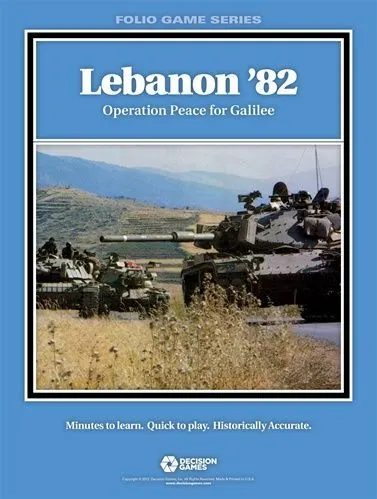
Lebanon '82: Operation Peace for Galilee
- 2 joueurs
- 90 min
- Complexité 2,1/5
- 2012
2010
Aide aux règles de DMZ: The Next Korean War
Des explications claires des tours, effets de cartes et situations litigieuses, avec des références aux sources officielles et un historique des questions sauvegardé.
Que voulez-vous savoir ?
Les réponses viennent du livret officiel, avec la page à vérifier.
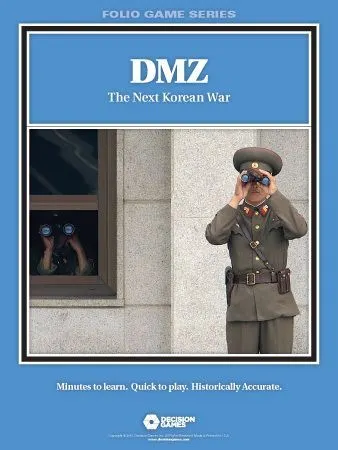
DMZ: The Next Korean War est un jeu de société sorti en 2010 pour 1 à 2 joueurs et avec des parties de 60 à 120 minutes. Il a été conçu par Eric R. Harvey et ses principales mécaniques sont Dice Rolling et Hexagon Grid.




En anglais
From the Decision Games' website: Technically speaking, the Korean War has remained active since the cease-fire agreement of 1953: the belligerents have never actually ratified a final peace accord. Since 1953, the Korean peninsula has remained devoid of open war, though only South Korea has prospered during that time. In contrast, North Korea has become isolated, bankrupt and confrontational. Indeed, as the North Korean economy continues to implode, and more starvation ensues, it's conceivable a desperate North Korea could resort to war to try to avoid its own final collapse. DMZ utilizes the new Fire & Movement combat system that's designed so players can augment their units with "support fire" during the course of the turns. From artillery to helicopter gunships, units can receive support to engage enemy positions and formations, allowing combat to develop at all levels. A single armor brigade, for example — perhaps with close air support — could be tasked to assault a lone enemy infantry corps defending an airbase. As that attack gets underway, that armor brigade may find itself under fire from rocket batteries; more support fire will be necessary to take the airbase, but assets are limited. In DMZ, the attritional design of the new Combat Results Table simulates the true nature of modern warfare. Units are typically two-sided formations that can incur casualties, accurately replicating the realities of combat and the high losses likely to be sustained by both sides during another Korean War. Winning a battle is thus a matter of maneuver, firepower and asset management. Re-implements: DMZ: The Battle for South Korea, late 1970s
Selon le catalogue, DMZ: The Next Korean War se joue de 1 à 2 personnes. Cette fourchette correspond au nombre de joueurs indiqué par l’éditeur : le jeu s’installe donc pour toute taille de groupe dans cette limite. La mise en place, certaines règles et le décompte peuvent varier selon l’effectif ; vérifiez la configuration exacte dans la règle de votre édition.
La durée indiquée pour DMZ: The Next Korean War est de 60 à 120 minutes, selon l’estimation de l’éditeur pour une partie complète. La durée réelle dépend du groupe, de l’effectif et de la connaissance des règles : les premières parties sont plus longues, les groupes expérimentés terminent plus vite. Mise en place et explication des règles ne sont pas comprises.
DMZ: The Next Korean War obtient une note de complexité de 2,2 sur 5 auprès des joueurs de BoardGameGeek, ce qui en fait un jeu plutôt léger. Cette note reflète la quantité de règles, de planification et de décisions qu’exige une partie typique. Prévoyez une explication plus longue pour les jeux exigeants et utilisez un guide de préparation avant la soirée.
DMZ: The Next Korean War appartient à ces catégories : Wargame et Modern Warfare. Ses principales mécaniques sont Dice Rolling et Hexagon Grid. Les catégories décrivent le thème et l’univers d’un jeu, tandis que les mécaniques décrivent ce que les joueurs font réellement pendant leur tour. Chaque mécanique mène à une page du catalogue avec des jeux similaires.
Les auteurs crédités pour DMZ: The Next Korean War sont : Eric R. Harvey. Ces crédits proviennent des données publiées du jeu et désignent les personnes responsables de sa conception, et non les illustrateurs ou les éditeurs. Les pages d’auteurs sur MeepleRules regroupent les autres titres des mêmes auteurs, ce qui est utile lorsqu’un jeu vous plaît et que vous en cherchez de similaires.
Le catalogue présente DMZ: The Next Korean War comme un jeu de base. Il se joue seul avec le matériel contenu dans la boîte et ne nécessite aucun autre titre. Les extensions, s’il en existe, y ajoutent du contenu ou des règles et sont répertoriées séparément dans le catalogue, avec un lien vers ce jeu de base.