- Rang BGG
- BGG #4 607
- Note BGG
- 8,2
Downfall: Conquest of the Third Reich, 1942-1945
- 2 joueurs
- 360–720 min
- Complexité 3,0/5
- 2023

Extension de Fighting Formations: Grossdeutschland Motorized Infantry Division
2018
Aide aux règles de Fighting Formations: Grossdeutschland Division's Battle for Kharkov
Des explications claires des tours, effets de cartes et situations litigieuses, avec des références aux sources officielles et un historique des questions sauvegardé.
Que voulez-vous savoir ?
Les réponses viennent du livret officiel, avec la page à vérifier.
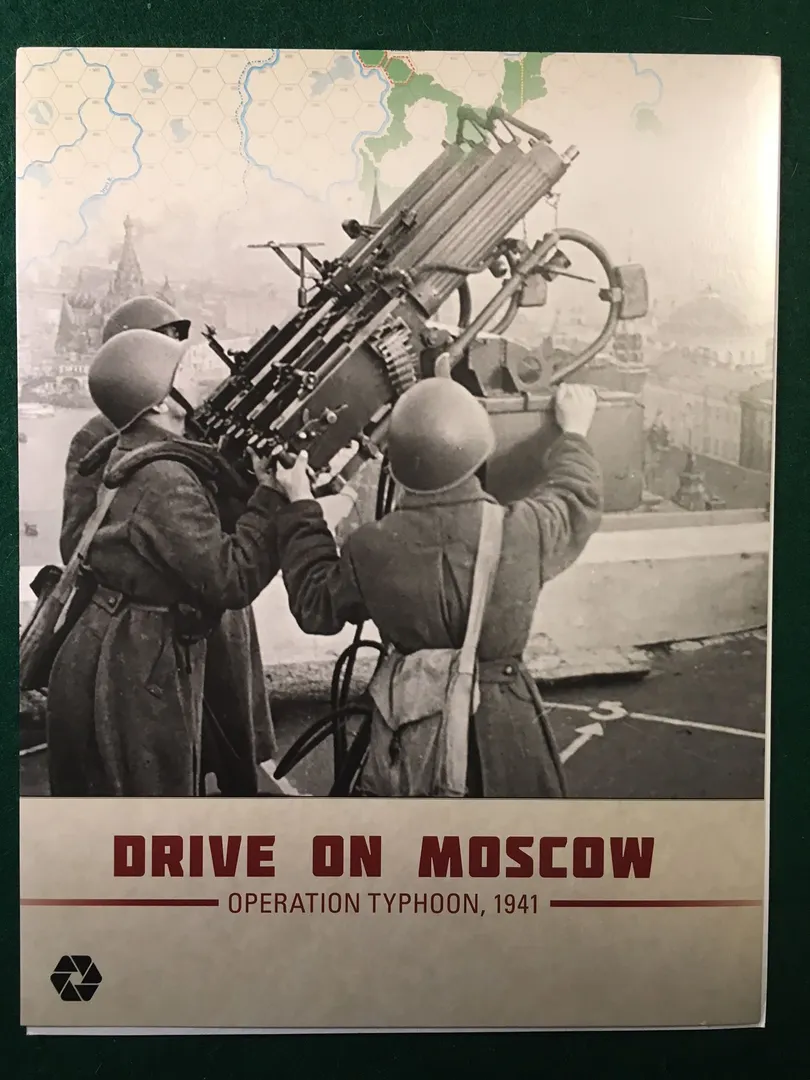
Fighting Formations: Grossdeutschland Division's Battle for Kharkov est une extension de Fighting Formations: Grossdeutschland Motorized Infantry Division sortie en 2018 pour 2 joueurs, avec des parties de 90 à 270 minutes et à partir de 12 ans. Il a été conçu par Bryan R. VanNortwick et ses principales mécaniques sont Dice Rolling, Hexagon Grid et Simulation.





En anglais
Attacks and counterattacks were the order of the day, any day... In the early winter months of 1943 the Soviets were driving deep into German lines. Their hope was to destroy the southern wing of the German army while it was still reeling from its defeat at Stalingrad. There were large gaps in the German lines and a quick advance here could turn the tide of the war. Time after time the Panzergrenadier Division Grossdeutschland was called upon to reinforce, fill and stabilize weak points, and to close the gaps before the onslaught of Soviet troops could pour through. Oftentimes they were outnumbered and arrived just in the nick of time. As the front stabilized they were called upon again to spearhead the German drives against the Soviet 40th and 69th Armies. The Soviets made several coordinated attacks during these months, one including Operation Star (February 2-19). During this offensive the Soviets took Belgorod and Kharkov. On the German side Manstein initiated his "Backhand Blow" on February 20. These battles went on through March 5 and beyond. Kharkov was taken back by the Germans in March during this push. Further German advances set up the upcoming summer’s battle for Kursk. The areas around and cities of Belgorod and Kharkov were key points in many of the battles above. Both cities were major transportation hubs and control of the roads between them was critical to both the Soviets and the Germans. Advancing, reinforcements and supply was dependent upon whoever controlled these cities. By the end of February the Soviets were pushing the limits of their endurance and were very near the end of their supply lines. The Germans needed these same cities to stop the enemy advance, form a semblance of a solid line, and prepare for the inevitable counterattacks. Fierce battles raged on and on with many villages and hills along the path changing hands multiple times. Each side's positions for the summer of 1943 campaigns were now at stake. In this expansion for Fighting Formations we feature the Grossdeutschland Division as it fought in 1943 and early 1944 around the Ukrainian city of Kharkov. In each scenario, one player will take command of elements of this elite German formation while the other assumes control of the opposing forces of the Soviet Union. Fighting Formations: Grossdeutschland Division's Battle for Kharkov expands upon the original Fighting Formations game by taking the Grossdeutschland Division into 1943 and the winter of 1944. This expansion features ten new scenarios, many using new units for the German and Soviet sides, played on ten new maps. The new Battle for Kharkov playbook includes the following: • 10 new scenarios, including many smaller and shorter engagements • Updated order of battle for GD, encompassing units and hardware added in 1943 • Historical notes covering GD’s fighting in the Ukraine In addition to the new playbook, the game includes 3 large and 2 small back-printed game maps (10 maps total), and a half-sized counter sheet containing new pieces for both the German and Soviet arsenals. New units include: • The Soviet SU-76M “Suka” open-topped assault gun; • SU-85 tank destroyer; • T-34C; • T-26b light tank; • The German Mk VI Tiger I • PzIII M; • 7.5cm PaK 40 anti-tank gun; • Low quality troops representing GD artillerymen forced to fight on the front lines The new scenarios included in Battle for Kharkov are: • Cut Off—Units of the Grossdeutschland Regiment find themselves surrounded by advancing Soviet forces on the highway leading north to Belgorod on 11 February 1943. • Who’s Who—On 4 November 1943 near Krasny Orlik, Major Frantz, the Assault Gun Battalion commander, became quite wary when he heard the sounds of combat to his north. This northern flank was to be held by 9th Panzer. However, nothing could be seen over the high rail line that divided their two sections of the front. Were they still there and holding the line? Major Frantz decided to investigate the situation for himself and crossed the rail line with another assault gun. As he watched German troops and guns stream by in retreat he found himself in the midst of a tall cornfield with Russian T-34s streaming by at a range of 20 yards. They were faster than he was, and were by him in an instant…. • Duel—General Koniev's 2nd Ukrainian Front launched a major offensive in December of 1943, with the aim to break through the German lines in the Kirovograd area. Multiple attacks were launched and Soviet troops were pouring through. The Panzergrenadier Grossdeutschland Division was brought up to close the gaps and help create a continuous defensive line. There was a critically vulnerable point along the road to the east of the village of Anniska. Here II Battalion, Panzergrenadier Regiment GD was struggling to hold its position. They were reinforced by the anti-aircraft troops of GD's Army FlaK Battalion just in the nick of time. • Welcome to Kharkov—21 January 1943: Reports from the Soviet Voronezh Front were that they had broken through the Hungarian army's positions and were advancing into the Novy Oskol area northwest of Kharkov. The Oskol river was being breached and preparations were in progress for further attacks towards Belgorod and Kharkov. General Kazakov's 69th Army was to attack southeast taking Volchansk and then on into Kharkov. Before the city, however, lay Volokonovka, which would provide an opportunity to hit the German's defensive line and test their resolve. Were the German forces finally weakening? • Charge—9 March 1943: The 3rd Squadron of “Battle Group Strachwitz,” after taking fire from nearby Alexandrovka, was assigned the job of taking out the Soviet forces there. Rather than wait, they immediately charged down the slopes into the heavy defensive fire coming directly at them. • Can We Hold?—March 17 started out quietly, but it was not to stay that way. The II Battalion of the Grenadier Regiment was sent into Borisovka to free up other GD units for attacking elsewhere. The relieved units left mid-morning. In the late afternoon about a dozen Soviet tanks and infantry charged in from the northeast, broke through the outer line, and drove directly into the village. • Overrun—18 February 1943: Kharkov had just fallen to the Soviets and a realignment of the German defensive line was formed to its south. The Grossdeutschland Division's Fusilier Regiment was given the assignment of defending a section of road leading to the west out of Kharkov towards Ljubotin. Rybalko's Soviet 3rd Tank Army was trying to break through this new line southwest of the city. One of his attacks took place on the outskirts of the town of Korotich near a collective farm. • Just in Time—The Soviet Voronezh Front had three armies poised to attack towards Kharkov in early February ‘43 as part of Operation Star. Their forces had taken the city of Belgorod as this progressed and they were continuing to push southward to achieve their goal. Delaying actions to slow the advance was all the Germans were capable of at this point in time. The Soviet 40th Army was now northeast of Kharkov and was trying to find a seam between SS Reich units and the Grossdeutschland Division defending outside of Veseloye. They were looking for easy openings in the German line that could be taken advantage of and thus move down the Belgorod-Kharkov highway and into Kharkov itself. Grossdeutschland's reinforced Fusilier Regiment was in the direct line of this advance.... • A Change of Orders—The Soviets 2nd Ukrainian Front launched a major offensive in late December of 1943 in southern Russia. The attacks began in earnest on 5 January 1944 with the goal of breaking through the German lines in the Kirovograd area. These caused multiple gaps in the German lines. On the evening of January 7 Grossdeutschland units were close at hand and were called upon to help remedy the tenuous situation. • Tigers—In early March ‘43 the momentum in the area around the city of Kharkov was turning towards the Germans. Manstein's counterattack was pushing the Soviets back and gaining ground on all sides. Gaps were developing between the Soviet 40th and 69th Armies. On March 4 Grossdeutschland Division received its first Tiger tank company. Three days later GD jumped off, attacking towards Bogodukhov to the northwest of Kharkov.
Selon le catalogue, Fighting Formations: Grossdeutschland Division's Battle for Kharkov se joue à 2 personnes. C’est le nombre de joueurs indiqué par l’éditeur : le jeu est donc conçu pour exactement ce nombre de participants. Les variantes pour d’autres tailles de groupe, s’il en existe, sont décrites dans la règle de votre édition ; consultez-la avant d’installer une autre configuration.
La durée indiquée pour Fighting Formations: Grossdeutschland Division's Battle for Kharkov est de 90 à 270 minutes, selon l’estimation de l’éditeur pour une partie complète. La durée réelle dépend du groupe, de l’effectif et de la connaissance des règles : les premières parties sont plus longues, les groupes expérimentés terminent plus vite. Mise en place et explication des règles ne sont pas comprises.
Le catalogue indique Fighting Formations: Grossdeutschland Division's Battle for Kharkov à partir de 12 ans. C’est la recommandation de l’éditeur ; elle tient compte de la lecture nécessaire, de la complexité des règles et des petits composants, pas seulement du thème. Les plus jeunes peuvent souvent participer avec l’aide d’un adulte : vérifiez l’âge indiqué sur votre édition et tenez compte de l’expérience de votre groupe.
Fighting Formations: Grossdeutschland Division's Battle for Kharkov obtient une note de complexité de 3,3 sur 5 auprès des joueurs de BoardGameGeek, ce qui en fait un jeu de complexité moyenne. Cette note reflète la quantité de règles, de planification et de décisions qu’exige une partie typique. Prévoyez une explication plus longue pour les jeux exigeants et utilisez un guide de préparation avant la soirée.
Fighting Formations: Grossdeutschland Division's Battle for Kharkov appartient à ces catégories : Wargame, World War II et Expansion for Base-game. Ses principales mécaniques sont Dice Rolling, Hexagon Grid et Simulation. Les catégories décrivent le thème et l’univers d’un jeu, tandis que les mécaniques décrivent ce que les joueurs font réellement pendant leur tour. Chaque mécanique mène à une page du catalogue avec des jeux similaires.
Les auteurs crédités pour Fighting Formations: Grossdeutschland Division's Battle for Kharkov sont : Bryan R. VanNortwick. Ces crédits proviennent des données publiées du jeu et désignent les personnes responsables de sa conception, et non les illustrateurs ou les éditeurs. Les pages d’auteurs sur MeepleRules regroupent les autres titres des mêmes auteurs, ce qui est utile lorsqu’un jeu vous plaît et que vous en cherchez de similaires.
Le catalogue présente Fighting Formations: Grossdeutschland Division's Battle for Kharkov comme une extension de Fighting Formations: Grossdeutschland Motorized Infantry Division. Les extensions ajoutent du contenu, des règles ou des scénarios au jeu de base et ne se jouent généralement pas seules : il vous faut donc Fighting Formations: Grossdeutschland Motorized Infantry Division pour l’utiliser. Vérifiez que votre édition de Fighting Formations: Grossdeutschland Motorized Infantry Division est compatible, car certaines extensions ont été révisées d’une édition à l’autre.
