

- Rang BGG
- BGG #7 576
- Note BGG
- 7,4
The Next War: Modern Conflict in Europe
- 2 joueurs
- 360 min
- Complexité 4,2/5
- 1978
1977
Aide aux règles de Fulda Gap: The First Battle of the Next War
Des explications claires des tours, effets de cartes et situations litigieuses, avec des références aux sources officielles et un historique des questions sauvegardé.
Pour 2 joueurs
Que voulez-vous savoir ?
Les réponses viennent du livret officiel, avec la page à vérifier.
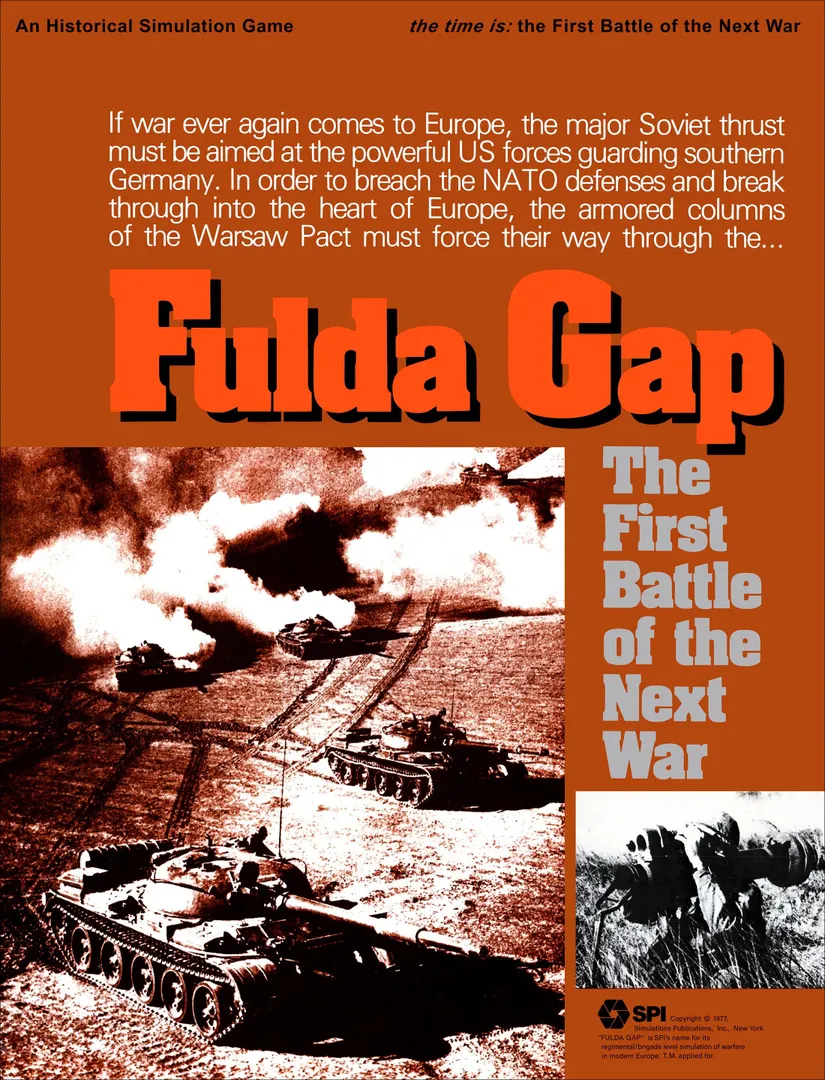
Fulda Gap: The First Battle of the Next War est un jeu de société sorti en 1977 pour 2 joueurs, avec des parties de 300 minutes et à partir de 12 ans. Il a été conçu par Jim Dunnigan et ses principales mécaniques sont Dice Rolling, Hexagon Grid et Simulation.





En anglais
"Fulda Gap: The First Battle of the Next War", is a regimental/brigade level wargame simulation of a possible Warsaw Pact assault into West Germany through the area of relatively open terrain centered around the town of Fulda sometime in the near future. Success would allow the Pact armies to drive a wedge between the NATO forces deployed to the north and south, seize several important logistic centers, and perhaps establish a bridgehead across the Rhine River. Of all the scenarios for a coming world war, none has received more attention than the possibility of a future NATO-Warsaw Pact confrontation. For 25 years, the armies of East and West have faced one another across a divided Germany, each knowing that it is in this region that the course of any war will be decided. There are two types of games: the Standard Game and the Advanced Game. Preferably, the Players should become familiar with the Standard Garne first and then increase the level of complexity until they find a rules mix with which they are most comfortable. The key to the game lies in the combination of a unique combat system and a new untried unit procedure. Basically, each ground combat unit consists of three "steps" and an untried status. As a unit enters combat, its actual strength— which may be greater or less than its normal face-value — must be determined. Combat results are expressed in terms of "retreat points" which must be expended either by retreating and/or by taking step losses. Since the owning player controls the path and method of retreat, there is a wide range of possible outcomes from each combat situation. Fulda Gap Shows the likely impact of a great number of factors on modern warfare. Supply and movement systems stress the importance of roads and autobahns; rules are provided to reflect the importance of divisional integrity, artillery, helicopters, airmobile units, replacements, Soviet doctrine, field fortifications, and disengagement. And players wishing to increase the complexity of the game may use an innovative air system. Extensive rules also cover chemical and nuclear warfare. Game Scale: Game Turn: 1 day Hex: 3.88 miles / 6.25 kilometers Units: Regiment & Brigade Game Inventory: One 22 x 34" full color map One dual-side printed countersheet (400 1/2" counters) One 16-page Fulda Gap rulebook One dual-side printed Turn Record/Reinforcement Track Two dual-side printed Charts & Tables folder (4 pages, Combat, Terrain tables, etc) Solitaire Playability: High Complexity Level: Medium Players: 2 or more Playing Time: 4-15 hours
Selon le catalogue, Fulda Gap: The First Battle of the Next War se joue à 2 personnes. C’est le nombre de joueurs indiqué par l’éditeur : le jeu est donc conçu pour exactement ce nombre de participants. Les variantes pour d’autres tailles de groupe, s’il en existe, sont décrites dans la règle de votre édition ; consultez-la avant d’installer une autre configuration.
La durée indiquée pour Fulda Gap: The First Battle of the Next War est de 300 minutes, selon l’estimation de l’éditeur pour une partie complète. La durée réelle dépend du groupe, de l’effectif et de la connaissance des règles : les premières parties sont plus longues, les groupes expérimentés terminent plus vite. Mise en place et explication des règles ne sont pas comprises.
Le catalogue indique Fulda Gap: The First Battle of the Next War à partir de 12 ans. C’est la recommandation de l’éditeur ; elle tient compte de la lecture nécessaire, de la complexité des règles et des petits composants, pas seulement du thème. Les plus jeunes peuvent souvent participer avec l’aide d’un adulte : vérifiez l’âge indiqué sur votre édition et tenez compte de l’expérience de votre groupe.
Fulda Gap: The First Battle of the Next War obtient une note de complexité de 3,2 sur 5 auprès des joueurs de BoardGameGeek, ce qui en fait un jeu de complexité moyenne. Cette note reflète la quantité de règles, de planification et de décisions qu’exige une partie typique. Prévoyez une explication plus longue pour les jeux exigeants et utilisez un guide de préparation avant la soirée.
Fulda Gap: The First Battle of the Next War appartient à ces catégories : Wargame et Modern Warfare. Ses principales mécaniques sont Dice Rolling, Hexagon Grid et Simulation. Les catégories décrivent le thème et l’univers d’un jeu, tandis que les mécaniques décrivent ce que les joueurs font réellement pendant leur tour. Chaque mécanique mène à une page du catalogue avec des jeux similaires.
Les auteurs crédités pour Fulda Gap: The First Battle of the Next War sont : Jim Dunnigan. Ces crédits proviennent des données publiées du jeu et désignent les personnes responsables de sa conception, et non les illustrateurs ou les éditeurs. Les pages d’auteurs sur MeepleRules regroupent les autres titres des mêmes auteurs, ce qui est utile lorsqu’un jeu vous plaît et que vous en cherchez de similaires.
Le catalogue présente Fulda Gap: The First Battle of the Next War comme un jeu de base. Il se joue seul avec le matériel contenu dans la boîte et ne nécessite aucun autre titre. Les extensions, s’il en existe, y ajoutent du contenu ou des règles et sont répertoriées séparément dans le catalogue, avec un lien vers ce jeu de base.