
- Rang BGG
- BGG #8 918
- Note BGG
- 8,0
Global War: World War II Worldwide 1939-1945
- 1 joueur
- 45–180 min
- Complexité 3,5/5
- 2023
2022
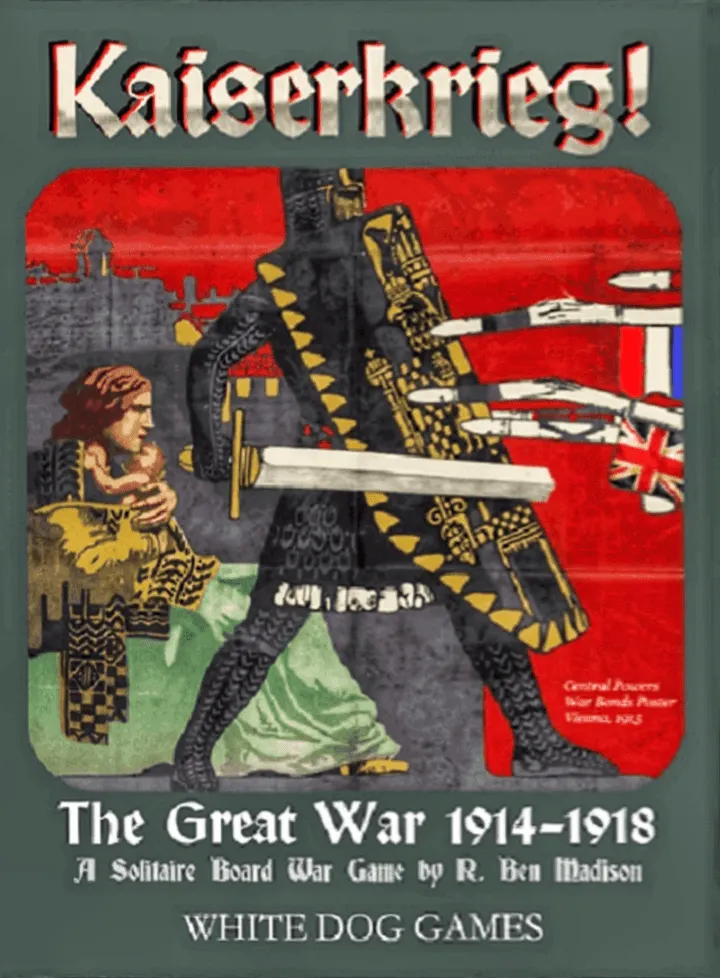
Aide aux règles de Kaiserkrieg! The Great War 1914-1918
Des explications claires des tours, effets de cartes et situations litigieuses, avec des références aux sources officielles et un historique des questions sauvegardé.
Pour 1 joueur
Que voulez-vous savoir ?
Les réponses viennent du livret officiel, avec la page à vérifier.
Kaiserkrieg! The Great War 1914-1918 est un jeu de société sorti en 2022 pour 1 joueur, avec des parties de 60 à 120 minutes et à partir de 14 ans. Il a été conçu par Ben Madison et ses principales mécaniques sont Events, Solo / Solitaire Game et Action Points.
En anglais
Kaiserkrieg! (‘Emperor’s War’) is a Strategic level Solitaire wargame of the First World War of 1914-1918. As the player, you control the Central Powers (“CP”; Germany, AustriaHungary, Turkey and Bulgaria). The game’s automatic systems direct the efforts of the Entente Powers (“EP”; France, Britain, Russia, Italy, Serbia, the United States, and their minor allies) who are trying to defeat you. As in many of my games, you play the “bad guys.” For simplicity’s sake, Imperial Germany and its main ally, the Austro-Hungarian Empire, are usually treated as one political entity in the game. The flags on the “City” Tiles are for decoration. In contrast to my other games, space precludes the addition of many historical notes in this rulebook. If you run across a name or historical reference that is new to you, Google is your friend! The heart of the game is its depiction of the ground war, which saw the battlefield deaths of some ten million soldiers. Kaiserkrieg’s treatment can be traced back to Darin Leviloff’s inspired Israeli Independence (2008) and the “States of Siege” system it started. The evolutionary leap in Kaiserkrieg! is the shift from the old ‘horizontal’ States of Siege model – where enemy forces converge on your central position along clearly defined lines of advance – to a new ‘vertical’ model where enemy forces mass in separate regions around you, to eventually achieve an advantage in size that threatens your overall position. This adaptation allows Leviloff’s original concept to more closely simulate the trench warfare realities of World War I on the continental level. The game also depicts the epic naval struggle of proGerman blockade runners trying to evade fleets of British cruisers. Many historians identify the failure to outwit the British naval blockade as the main reason for Germany’s defeat in the war. The ‘sideshow’ war in the Near East, where Germany’s Ottoman Turkish ally was assailed by Russia and the British Empire – including a massive army of Indian troops – is played with a simplified version of the game system (12.0). This theater also includes East Africa, where a German-led Black African army (the Askari) held out against Indian and British Empire forces even after the Germans in Europe had surrendered! The game is an extremely strategic view of the conflict. Points are dramatically simplified to make it playable and to emphasize the “cool stuff” of World War I, like Zeppelins, trenches, and U-boats. Kaiserkrieg! is not a detailed historical simulation, but a fun and challenging game covering the salient themes of the actual conflict while whetting the player’s appetite for more detailed treatments of this fascinating war. —description from the publisher
Selon le catalogue, Kaiserkrieg! The Great War 1914-1918 se joue à 1 personne. C’est le nombre de joueurs indiqué par l’éditeur : le jeu est donc conçu pour exactement ce nombre de participants. Les variantes pour d’autres tailles de groupe, s’il en existe, sont décrites dans la règle de votre édition ; consultez-la avant d’installer une autre configuration.
La durée indiquée pour Kaiserkrieg! The Great War 1914-1918 est de 60 à 120 minutes, selon l’estimation de l’éditeur pour une partie complète. La durée réelle dépend du groupe, de l’effectif et de la connaissance des règles : les premières parties sont plus longues, les groupes expérimentés terminent plus vite. Mise en place et explication des règles ne sont pas comprises.
Le catalogue indique Kaiserkrieg! The Great War 1914-1918 à partir de 14 ans. C’est la recommandation de l’éditeur ; elle tient compte de la lecture nécessaire, de la complexité des règles et des petits composants, pas seulement du thème. Les plus jeunes peuvent souvent participer avec l’aide d’un adulte : vérifiez l’âge indiqué sur votre édition et tenez compte de l’expérience de votre groupe.
Kaiserkrieg! The Great War 1914-1918 obtient une note de complexité de 3,2 sur 5 auprès des joueurs de BoardGameGeek, ce qui en fait un jeu de complexité moyenne. Cette note reflète la quantité de règles, de planification et de décisions qu’exige une partie typique. Prévoyez une explication plus longue pour les jeux exigeants et utilisez un guide de préparation avant la soirée.
Kaiserkrieg! The Great War 1914-1918 appartient à ces catégories : Wargame, Print & Play et World War I. Ses principales mécaniques sont Events, Solo / Solitaire Game et Action Points. Les catégories décrivent le thème et l’univers d’un jeu, tandis que les mécaniques décrivent ce que les joueurs font réellement pendant leur tour. Chaque mécanique mène à une page du catalogue avec des jeux similaires.
Les auteurs crédités pour Kaiserkrieg! The Great War 1914-1918 sont : Ben Madison. Ces crédits proviennent des données publiées du jeu et désignent les personnes responsables de sa conception, et non les illustrateurs ou les éditeurs. Les pages d’auteurs sur MeepleRules regroupent les autres titres des mêmes auteurs, ce qui est utile lorsqu’un jeu vous plaît et que vous en cherchez de similaires.
Le catalogue présente Kaiserkrieg! The Great War 1914-1918 comme un jeu de base. Il se joue seul avec le matériel contenu dans la boîte et ne nécessite aucun autre titre. Les extensions, s’il en existe, y ajoutent du contenu ou des règles et sont répertoriées séparément dans le catalogue, avec un lien vers ce jeu de base.