
- Rang BGG
- BGG #5 647
- Note BGG
- 8,3
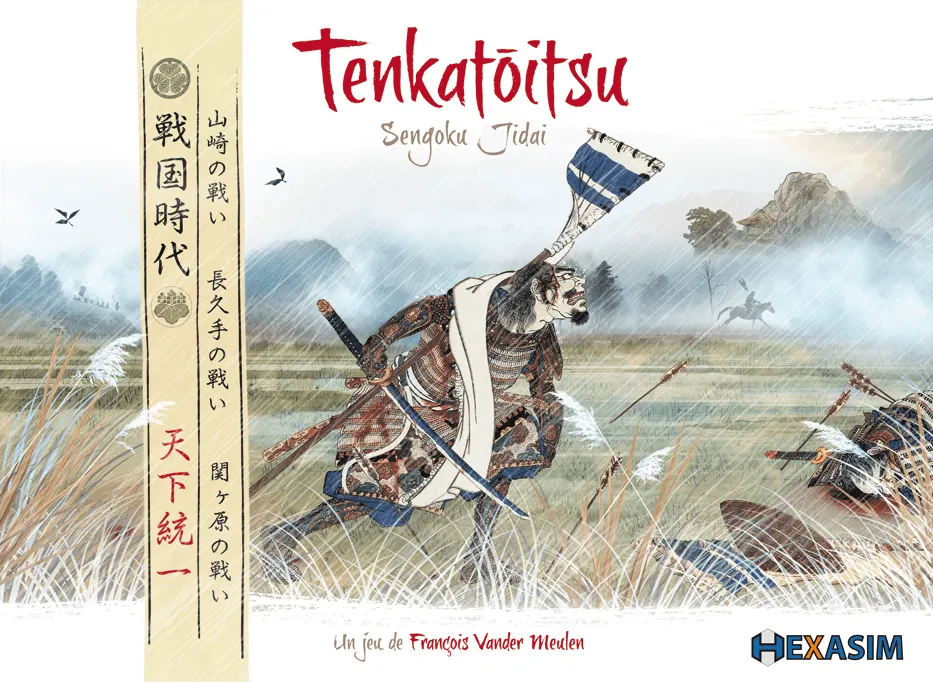
Tenkatoitsu
- 1–2 joueurs
- 180–420 min
- Complexité 3,4/5
- 2016
2009
Aide aux règles de Kawanakajima 1561
Des explications claires des tours, effets de cartes et situations litigieuses, avec des références aux sources officielles et un historique des questions sauvegardé.
Pour 1 joueur
Que voulez-vous savoir ?
Les réponses viennent du livret officiel, avec la page à vérifier.
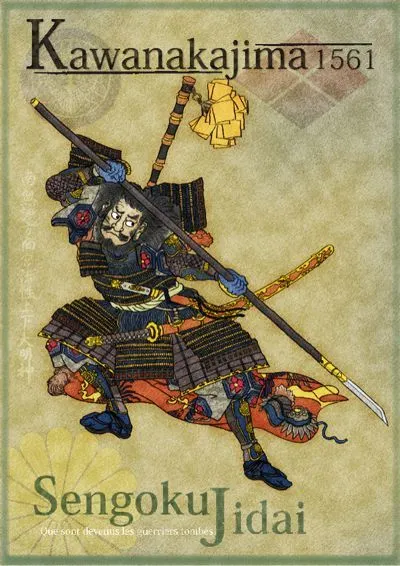
Kawanakajima 1561 est un jeu de société sorti en 2009 pour 1 à 2 joueurs et avec des parties de 120 à 240 minutes. Il a été conçu par François Vander Meulen et ses principales mécaniques sont Dice Rolling, Hexagon Grid et Simulation.




En anglais
(from Hexasim website:) Kawanakajima 1561, simulates the fourth battle of Kawanakajima. This will be the first game in the series Sengoku Jidai, which will cover battles in 16th century Japan. The system is designed so players can finish a game in an evening, and has simple but dynamic mechanics. In the game, each player takes the role of a commander in chief. Each army consists of various clans, and the players have to choose an action for each of their clans. Each clan is represented by 1 to 3 units. The units have various abilities, summarized by the 4 factors: élan, mass, fire and the presence of a leader. Elan represents factors such as the unit's mobility, and its boldness in attack, and is also used to reflect the advantage that cavalry can have over infantry when attacking. The unit's mass represents its staying power, such as its ability to resist a cavalry charge or a rout. A unit's abilities are tied to the value of its four factors and the current mode of the clan that it belongs to. A clan can be placed in one of four modes: Attack, Defense, Move, and Rally. The owning clan's mode will affect a unit's ability to move or engage in combat. A game turn consists of alternating phases where a player can activate his units. The order in which activations will occur is tied to a chit pull system. The game system requires each player to plan carefully how to win. They must maneuver to gain numerical superiority, deploy in terrain that takes advantage of their clan's mode, and try to surprise his opponent by attacking troops that are not prepared. The system also places the players under the same historical limitations as the actual Japanese leaders. Japanese generals of this time prearranged their battle plans and coordinated their armies with a precise system of semaphore flags and sound signals. The game includes 2 scenarios: one depicting the historical battle, and a "what if?" hypothetical scenario. In the historical scenario, Takeda's army is divided in two contingents. One of the contingents is taken by surprise by Uesugi's army, and has to fight a holding action until the rest of the army can come to its aid. The hypothetical scenario explores what could have happened several days before the historical battle. In Kawanakajima 1561 a hex represents about 250 meters and a strength point corresponds to around 100 men. Game components: 1 map A1 (84cm*60cm) 228 game counters (88 5/8inch, 140 1/2inch) one rule book with scenarios Game play aids Cardboard jacket 4 dice
Selon le catalogue, Kawanakajima 1561 se joue de 1 à 2 personnes. Cette fourchette correspond au nombre de joueurs indiqué par l’éditeur : le jeu s’installe donc pour toute taille de groupe dans cette limite. La mise en place, certaines règles et le décompte peuvent varier selon l’effectif ; vérifiez la configuration exacte dans la règle de votre édition.
La durée indiquée pour Kawanakajima 1561 est de 120 à 240 minutes, selon l’estimation de l’éditeur pour une partie complète. La durée réelle dépend du groupe, de l’effectif et de la connaissance des règles : les premières parties sont plus longues, les groupes expérimentés terminent plus vite. Mise en place et explication des règles ne sont pas comprises.
Kawanakajima 1561 obtient une note de complexité de 2,8 sur 5 auprès des joueurs de BoardGameGeek, ce qui en fait un jeu plutôt léger. Cette note reflète la quantité de règles, de planification et de décisions qu’exige une partie typique. Prévoyez une explication plus longue pour les jeux exigeants et utilisez un guide de préparation avant la soirée.
Kawanakajima 1561 appartient à ces catégories : Wargame, Renaissance et Pike and Shot. Ses principales mécaniques sont Dice Rolling, Hexagon Grid et Simulation. Les catégories décrivent le thème et l’univers d’un jeu, tandis que les mécaniques décrivent ce que les joueurs font réellement pendant leur tour. Chaque mécanique mène à une page du catalogue avec des jeux similaires.
Les auteurs crédités pour Kawanakajima 1561 sont : François Vander Meulen. Ces crédits proviennent des données publiées du jeu et désignent les personnes responsables de sa conception, et non les illustrateurs ou les éditeurs. Les pages d’auteurs sur MeepleRules regroupent les autres titres des mêmes auteurs, ce qui est utile lorsqu’un jeu vous plaît et que vous en cherchez de similaires.
Le catalogue présente Kawanakajima 1561 comme un jeu de base. Il se joue seul avec le matériel contenu dans la boîte et ne nécessite aucun autre titre. Les extensions, s’il en existe, y ajoutent du contenu ou des règles et sont répertoriées séparément dans le catalogue, avec un lien vers ce jeu de base.