
- Rang BGG
- BGG #9 881
- Note BGG
- 8,0
Von Manstein's Triumph
- 2 joueurs
- 120–180 min
- Complexité 2,2/5
- 2022
2009
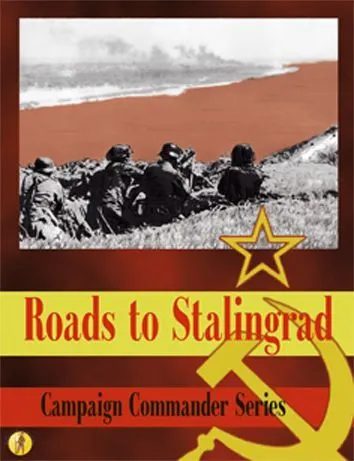
Aide aux règles de Roads to Stalingrad: Campaign Commander Series
Des explications claires des tours, effets de cartes et situations litigieuses, avec des références aux sources officielles et un historique des questions sauvegardé.
Pour 2 joueurs
Que voulez-vous savoir ?
Les réponses viennent du livret officiel, avec la page à vérifier.
Roads to Stalingrad: Campaign Commander Series est un jeu de société sorti en 2009 pour 2 joueurs et avec des parties de 180 minutes. Il a été conçu par Francisco Ronco et ses principales mécaniques sont Area Movement, Dice Rolling et Simultaneous Action Selection.


En anglais
Campaign Commander Volume I: Roads to Stalingrad. "Roads to Stalingrad" is the first volume of the Campaign Commander Series and depicts the campaign in southern Russia from the summer of 1942 to the end of the winter of 1943. After a terrible first winter in Russia, the German troops reorganized and readied themselves to launch the offensive to end the war. The soviets got ready first; they launched an attack to retake Kharkov that ended in disaster for the troops involved. After finishing this offensive the Axis forces - numbering many Hungarians, Romanians and Italians - launched, at the beginning of July 1942 the operation code named "Case Blue". German advance seemed unstoppable, reaching the Caucasus and the banks of the river Volga. At the city of Stalingrad the German army would experience a real nightmare fighting through August to October in an attempt to conquer it. Control of the city meant that the Germans could cut the traffic along the Volga, while for the Soviets it became a symbol of resistance against the invaders. Both Stalin and Hitler sent more and more troops to the cauldron of that destroyed city, into the fiercest and bloodiest battle ever known in history. In the event, conquering the city was rather useless to the Germans since, beginning on the 19th of November, Operation Uranus was launched and Marshall Zhukov could trap the German 6th Army into the ruins just won. Successive soviet offensives destroyed the Italian, Romanian and Hungarian armies on the river Don, forcing the Germans to evacuate their conquests in the Caucasus and endangering even the survival of the whole German Army Group South. Only the timely intervention of Marshall Erich von Manstein allowed the Germans to stop the Soviet advance and stabilize the front, thus saving an already catastrophic situation. The game is played at the operational level - with a zonal map at a 1:120000 scale. Designed for two players, one handles the Axis while the other commands the Soviets. The game has an estimated playing time of 3-4 hours and uses a double system of counters/map and cards in its mechanics. Players must use appropriately their troops and resources to obtain victory points either by destroying enemy forces or by occupying cities on the map. This is not a card driven game, cards are used for causing certain events, influence the outcome of battles and to place on map the necessary resources and reinforcements to fight on. The game starts in summer, the Axis player has the initiative and will mercilessly and relentlessly pound the Soviets. The Soviet player will have to hope for the winter - a card to be played given certain conditions - to stop the Axis advance and defeat them. As the other titles in the series, this game has very simple rules and has been designed to make games wholly interactive, creating a solid and enjoyable experience for those who simply cannot find the time and space to play a longer and more complex game. The Axis player must face the historical disjunctive, should he concentrate on taking the Caucasus, Stalingrad or both? The Soviet player will have to be patient and force his enemy to overextend his resources, at the same time managing to accumulate forces for a lethal winter offensive.
Selon le catalogue, Roads to Stalingrad: Campaign Commander Series se joue à 2 personnes. C’est le nombre de joueurs indiqué par l’éditeur : le jeu est donc conçu pour exactement ce nombre de participants. Les variantes pour d’autres tailles de groupe, s’il en existe, sont décrites dans la règle de votre édition ; consultez-la avant d’installer une autre configuration.
La durée indiquée pour Roads to Stalingrad: Campaign Commander Series est de 180 minutes, selon l’estimation de l’éditeur pour une partie complète. La durée réelle dépend du groupe, de l’effectif et de la connaissance des règles : les premières parties sont plus longues, les groupes expérimentés terminent plus vite. Mise en place et explication des règles ne sont pas comprises.
Roads to Stalingrad: Campaign Commander Series obtient une note de complexité de 2,5 sur 5 auprès des joueurs de BoardGameGeek, ce qui en fait un jeu plutôt léger. Cette note reflète la quantité de règles, de planification et de décisions qu’exige une partie typique. Prévoyez une explication plus longue pour les jeux exigeants et utilisez un guide de préparation avant la soirée.
Roads to Stalingrad: Campaign Commander Series appartient à ces catégories : Wargame et World War II. Ses principales mécaniques sont Area Movement, Dice Rolling et Simultaneous Action Selection. Les catégories décrivent le thème et l’univers d’un jeu, tandis que les mécaniques décrivent ce que les joueurs font réellement pendant leur tour. Chaque mécanique mène à une page du catalogue avec des jeux similaires.
Les auteurs crédités pour Roads to Stalingrad: Campaign Commander Series sont : Francisco Ronco. Ces crédits proviennent des données publiées du jeu et désignent les personnes responsables de sa conception, et non les illustrateurs ou les éditeurs. Les pages d’auteurs sur MeepleRules regroupent les autres titres des mêmes auteurs, ce qui est utile lorsqu’un jeu vous plaît et que vous en cherchez de similaires.
Le catalogue présente Roads to Stalingrad: Campaign Commander Series comme un jeu de base. Il se joue seul avec le matériel contenu dans la boîte et ne nécessite aucun autre titre. Les extensions, s’il en existe, y ajoutent du contenu ou des règles et sont répertoriées séparément dans le catalogue, avec un lien vers ce jeu de base.