
- Rang BGG
- BGG #8 645
- Note BGG
- 8,0
The Western Front: 1914 to 1918
- 2 joueurs
- 360 min
- Complexité 3,4/5
- 2004
2003
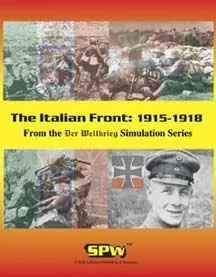
Aide aux règles de The Italian Front: 1915-1918
Des explications claires des tours, effets de cartes et situations litigieuses, avec des références aux sources officielles et un historique des questions sauvegardé.
Pour 2 joueurs
Que voulez-vous savoir ?
Les réponses viennent du livret officiel, avec la page à vérifier.
The Italian Front: 1915-1918 est un jeu de société sorti en 2003 pour 2 joueurs, avec des parties de 360 minutes et à partir de 12 ans. Il a été conçu par David Schroeder et ses principales mécaniques sont Dice Rolling et Hexagon Grid.





En anglais
Five Separate Scenarios PLUS Campaign Game PLUS Links to Other Games of the Series. May 1915 - First Isonzo Italy decides to enter the war. Once a member of the Triple Alliance with Germany and Austria-Hungary, Italy now sides with the Entente. Italy's dream is of annexing Austro-Hungarian territory inhabited by ethnic Italians. Austria-Hungary views Italy not only as traitorous, but also as its traditional enemy. The stage is set for a bloodbath. The Italian army attempts to cross a narrow path into Austria-Hungary, across the Isonzo River towards Trieste. There the Austro-Hungarian army is dug in and waiting for them. May 1916 - The Strafexpedition The Chief of Staff of the Austro Hungarian army, Conrad von Hotzendorff, feels the time is right to punish Italy. He ignores the German chief Falkenhayn who foresees problems on the Eastern Front. Conrad masses guns and men in the Tirol for a strike to cut off the Italian armies to the east along the Isonzo. The plan looks good on paper, but the attacks will take place across rugged country. The Italians in the southern Tirol have neglected their rear area defenses. Italian reinforcements rush to the area. It is a dicey affair, but the Italian lines hold fast. The peril to the Italian forces along the Isonzo is checked. May 1917 - Tenth Isonzo Again and again and again, valiant Italian infantry has been fed into the maelstrom of the Isonzo. Each battle differs from the last only by their increasing intensity. The 9th Isonzo battle brought the capture of Gorizia. Now the Italians work to enlarge their holdings on the east of the bloody Isonzo. In the end, each side is once again exhausted. The Italians have become weary of the war. Yet, the Austrians feel that one more attack along the Isonzo may be the one that breaks their army first. October 1917 - Caporreto With Russia just about finished, the German army turns to help its beleaguered ally. Crack German divisions are sent to the Italian front to remove the mortal threat to Austria-Hungary. The Austrians reinforce the front with specially trained assault units. The Italians along the headwaters of the Isonzo are overwhelmed. German and Austrian units pour through the mountain gaps and into the Italian rear. Italian units melt away in the rush to get out of the trap. The gains of the Isonzo battles are permanently lost. Enterprising Austrians cross the Tagliamento River. Further Italian retreats ensue. The rout of the Italians ends along the banks of the Piave, the last natural barrier before Venice and the open country of the Po Valley. But Italy is not defeated, and her citizens rally anew to the cause. June 1918 - Albrecht & Radetzky The Germans are on the attack in France. Conrad wants in on the glory. Although the soldiers of the once proud Habsburg armies are weak and emaciated, they will have to go on the offensive one more time. As so often before, the Austrians split their strength between Conrad's armies in the Tirol and the forces along the Piave. Conrad's attacks from the north are ineffective. Once again the Marshal has made unrealistic plans his forces cannot execute. In the rugged mountain terrain only a single division manages to make any gains. Initial attacks across the Piave are successful, but quickly bog down. The Austrians have crossed the river, but cannot push far enough forward on the west bank to keep their pontoon bridges out of range of Italian artillery. Unable to advance, and unable to maintain viable supply lines across the river, they cross back, only to await the end. CONTENTS: 560 Die-Cut Counters One 34in x 22in Map Scenario Rulebook, Charts, and Tables Scale is 20km / hex 4 days per turn Unit Sizes: Division / Brigade (from the publisher's website and user's description)
Selon le catalogue, The Italian Front: 1915-1918 se joue à 2 personnes. C’est le nombre de joueurs indiqué par l’éditeur : le jeu est donc conçu pour exactement ce nombre de participants. Les variantes pour d’autres tailles de groupe, s’il en existe, sont décrites dans la règle de votre édition ; consultez-la avant d’installer une autre configuration.
La durée indiquée pour The Italian Front: 1915-1918 est de 360 minutes, selon l’estimation de l’éditeur pour une partie complète. La durée réelle dépend du groupe, de l’effectif et de la connaissance des règles : les premières parties sont plus longues, les groupes expérimentés terminent plus vite. Mise en place et explication des règles ne sont pas comprises.
Le catalogue indique The Italian Front: 1915-1918 à partir de 12 ans. C’est la recommandation de l’éditeur ; elle tient compte de la lecture nécessaire, de la complexité des règles et des petits composants, pas seulement du thème. Les plus jeunes peuvent souvent participer avec l’aide d’un adulte : vérifiez l’âge indiqué sur votre édition et tenez compte de l’expérience de votre groupe.
The Italian Front: 1915-1918 obtient une note de complexité de 2,9 sur 5 auprès des joueurs de BoardGameGeek, ce qui en fait un jeu plutôt léger. Cette note reflète la quantité de règles, de planification et de décisions qu’exige une partie typique. Prévoyez une explication plus longue pour les jeux exigeants et utilisez un guide de préparation avant la soirée.
The Italian Front: 1915-1918 appartient à ces catégories : Wargame et World War I. Ses principales mécaniques sont Dice Rolling et Hexagon Grid. Les catégories décrivent le thème et l’univers d’un jeu, tandis que les mécaniques décrivent ce que les joueurs font réellement pendant leur tour. Chaque mécanique mène à une page du catalogue avec des jeux similaires.
Les auteurs crédités pour The Italian Front: 1915-1918 sont : David Schroeder. Ces crédits proviennent des données publiées du jeu et désignent les personnes responsables de sa conception, et non les illustrateurs ou les éditeurs. Les pages d’auteurs sur MeepleRules regroupent les autres titres des mêmes auteurs, ce qui est utile lorsqu’un jeu vous plaît et que vous en cherchez de similaires.
Le catalogue présente The Italian Front: 1915-1918 comme un jeu de base. Il se joue seul avec le matériel contenu dans la boîte et ne nécessite aucun autre titre. Les extensions, s’il en existe, y ajoutent du contenu ou des règles et sont répertoriées séparément dans le catalogue, avec un lien vers ce jeu de base.