
- Rang BGG
- BGG #8 150
- Note BGG
- 6,3
Firepower
- 1–6 joueurs
- 60 min
- Complexité 3,6/5
- 1984
2010
Aide aux règles de The Spanish Civil War 1936-1939
Des explications claires des tours, effets de cartes et situations litigieuses, avec des références aux sources officielles et un historique des questions sauvegardé.
Pour 1 joueur
Que voulez-vous savoir ?
Les réponses viennent du livret officiel, avec la page à vérifier.
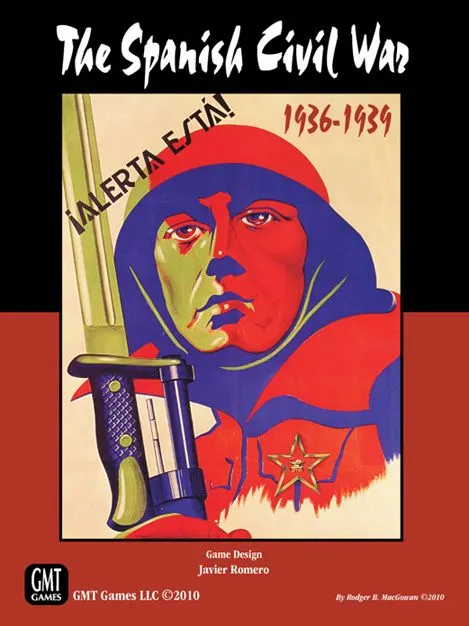
The Spanish Civil War 1936-1939 est un jeu de société sorti en 2010 pour 1 à 2 joueurs et avec des parties de 360 minutes. Il a été conçu par Javier Romero et ses principales mécaniques sont Dice Rolling, Hexagon Grid et Simulation.






En anglais
The game scales are Column-Brigade-Division, with monthly turns. There are Corps HQs for the Nationalists and Army HQs for the Republic. There are one 22" x 17"map, and two ½" counter sheets including Nationalist, Republicans, Italian, French, German, Portuguese and British units. The sequence of play is quite classic: Mutual Administrative Phase (Events, replacements, reinforcements, withdrawals), Nationalist Movement-Combat, Republican Movement-Combat, Victory/Attrition Phase. Supply is checked for both sides at the end of each turn. The main trouble designing this game was how to simulate the first months of the war and the transition to a more conventional conflict during and after the battles for Madrid (October 1936-March 1937). The main unit during the firsts stages of the war was the "column" formed by a mix of police, army, paramilitary forces, volunteers, etc. The "column" tactics was used during the Moroccan wars, and consisted in separating a force in small independent groups, highly mobile but with few possibilities of supporting each other. These tactics were mostly used by the Nationalists, but also by the Republicans. For the Nationalists, it worked against the militias of the early months of the war but failed against a better organized, armed and commanded army during the battles for Madrid. To simulate this, most early Republican units have two steps: the first would be the "column" or "militia" side, the second the "Ejército Popular" (People’s Army) side. After passing a "Conversion" or "Militarization" phase, the Republican columns are flipped to their EP side. The "Militarization" , that began during the Fall of 1936, was the conversion of the politically enthusiastic but poorly led and trained militia in more orthodox military units. The Nationalist columns are divided between "Army of Africa" columns and the rest. Their colonial units are two-steppers and are withdrawn and substituted by brigades and divisions during 1937. The O.B. of the first months of the war is also a problem. Between July and November 1936 both sides formed dozens of small military and paramilitary units, called "battalions", "columns", "regiments", etc., etc. It is rare to find two authors that have the same OB, and the few that offer an Order of Battle are rather imprecise. Sometimes the same column receives different names. One author names it after their commander, other after their area of operations, and so on... so I had to compare and check which column was cited in most of the sources.
Selon le catalogue, The Spanish Civil War 1936-1939 se joue de 1 à 2 personnes. Cette fourchette correspond au nombre de joueurs indiqué par l’éditeur : le jeu s’installe donc pour toute taille de groupe dans cette limite. La mise en place, certaines règles et le décompte peuvent varier selon l’effectif ; vérifiez la configuration exacte dans la règle de votre édition.
La durée indiquée pour The Spanish Civil War 1936-1939 est de 360 minutes, selon l’estimation de l’éditeur pour une partie complète. La durée réelle dépend du groupe, de l’effectif et de la connaissance des règles : les premières parties sont plus longues, les groupes expérimentés terminent plus vite. Mise en place et explication des règles ne sont pas comprises.
The Spanish Civil War 1936-1939 obtient une note de complexité de 3,1 sur 5 auprès des joueurs de BoardGameGeek, ce qui en fait un jeu de complexité moyenne. Cette note reflète la quantité de règles, de planification et de décisions qu’exige une partie typique. Prévoyez une explication plus longue pour les jeux exigeants et utilisez un guide de préparation avant la soirée.
The Spanish Civil War 1936-1939 appartient à ces catégories : Wargame et Civil War. Ses principales mécaniques sont Dice Rolling, Hexagon Grid et Simulation. Les catégories décrivent le thème et l’univers d’un jeu, tandis que les mécaniques décrivent ce que les joueurs font réellement pendant leur tour. Chaque mécanique mène à une page du catalogue avec des jeux similaires.
Les auteurs crédités pour The Spanish Civil War 1936-1939 sont : Javier Romero. Ces crédits proviennent des données publiées du jeu et désignent les personnes responsables de sa conception, et non les illustrateurs ou les éditeurs. Les pages d’auteurs sur MeepleRules regroupent les autres titres des mêmes auteurs, ce qui est utile lorsqu’un jeu vous plaît et que vous en cherchez de similaires.
Le catalogue présente The Spanish Civil War 1936-1939 comme un jeu de base. Il se joue seul avec le matériel contenu dans la boîte et ne nécessite aucun autre titre. Les extensions, s’il en existe, y ajoutent du contenu ou des règles et sont répertoriées séparément dans le catalogue, avec un lien vers ce jeu de base.