
- Rang BGG
- BGG #13 995
- Note BGG
- 8,3
Burnside Takes Command
- 2 joueurs
- 120 min
- Complexité 3,2/5
- 2003
2012
Aide aux règles de The Wolfenbüttel War
Des explications claires des tours, effets de cartes et situations litigieuses, avec un historique des questions sauvegardé.
Que voulez-vous savoir ?
Les réponses viennent du livret officiel, avec la page à vérifier.
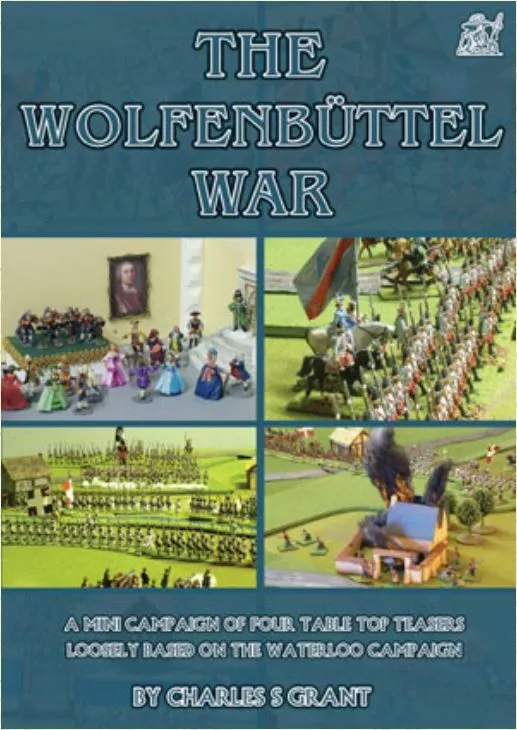
The Wolfenbüttel War est une extension de jeu de société sortie en 2012 pour 2 joueurs et à partir de 12 ans. Il a été conçu par Charles S. Grant (II) et ses principales mécaniques sont Simulation et Scenario / Mission / Campaign Game.




En anglais
The Wolfenbüttel War concerns the hostilities of Charles’ two fictitious mid-eighteenth century combatants, the Grand Duchy of Lorraine and the Vereinigte Freie Städte (VFS). The scenarios are applicable to any horse and musket period with little modification. Where this mini-campaign differs from its predecessors (Raid on St.Michel, The Annexation of Chiraz) is that it is loosely based on a real campaign – that of the Hundred Days, culminating at Waterloo. The four scenarios and the movements between them are drawn from the battles of Quatre Bras, Ligny, Wavre and Waterloo. However, while the campaign sequence is followed the outcome is far from certain. The book provides the fictitious background to the war, planning details including the selection of forces, the instructions for each army, table top maps and orders for each side. There are instructions for the game organiser and options for forces in each battle if fought as a stand alone wargame. The book is illustrated with photographs of each battle as it was fought with Charles’ armies. Newspapers and a Who’s Who, not to mention the Ballroom scene, add colour to the story of the Wolfenbüttel War. —description from the publisher's website
Selon le catalogue, The Wolfenbüttel War se joue à 2 personnes. C’est le nombre de joueurs indiqué par l’éditeur : le jeu est donc conçu pour exactement ce nombre de participants. Les variantes pour d’autres tailles de groupe, s’il en existe, sont décrites dans la règle de votre édition ; consultez-la avant d’installer une autre configuration.
Le catalogue indique The Wolfenbüttel War à partir de 12 ans. C’est la recommandation de l’éditeur ; elle tient compte de la lecture nécessaire, de la complexité des règles et des petits composants, pas seulement du thème. Les plus jeunes peuvent souvent participer avec l’aide d’un adulte : vérifiez l’âge indiqué sur votre édition et tenez compte de l’expérience de votre groupe.
The Wolfenbüttel War appartient à ces catégories : Wargame et Expansion for Base-game. Ses principales mécaniques sont Simulation et Scenario / Mission / Campaign Game. Les catégories décrivent le thème et l’univers d’un jeu, tandis que les mécaniques décrivent ce que les joueurs font réellement pendant leur tour. Chaque mécanique mène à une page du catalogue avec des jeux similaires.
Les auteurs crédités pour The Wolfenbüttel War sont : Charles S. Grant (II). Ces crédits proviennent des données publiées du jeu et désignent les personnes responsables de sa conception, et non les illustrateurs ou les éditeurs. Les pages d’auteurs sur MeepleRules regroupent les autres titres des mêmes auteurs, ce qui est utile lorsqu’un jeu vous plaît et que vous en cherchez de similaires.
Le catalogue présente The Wolfenbüttel War comme une extension. Les extensions ajoutent du contenu, des règles ou des scénarios à un jeu de base existant et ne se jouent généralement pas seules. Vérifiez sur la boîte ou dans la description de l’éditeur quel jeu de base est requis, et assurez-vous que votre édition de ce jeu est compatible avec cette extension.
