
- Pozycja w BGG
- BGG #22 276
- Ocena BGG
- 6,2
Duel in the Desert: Rommel's Campaign in North Africa
- 2 graczy
- 90 min
- Złożoność 2,5/5
- 1986
1983
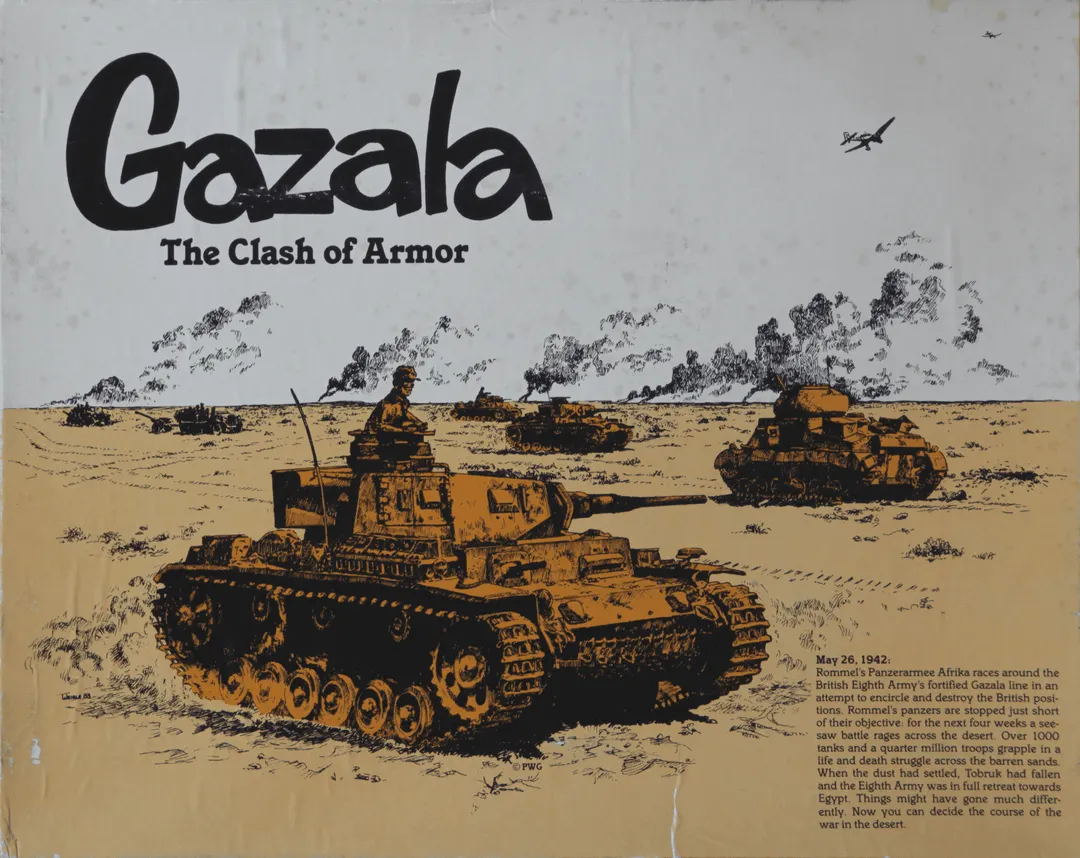
Pomoc w zasadach gry Gazala: The Clash of Armor
Zrozumiałe wyjaśnienia tur, efektów kart i spornych sytuacji z odnośnikami do oficjalnych źródeł i zapisaną historią pytań.
Dla 2 graczy
Co chcesz wiedzieć?
Odpowiedzi pochodzą z oficjalnej instrukcji, ze stroną do sprawdzenia.
Gazala: The Clash of Armor to gra planszowa wydana w 1983 roku dla 2 graczy, z rozgrywką trwającą 180 minut i dla osób od 12 lat. Projekt gry: David Bolt. Główne mechaniki: Dice Rolling, Variable Set-up i Grid Movement.
Po angielsku
The History Late May 1942 saw the massing of unprecedented strength on both sides of the desert war. For several months the front had lain static and quiet while the opposing armies absorbed hundreds of new tanks and guns. The front erupted in a massive armored battle on May 27, which continued for four long weeks. In battle after battle Rommel, the desert fox, seemed to be surrounded and defeated, only to slip away and strike again. The British superiority in armor was hurled repeatedly against the deadly German 88 mm flak guns, leaving the desert covered with tank wrecks. Bravery was common among all the nationalities present: German, British, Free French, Italian, Indian, and South African troops all fought fiercely among the desert sands for the citadel of Tobruk. The Game The game GAZALA 1942 has daily turns that are composed of morning, afternoon, and evening phases. Each phase has a movement, combat, and exploitation segment. Players alternate moving formations (regiments, divisions, and corps) in a uniquely integrated movement system. The player with the initiative attempts to move one formation of his choice, and if successful in activating the formation, he may move all the units that belong to it. The opposing player than has the opportunity to move one of his formations in response, if he can activate it. This system captures the feeling of desert warfare in which neither side knew for certain who was going to move what where. Combined with the unlimited possibilities of movement is a hidden unit rule that has units on the map inverted, only a dust-cloud is shown to the opponent. Players must conduct reconnaissance in order to determine if a single inverted unit on the map represents an infantry battalion, or an entire panzer regiment. Units are composed of strength points: each strength point represents 100 infantry, or 3 tanks, or 3–6 guns. Movement points, which are expended at different rates by moving units that have different mobility abilities, are also spent to prepare for combat, perform reconnaissance, and cross minefields. Both players participate in the same combat phase with everything from anti-tank fire (differentiated for range), direct fire and assaults (which occur between opposing units that occupy the same hex), barrages, and airstrikes (plotted in advance, and liable to come down on your troops if you aren’t careful). The rules cover the full range of features that were characteristic of desert warfare. There are five scenarios including an introductory scenario, and a campaign game. With full examples of play, extensive players’ notes, and an Order of Battle compiled by Gary Helmer, Frank Prieskop, and David Bolt, GAZALA 1942 offers players a detailed and comprehensive insight into one of the most mobile and fluid periods of warfare ever known. 5 scenarios (campaign game 27 May - 2 June) Scale 1,5 miles per hex 1 battalion per counter 1 day per turn Components 32 pages rulebook 1 map (86 x 55.7 cm) 600 counters 6 standard size pages of charts (from the back box and BGG user)
Według katalogu Gazala: The Clash of Armor obsługuje 2 graczy. To liczba graczy podana przez wydawcę, więc gra jest zaprojektowana dokładnie dla takiej liczby uczestników. Warianty dla grup innej wielkości, jeśli w ogóle istnieją, opisano w instrukcji twojego wydania; sprawdź ją uważnie, zanim przygotujesz inną konfigurację stołu.
Podany czas rozgrywki w Gazala: The Clash of Armor wynosi 180 minut. To szacunek wydawcy dla pełnej partii. Rzeczywisty czas zależy od grupy, liczby graczy i znajomości zasad: pierwsze partie zwykle trwają dłużej, a doświadczone grupy kończą szybciej. Przygotowanie gry i tłumaczenie zasad nie są wliczone w ten szacunek.
Katalog podaje dla Gazala: The Clash of Armor wiek od 12 lat. To zalecenie wydawcy, które uwzględnia wymagania dotyczące czytania, złożoność zasad i drobne elementy, a nie tylko tematykę. Młodsi gracze często mogą dołączyć z pomocą dorosłego; sprawdź zalecenie wiekowe swojego wydania i weź pod uwagę doświadczenie grupy z grami planszowymi.
Gazala: The Clash of Armor ma ocenę złożoności 4,2 na 5 według graczy BoardGameGeek, co czyni ją grą ciężką. Ocena pokazuje, ile znajomości zasad, planowania i podejmowania decyzji wymaga typowa rozgrywka. Cięższe gry wymagają dłuższego pierwszego tłumaczenia, dlatego przed wieczorem z grami warto skorzystać z przewodnika przygotowania.
Gazala: The Clash of Armor należy do tych kategorii: Wargame i World War II. Główne mechaniki to Dice Rolling, Variable Set-up i Grid Movement. Kategorie opisują temat i świat gry, a mechaniki to, co gracze faktycznie robią w swojej turze. Każda mechanika prowadzi do strony katalogu z podobnymi grami, co pomaga znaleźć coś porównywalnego na kolejny wieczór.
Autorzy wymienieni przy Gazala: The Clash of Armor to: David Bolt. Te informacje pochodzą z opublikowanych danych gry i wskazują osoby odpowiedzialne za jej projekt, a nie ilustratorów czy wydawców. Strony autorów w MeepleRules zbierają inne tytuły tych samych twórców, co pomaga, gdy gra ci się podoba i szukasz podobnych.
W katalogu Gazala: The Clash of Armor figuruje jako gra podstawowa. Można w nią grać samodzielnie, korzystając z elementów z pudełka, bez żadnego innego tytułu. Dodatki, jeśli istnieją, dokładają nową zawartość lub zasady i są wymienione w katalogu osobno, z odnośnikiem do tej gry podstawowej.