
- Ocena BGG
- 7,4
Mamluk
- 2 graczy
- 240 min
- Złożoność 3,6/5
- 2006
2004
Pomoc w zasadach gry The Devil's Horsemen: The Mongol War Machine
Zrozumiałe wyjaśnienia tur, efektów kart i spornych sytuacji z odnośnikami do oficjalnych źródeł i zapisaną historią pytań.
Dla 2 graczy
Co chcesz wiedzieć?
Odpowiedzi pochodzą z oficjalnej instrukcji, ze stroną do sprawdzenia.
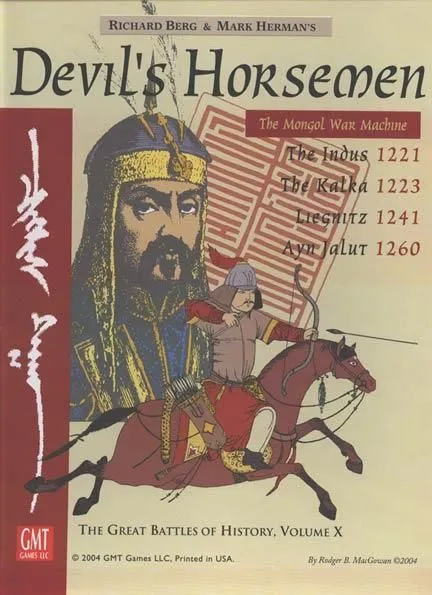
The Devil's Horsemen: The Mongol War Machine to gra planszowa wydana w 2004 roku dla 2 graczy, z rozgrywką trwającą 240 minut i dla osób od 12 lat. Projekt gry: Richard H. Berg i Mark Herman. Główne mechaniki: Hexagon Grid i Simulation.












Po angielsku
"The Mongol War Machine in the 13th Century" - Volume X in the Great Battles of History Series (GBoH). (from GMT Games website:) The Great Battles of History series is back with Devil's Horsemen, an examination of the military tactics of steppe tribe warfare, as immortalized by the mighty armies of Genghis Khan and the Mongols. The game focuses on cavalry and archery action, featuring mounted archers of exceptional skill. Devil's Horsemen depicts the four major battles of the era - The Indus, The Kalka, Liegnitz and Ayn Jalut. Devil's Horsemen features basic rules for both regular and SimpleGBoH play. The rules bring the system into full flower of mounted archery, with a detailed, augmented set of archery and cavalry mechanics that include various types of Shower Fire (as opposed to plain Volley Fire), Impetuosity and Aggression, Feigned Retreat, Harass and Disperse tactics, and Rally to Standards, with the various armies and units being rated for their ability to use these. Devil's Horsemen presens a truly colorful array of armies for you to lead into battle: there are 10 full tumen (divisions) of Mongols, plus Polovtsians, Galicians, Chernigovians, Kievans, Persian Khwarazmians, Poles, Silesians, Bohemians, the great Teutonic Knights, and the first army to ever significantly defeat the Mongols, The Mamluks. These mighty armies show up in four great battles of the period (ranging from battles needing 1/2 mapsheet to two full-mapsheets). The Indus (Genghis Khan vs. Shah Jalal ad-Din and the Khwarazmian Persians, 1221). One mapsheet in size, this is the battle that gave The Mongols control over all of Central Asia. The Kalka (Prince Subudei vs. the combined Armies of Rus, 1223). Two mapsheets in size, this battle includes two massive (and very nattily dressed) armies, with the Rus suffering under fractured command, and the Mongols giving us a foretaste of the famous Zulu horns of the buffalo tactics. Liegnitz (Prices Baidan and Kaidan vs. Henry the Pious and an army of Eastern Europeans, 1241). A 1/2 mapsheet battle which introduced Europe to the Mongols, and from which we get the famous Christian prayer of the era, From the Fury of the Tartars, oh Lord, Deliver Us. But you do get to use the best European heavy cavalry of the day, the Teutonic knights, under fearsome commander, Poppo. Ayn Jalut (Prince Ketbugha vs. The Mamluks, 1260). A 1/2 mapsheet battle that saw the first real defeat of a Mongol Army, this time by the new Middle East Muslim power, the Mamluks. Granted, this was a second-rate, rear-guard group of Mongols, but the Mamluks showed they were a new force to reckon with. COMPONENTS 979 full-color counters Two full-color double-sided 22x34" mapsheets Rules Book Scenario Book One Player Aid Card One 10-sided die DESIGNERS: Mark Herman and Richard Berg ART DIRECTOR/PACKAGE DESIGN: Rodger B. MacGowan MAP ART: Mark Simonitch COUNTER ART: Mark Simonitch, Rodger B. MacGowan, Mike Lemick
Według katalogu The Devil's Horsemen: The Mongol War Machine obsługuje 2 graczy. To liczba graczy podana przez wydawcę, więc gra jest zaprojektowana dokładnie dla takiej liczby uczestników. Warianty dla grup innej wielkości, jeśli w ogóle istnieją, opisano w instrukcji twojego wydania; sprawdź ją uważnie, zanim przygotujesz inną konfigurację stołu.
Podany czas rozgrywki w The Devil's Horsemen: The Mongol War Machine wynosi 240 minut. To szacunek wydawcy dla pełnej partii. Rzeczywisty czas zależy od grupy, liczby graczy i znajomości zasad: pierwsze partie zwykle trwają dłużej, a doświadczone grupy kończą szybciej. Przygotowanie gry i tłumaczenie zasad nie są wliczone w ten szacunek.
Katalog podaje dla The Devil's Horsemen: The Mongol War Machine wiek od 12 lat. To zalecenie wydawcy, które uwzględnia wymagania dotyczące czytania, złożoność zasad i drobne elementy, a nie tylko tematykę. Młodsi gracze często mogą dołączyć z pomocą dorosłego; sprawdź zalecenie wiekowe swojego wydania i weź pod uwagę doświadczenie grupy z grami planszowymi.
The Devil's Horsemen: The Mongol War Machine ma ocenę złożoności 3,4 na 5 według graczy BoardGameGeek, co czyni ją grą średnio złożoną. Ocena pokazuje, ile znajomości zasad, planowania i podejmowania decyzji wymaga typowa rozgrywka. Cięższe gry wymagają dłuższego pierwszego tłumaczenia, dlatego przed wieczorem z grami warto skorzystać z przewodnika przygotowania.
The Devil's Horsemen: The Mongol War Machine należy do tych kategorii: Wargame i Medieval. Główne mechaniki to Hexagon Grid i Simulation. Kategorie opisują temat i świat gry, a mechaniki to, co gracze faktycznie robią w swojej turze. Każda mechanika prowadzi do strony katalogu z podobnymi grami, co pomaga znaleźć coś porównywalnego na kolejny wieczór.
Autorzy wymienieni przy The Devil's Horsemen: The Mongol War Machine to: Richard H. Berg i Mark Herman. Te informacje pochodzą z opublikowanych danych gry i wskazują osoby odpowiedzialne za jej projekt, a nie ilustratorów czy wydawców. Strony autorów w MeepleRules zbierają inne tytuły tych samych twórców, co pomaga, gdy gra ci się podoba i szukasz podobnych.
W katalogu The Devil's Horsemen: The Mongol War Machine figuruje jako gra podstawowa. Można w nią grać samodzielnie, korzystając z elementów z pudełka, bez żadnego innego tytułu. Dodatki, jeśli istnieją, dokładają nową zawartość lub zasady i są wymienione w katalogu osobno, z odnośnikiem do tej gry podstawowej.