
- Pozycja w BGG
- BGG #5504
- Ocena BGG
- 7,9
Conquest & Consequence
- 2–3 graczy
- 240–360 min
- Złożoność 3,9/5
- 2021
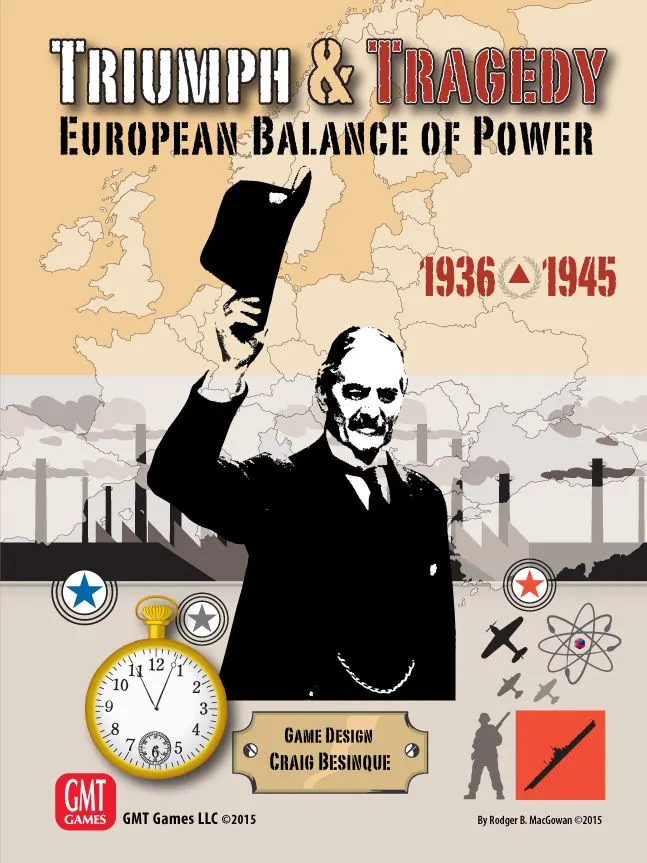
2015
Pomoc w zasadach gry Triumph & Tragedy: European Balance of Power 1936-1945
Zrozumiałe wyjaśnienia tur, efektów kart i spornych sytuacji z odnośnikami do oficjalnych źródeł i zapisaną historią pytań.
Dla 2 graczy
Co chcesz wiedzieć?
Odpowiedzi pochodzą z oficjalnej instrukcji, ze stroną do sprawdzenia.
Triumph & Tragedy: European Balance of Power 1936-1945 to gra planszowa wydana w 2015 roku dla 2–3 graczy, z rozgrywką trwającą 240–360 minut i dla osób od 12 lat. Projekt gry: Craig Besinque. Główne mechaniki: Hand Management, Area Movement i Dice Rolling.



Po angielsku
Triumph & Tragedy is a geopolitical strategy game for 3 players (also playable by 2) covering the competition for European supremacy during the period 1936-45 between Capitalism (the West), Communism (the Soviet Union) and Fascism (the Axis). It has diplomatic, economic, technological and military components, and can be won by gaining economic hegemony or technological supremacy (A-bomb), or by vanquishing a rival militarily. The 22 x 34 area map covers Eurasia to India and the Urals, plus the Americas. Military units are 5/8" blocks, of 7 types (Infantry/Tank/Fortress/AirForce/Carrier/Fleet/Submarine), in 7 different colors (Germany/Italy/Russia/Britain/France/USA/Neutral). The mix of over 200 blocks allows great flexibility of force composition. There is a 55-card Action deck and a 55-card Investment deck, plus 30 Peace Dividend chits and 110 markers of various types. The game starts in 1936, with all 3 Great Powers virtually disarmed: Germany has repudiated the Versailles Peace Treaty, initiating an arms race in Europe. With blocks, the nature of military buildups remain unknown to rivals unless/until military conflict breaks out. The game may end peacefully or there may be war. There are game sanctions for attacking neutral minors or declaring war on an opponent, and rewards for remaining peaceful (you get a Peace Dividend chit of value 0-2 for every year you remain at Peace). You can win peacefully by: • Economic Hegemony (total of Production + secret Peace Dividend values + Atomic Research is the greatest in 1945, or reaches 25 at any time) OR • Technological Supremacy (build the A-bomb which takes 4 stages and be able to deliver it to a Main Capital). If there is war, you can still win by either of the above methods (with extra Economic Hegemony victory points available), or by: • Military Victory (capture TWO enemy capitals out of nine: each player controls three). Economic production underlies all forms of power in the game. Production is the LEAST of controlled Population (cities), controlled Resources, and Industry (which starts low and can be built up with Investment cards), except that Resources can be ignored if at Peace. Powers can spend their current economic Production on either: • Military units (new 1-step units or additional steps on existing units), OR • Action cards, which have Diplomatic values (to gain Population and Resources without conflict) and a Command value (to move military units), OR • Investment cards, which have Technological values (to enhance unit abilities) and a Factory value (the only way to increase Industry levels). Building a unit step or buying a card costs 1 Production. Simple. You can’t inspect cards bought until after you have spent all Production. Initially, the Axis economy is Population/Resource limited, but ahead in [war] Industry, while the West and Russia are Industry-limited, with adequate empires of Population and Resources. Throttling/limiting rival economies by denial of Population/Resources is a key form of competition. In peacetime, this is primarily done via Diplomacy, committing Action cards to gain control of minor nations and their Population/Resources, or to deny or reduce Rival control of them. At war, this can be done more directly by military conquest on land, by Naval/Submarine blockade of trade routes at sea, and by Strategic Bombing of enemy Industry by air forces. The early phase of the game tends to revolve around: • Diplomatic infighting (using Action cards), to gain minor nations (Czech, Rumania, etc) for their Population and Resources, and • Industrial buildup (via Investment cards), with • Military buildups (with the nature of forces being built being unknown to opponents), • Technology advancement (also via Investment cards), and some • Military operations (using Action cards for Command), which can include Violating (attacking) neutral minors to gain Population/Resources when Diplomacy fails. If the game continues peacefully due to imposing defenses or player inclination, pressure builds as players approach a Production of 20, as secret Peace Dividend chits may take someone over the 25 Victory threshold. Or players may succeed in developing the Atomic Bomb and steal a victory that way. At some point, however, one Power (seeing opportunity or necessity) may Declare War on another. The victim gets immediate economic benefits in reaction, but military reality comes to the forefront from this point onward. The third party may well continue its economic development in peace. Or not. Unit movement is by Command card, which specifies a Command Priority letter that determines order of movement/combat and a Command Value number that determines the maximum number of units that can be moved. Command cards are only valid during one specified Season (Spring/Summer/Fall), so a variety of Command cards in one’s hand is necessary for a Power to be able to move in every Season. But HandSizes are limited, so each player must balance competing demands for card resources with military security. Combat occurs when rival units occupy the same area, and is executed by units firing in order by Type (defenders firing first amongst equal types), rolling dice for hits. Units have different Firepowers (hit values) depending on the Class of unit they are targeting (ground, naval, air, sub). Land combat is one round per Season while sea battles are fought to a conclusion. Ground units without a Supply line lose 1 step per Season and cannot build (except Fortress units which are immune to both effects but cannot move). Triumph & Tragedy is a true three-sided game: there is no requirement that the West and Russia be on the same side (and in fact there are valid reasons to attack each other), and only ONE player can win the game. Table talk is allowed (and encouraged) but agreements are not enforceable. Alliances are shifting and co-operation is undependable. The game can continue as an economic battle of attrition or a sudden military explosion can change everything. There is immense replayability as players can pursue dominance in Europe via land, sea or air military superiority, technological supremacy, or economic hegemony without rivals realizing their strategy until it is TOO LATE! It is a highly interactive, tense, fast-moving game with little downtime between player turns, covering THE crucial geopolitical decade of the 20th century in 4-6 hours.
Według katalogu Triumph & Tragedy: European Balance of Power 1936-1945 obsługuje od 2 do 3 graczy. Ten zakres odpowiada liczbie graczy podanej przez wydawcę, więc grę można przygotować dla dowolnej grupy w jego granicach. Przygotowanie, niektóre zasady i punktacja mogą jednak różnić się w zależności od liczby graczy; dokładną konfigurację sprawdź w instrukcji swojego wydania.
Podany czas rozgrywki w Triumph & Tragedy: European Balance of Power 1936-1945 wynosi 240–360 minut. To szacunek wydawcy dla pełnej partii. Rzeczywisty czas zależy od grupy, liczby graczy i znajomości zasad: pierwsze partie zwykle trwają dłużej, a doświadczone grupy kończą szybciej. Przygotowanie gry i tłumaczenie zasad nie są wliczone w ten szacunek.
Katalog podaje dla Triumph & Tragedy: European Balance of Power 1936-1945 wiek od 12 lat. To zalecenie wydawcy, które uwzględnia wymagania dotyczące czytania, złożoność zasad i drobne elementy, a nie tylko tematykę. Młodsi gracze często mogą dołączyć z pomocą dorosłego; sprawdź zalecenie wiekowe swojego wydania i weź pod uwagę doświadczenie grupy z grami planszowymi.
Triumph & Tragedy: European Balance of Power 1936-1945 ma ocenę złożoności 3,4 na 5 według graczy BoardGameGeek, co czyni ją grą średnio złożoną. Ocena pokazuje, ile znajomości zasad, planowania i podejmowania decyzji wymaga typowa rozgrywka. Cięższe gry wymagają dłuższego pierwszego tłumaczenia, dlatego przed wieczorem z grami warto skorzystać z przewodnika przygotowania.
Triumph & Tragedy: European Balance of Power 1936-1945 należy do tych kategorii: Economic, Wargame i Territory Building. Główne mechaniki to Hand Management, Area Movement i Dice Rolling. Kategorie opisują temat i świat gry, a mechaniki to, co gracze faktycznie robią w swojej turze. Każda mechanika prowadzi do strony katalogu z podobnymi grami, co pomaga znaleźć coś porównywalnego na kolejny wieczór.
Autorzy wymienieni przy Triumph & Tragedy: European Balance of Power 1936-1945 to: Craig Besinque. Te informacje pochodzą z opublikowanych danych gry i wskazują osoby odpowiedzialne za jej projekt, a nie ilustratorów czy wydawców. Strony autorów w MeepleRules zbierają inne tytuły tych samych twórców, co pomaga, gdy gra ci się podoba i szukasz podobnych.
W katalogu Triumph & Tragedy: European Balance of Power 1936-1945 figuruje jako gra podstawowa. Można w nią grać samodzielnie, korzystając z elementów z pudełka, bez żadnego innego tytułu. Dodatki, jeśli istnieją, dokładają nową zawartość lub zasady i są wymienione w katalogu osobno, z odnośnikiem do tej gry podstawowej.