

- BGG-Rang
- BGG #9.028
- BGG-Bewertung
- 7,2
Great War at Sea: Jutland
- 2 Spieler
- 30–120 Min.
- Komplexität 3,1/5
- 2006
Regelhilfe für Great War at Sea: Central Powers
Verständliche Erklärungen zu Spielzügen, Karteneffekten und strittigen Situationen mit Verweisen auf offizielle Quellen und gespeichertem Fragenverlauf.
Was möchtest du wissen?
Antworten stammen aus dem offiziellen Regelheft, mit Seitenangabe zum Nachprüfen.
Great War at Sea: Central Powers ist eine Erweiterung für Great War at Sea: Dreadnoughts aus dem Jahr 2015 für 1–2 Personen, mit 30–180 Minuten pro Partie und ab 12 Jahren. Entwickelt wurde es von Michael Bennighof; die wichtigsten Mechaniken sind Dice Rolling, Secret Unit Deployment und Hexagon Grid.








Auf Englisch
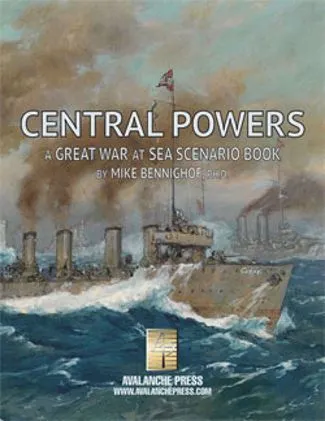
From the publisher's website: In Great War at Sea: Triple Alliance, we explored the notion of Italy remaining true to her alliance partners, Germany and Austria-Hungary, during the outbreak of the First World War in 1914. Staff officers from all three fleets prepared detailed operational plans, yet when war came in August 1914 Italy refused to join her Alliance partners and those plans would never be used. The joint staffs foresaw an aggressive Triple Alliance, one attemtping to seize control of the Mediterranean from the British and French. Our book Triple Alliance looked at the first year of such a naval war in a set of 43 new scenarios for our Great War at Sea: Mediterranean boxed game. Central Powers picks up that story in September 1915, with Italy, Austria-Hungary and Germany still struggling against Britain and France as new warships join the fleets of both sides. The fleets are almost evenly matched, with a slight Allied superiority in numbers matched by the Central Powers' central position. In this war, the fighting on the Mediterranean Sea has been just as bloody and destructive as that on the land fronts. Central Powers is a book supplement for the Great War at Sea series based on this naval war that never happened, but was probably more likely to have occurred than the actual events. It is not a complete game; ownership of our Mediterranean and Jutland boxed games and Triple Alliance, Dreadnoughts and Zeppelins supplements is required to enjoy all of the scenarios. The book includes 90 new playing pieces. The French receive their powerful Normandie- and Lyons-class super-dreadnoughts, and a pair of battle cruisers as well. And there's a quartet of French light cruisers proposed before the war but never built, that would have been very useful in fleet actions. With the Royal Navy unwilling to detach too much strength from the Grand Fleet facing the Germans across the North Sea, it falls on the other Allies to bolster this very active naval front. The Americans enter the Mediterranean naval war with their oldest dreadnoughts and newest pre-dreadnoughts, plus a large squadron of the armored cruisers. The Japanese are present as well with a squadron of battleships and one of cruisers. Plus there are four re-armed Austrian light cruisers (there have to be Austrians) and an Italian seaplane carrier (with seaplanes). The forty-two (42) scenarios continue the Triple Alliance story line through to the end of the Great War; since the book shares the special rules of Triple Alliance, we have more room for the story! It's a unique project, telling the alternative history of the entire Triple Alliance Mediterranean naval war in a series of game scenarios.
Laut Katalog unterstützt Great War at Sea: Central Powers 1–2 Personen. Diese Spanne entspricht der vom Verlag angegebenen Spielerzahl, das Spiel lässt sich also für jede Gruppengröße innerhalb dieser Spanne aufbauen. Aufbau, einzelne Regeln und Wertungsdetails können je nach Personenzahl trotzdem abweichen; prüfe daher die genaue Konfiguration in der Anleitung deiner Ausgabe.
Die angegebene Spieldauer für Great War at Sea: Central Powers beträgt 30–180 Minuten. Das ist die Schätzung des Verlags für eine vollständige Partie. Die tatsächliche Dauer hängt von der Gruppe, der Personenzahl und der Regelkenntnis ab: Erste Partien dauern meist länger, erfahrene Gruppen sind oft schneller fertig. Aufbau und Regelerklärung sind in dieser Schätzung nicht enthalten.
Im Katalog wird Great War at Sea: Central Powers ab 12 Jahren empfohlen. Das ist die Empfehlung des Verlags und berücksichtigt Leseanforderungen, Regelkomplexität und Kleinteile, nicht nur das Thema. Jüngere Kinder können oft mit Hilfe eines Erwachsenen mitspielen; beachte die Altersangabe deiner Ausgabe und die Brettspielerfahrung deiner Gruppe.
Great War at Sea: Central Powers hat bei BoardGameGeek eine Komplexitätswertung von 3,0 von 5 und gilt damit als mittelschweres Spiel. Die Wertung zeigt, wie viel Regelwissen, Planung und Entscheidungen eine typische Partie verlangt. Schwerere Spiele brauchen bei der ersten Erklärung mehr Zeit, daher hilft vor dem Spieleabend eine Vorbereitungsanleitung.
Great War at Sea: Central Powers gehört zu diesen Kategorien: Wargame, Nautical und Expansion for Base-game. Die wichtigsten Mechaniken sind Dice Rolling, Secret Unit Deployment und Hexagon Grid. Kategorien beschreiben Thema und Setting eines Spiels, Mechaniken dagegen, was die Spielenden in ihrem Zug tatsächlich tun. Jede Mechanik führt zu einer Katalogseite mit ähnlichen Spielen, falls du etwas Vergleichbares suchst.
Als Autoren von Great War at Sea: Central Powers sind angegeben: Michael Bennighof. Diese Angaben stammen aus den veröffentlichten Spieldaten und nennen die für das Spieldesign verantwortlichen Personen, nicht die Illustratoren oder Verlage. Die Autorenseiten auf MeepleRules sammeln weitere Titel derselben Autoren – praktisch, wenn dir ein Spiel gefällt und du ähnliche Spiele suchst.
Im Katalog ist Great War at Sea: Central Powers als Erweiterung zu Great War at Sea: Dreadnoughts aufgeführt. Erweiterungen ergänzen das Grundspiel um neues Material, neue Regeln oder Szenarien und sind meist nicht eigenständig spielbar; du brauchst also Great War at Sea: Dreadnoughts, um sie zu nutzen. Prüfe, ob deine Ausgabe von Great War at Sea: Dreadnoughts kompatibel ist, da manche Erweiterungen zwischen den Auflagen überarbeitet wurden.