
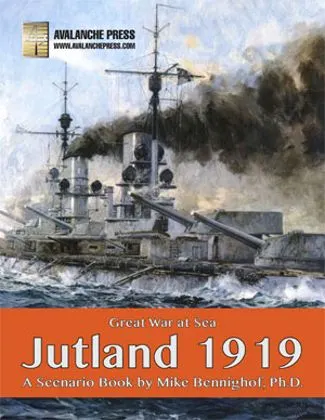
- BGG-Bewertung
- 8,4
Great War at Sea: Jutland 1919
- 2 Spieler
- 30–240 Min.
- Komplexität 3,0/5
- 2018
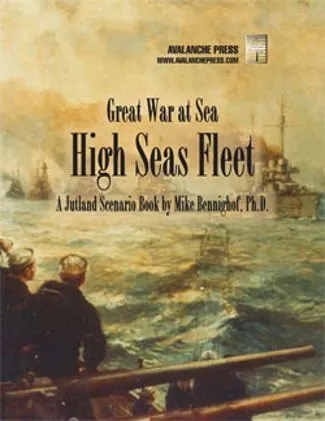
Regelhilfe für Great War at Sea: High Seas Fleet
Verständliche Erklärungen zu Spielzügen, Karteneffekten und strittigen Situationen mit Verweisen auf offizielle Quellen und gespeichertem Fragenverlauf.
Was möchtest du wissen?
Antworten stammen aus dem offiziellen Regelheft, mit Seitenangabe zum Nachprüfen.
Great War at Sea: High Seas Fleet ist eine Erweiterung für Great War at Sea: Jutland aus dem Jahr 2015 für 1–2 Personen, mit 30–240 Minuten pro Partie und ab 12 Jahren. Entwickelt wurde es von Michael Bennighof; die wichtigsten Mechaniken sind Dice Rolling, Secret Unit Deployment und Hexagon Grid.










Auf Englisch
Description from the publisher: During the brief period between 1906 and 1914, so the story goes, Britain and Germany engaged in a furious naval arms race sparked by the launch of the Royal Navy’s revolutionary battleship Dreadnought. This rivalry, egged on in Germany by Grand Admiral Alfred von Tirpitz, then helped ignite the First World War. As usual, reality is a little more complicated than popular history. Tirpitz’s enemy lay not across the North Sea but rather in the War Ministry offices just on the other side of the Brandenburger Tor. Army and Navy battled furiously for funding, inventing, respectively, the (possibly mythical) Schlieffen Plan and the Risk Theory (less mythical, but just as detached from reality) to justify ever-higher levels of spending. In the event, neither got what they wanted: the Navy did not build a new class of dreadnoughts every fiscal year, nor did the Army get to muster two dozen new divisions to “reinforce the right.” But what if Tirpitz had won his real battle? Germany had the financial and industrial resources to build a fleet to challenge the British. What might this fleet have looked like, and how would it have stood up to the Grand Fleet in battle? High Seas Fleet is a supplement for the Great War at Sea series that studies this question with background essays, over two dozen new scenarios, and 70 new scorchless, sootless laser-cut playing pieces. It is not playable by itself; you’ll need our Jutland game (and only our Jutland game) to play the scenarios. You can, of course, just read the essays and fondle the pieces without owning Jutland. We won’t tell. New pieces include German battleships designed but never built: the 1904 semi-dreadnought, the 1905 dreadnought, the 1912 dreadnought with 13.8-inch main guns, and the repeat Baden class super-dreadnoughts. There are additional cruisers and battleships to fill out the classes of the German program, and the full Blücher class of six armored cruisers. This is a powerful fleet that can stand toe-to-toe with the British Grand Fleet – the fleet the propagandists boasted of but Tirpitz feared to actually build. Now you can lead it into battle.
Laut Katalog unterstützt Great War at Sea: High Seas Fleet 1–2 Personen. Diese Spanne entspricht der vom Verlag angegebenen Spielerzahl, das Spiel lässt sich also für jede Gruppengröße innerhalb dieser Spanne aufbauen. Aufbau, einzelne Regeln und Wertungsdetails können je nach Personenzahl trotzdem abweichen; prüfe daher die genaue Konfiguration in der Anleitung deiner Ausgabe.
Die angegebene Spieldauer für Great War at Sea: High Seas Fleet beträgt 30–240 Minuten. Das ist die Schätzung des Verlags für eine vollständige Partie. Die tatsächliche Dauer hängt von der Gruppe, der Personenzahl und der Regelkenntnis ab: Erste Partien dauern meist länger, erfahrene Gruppen sind oft schneller fertig. Aufbau und Regelerklärung sind in dieser Schätzung nicht enthalten.
Im Katalog wird Great War at Sea: High Seas Fleet ab 12 Jahren empfohlen. Das ist die Empfehlung des Verlags und berücksichtigt Leseanforderungen, Regelkomplexität und Kleinteile, nicht nur das Thema. Jüngere Kinder können oft mit Hilfe eines Erwachsenen mitspielen; beachte die Altersangabe deiner Ausgabe und die Brettspielerfahrung deiner Gruppe.
Great War at Sea: High Seas Fleet hat bei BoardGameGeek eine Komplexitätswertung von 3,0 von 5 und gilt damit als mittelschweres Spiel. Die Wertung zeigt, wie viel Regelwissen, Planung und Entscheidungen eine typische Partie verlangt. Schwerere Spiele brauchen bei der ersten Erklärung mehr Zeit, daher hilft vor dem Spieleabend eine Vorbereitungsanleitung.
Great War at Sea: High Seas Fleet gehört zu diesen Kategorien: Wargame, Nautical und Expansion for Base-game. Die wichtigsten Mechaniken sind Dice Rolling, Secret Unit Deployment und Hexagon Grid. Kategorien beschreiben Thema und Setting eines Spiels, Mechaniken dagegen, was die Spielenden in ihrem Zug tatsächlich tun. Jede Mechanik führt zu einer Katalogseite mit ähnlichen Spielen, falls du etwas Vergleichbares suchst.
Als Autoren von Great War at Sea: High Seas Fleet sind angegeben: Michael Bennighof. Diese Angaben stammen aus den veröffentlichten Spieldaten und nennen die für das Spieldesign verantwortlichen Personen, nicht die Illustratoren oder Verlage. Die Autorenseiten auf MeepleRules sammeln weitere Titel derselben Autoren – praktisch, wenn dir ein Spiel gefällt und du ähnliche Spiele suchst.
Im Katalog ist Great War at Sea: High Seas Fleet als Erweiterung zu Great War at Sea: Jutland aufgeführt. Erweiterungen ergänzen das Grundspiel um neues Material, neue Regeln oder Szenarien und sind meist nicht eigenständig spielbar; du brauchst also Great War at Sea: Jutland, um sie zu nutzen. Prüfe, ob deine Ausgabe von Great War at Sea: Jutland kompatibel ist, da manche Erweiterungen zwischen den Auflagen überarbeitet wurden.