

- BGG-Rang
- BGG #3.216
- BGG-Bewertung
- 7,7
The Great Battles of Alexander: Deluxe Edition
- 1–4 Spieler
- 240 Min.
- Komplexität 3,6/5
- 1995
Regelhilfe für Salamis
Verständliche Erklärungen zu Spielzügen, Karteneffekten und strittigen Situationen mit Verweisen auf offizielle Quellen und gespeichertem Fragenverlauf.
Was möchtest du wissen?
Antworten stammen aus dem offiziellen Regelheft, mit Seitenangabe zum Nachprüfen.
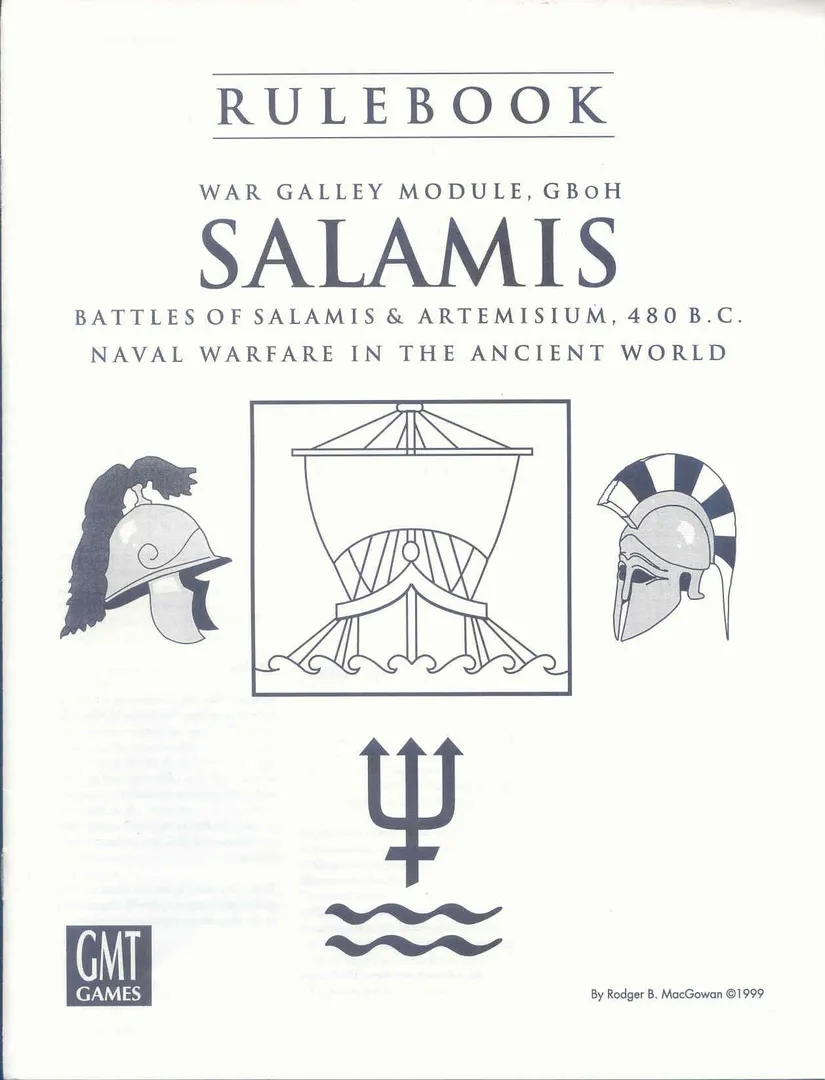
Salamis ist eine Erweiterung für War Galley: Naval Warfare in the Ancient World aus dem Jahr 1999 für 2 Personen, mit 360 Minuten pro Partie und ab 12 Jahren. Entwickelt wurde es von Richard H. Berg und Mark Herman; die wichtigsten Mechaniken sind Hexagon Grid.









Auf Englisch
Add-on module for War Galley: Naval Warfare in the Ancient World. Salamis, one of the most famous naval battles in history, was a direct result of the Persian need to keep their large, invading army supplied by controlling the sea lanes. With Xerxes' army temporarily delayed at Thermopylae, the Greek fleet, based at Artemisium, some 50 miles or so directly east of Thermopylae, took the opportunity to attempt to stop the Persians from extending this Line of Communications. In a battle that appears to have extended over two or three days, the Greeks managed to eke out a slim tactical win. However, when Thermopylae fell, Themistocles' position became untenable, and the Greek fleet retreated to anchorage in the narrow channel of the Bay of Eleusis, west of Athens, at Salamis. With her naval flanks secured, the Persians rolled into lower Greece, capturing Athens and razing the town. However, to complete his subjugation of Greece, Xerxes had to destroy their fleet. To that end, the Persians sailed to a position south of Salamis. At Artemisium the Greeks had learned that, while their crews and marines were superior, the huge disparity in numbers could be telling. Unless they could neutralize this Persian strength. To that end, Themistocles lured the huge Persian fleet to attack the Greeks in the Bay of Eleusis, whose entrances were so restrictive as to negate any numerical superiority. There were two entrances to the bay. To plug up the western escape hatch, Xerxes dispatched his crack Egyptian squadron. Upon hearing this, Adeimantus and his Corinthians peeled off from the main fleet and sailed to the western mouth to block any Egyptian attempt to gain entrance. This "action" appears to have been a stand off, with both sides "blockading" and not fighting. At the eastern entrance, the Greeks deployed in three lines, along a narrow front of about 1800 yards, thus negating Persian numerical superiority. The Persians entered the bay in three long lines astern, which they then turned into nine lines abreast. The result was a boarding battle, and this was where the Greeks shone. Despite having half the manpower per ship of the Persians, their weaponry, armor and land-based tactics were superior to that of the Persians. And that superiority resulted in a smashing Greek victory. Xerxes retired to Thessaly, to try again the next year. The result was a great Greek victory, on land, at Plataea, followed by the Greek victory that completely cut Persian Lines of Communication, at Mycale. (from GMT website)
Laut Katalog unterstützt Salamis 2 Personen. Das ist die vom Verlag angegebene Spielerzahl, das Spiel ist also genau für diese Anzahl von Mitspielenden ausgelegt. Varianten für andere Gruppengrößen sind, sofern vorhanden, in der Anleitung deiner Ausgabe beschrieben; prüfe sie, bevor du eine andere Konfiguration aufbaust.
Die angegebene Spieldauer für Salamis beträgt 360 Minuten. Das ist die Schätzung des Verlags für eine vollständige Partie. Die tatsächliche Dauer hängt von der Gruppe, der Personenzahl und der Regelkenntnis ab: Erste Partien dauern meist länger, erfahrene Gruppen sind oft schneller fertig. Aufbau und Regelerklärung sind in dieser Schätzung nicht enthalten.
Im Katalog wird Salamis ab 12 Jahren empfohlen. Das ist die Empfehlung des Verlags und berücksichtigt Leseanforderungen, Regelkomplexität und Kleinteile, nicht nur das Thema. Jüngere Kinder können oft mit Hilfe eines Erwachsenen mitspielen; beachte die Altersangabe deiner Ausgabe und die Brettspielerfahrung deiner Gruppe.
Salamis hat bei BoardGameGeek eine Komplexitätswertung von 3,1 von 5 und gilt damit als mittelschweres Spiel. Die Wertung zeigt, wie viel Regelwissen, Planung und Entscheidungen eine typische Partie verlangt. Schwerere Spiele brauchen bei der ersten Erklärung mehr Zeit, daher hilft vor dem Spieleabend eine Vorbereitungsanleitung.
Salamis gehört zu diesen Kategorien: Wargame, Nautical und Ancient. Die wichtigsten Mechaniken sind Hexagon Grid. Kategorien beschreiben Thema und Setting eines Spiels, Mechaniken dagegen, was die Spielenden in ihrem Zug tatsächlich tun. Jede Mechanik führt zu einer Katalogseite mit ähnlichen Spielen, falls du etwas Vergleichbares suchst.
Als Autoren von Salamis sind angegeben: Richard H. Berg und Mark Herman. Diese Angaben stammen aus den veröffentlichten Spieldaten und nennen die für das Spieldesign verantwortlichen Personen, nicht die Illustratoren oder Verlage. Die Autorenseiten auf MeepleRules sammeln weitere Titel derselben Autoren – praktisch, wenn dir ein Spiel gefällt und du ähnliche Spiele suchst.
Im Katalog ist Salamis als Erweiterung zu War Galley: Naval Warfare in the Ancient World aufgeführt. Erweiterungen ergänzen das Grundspiel um neues Material, neue Regeln oder Szenarien und sind meist nicht eigenständig spielbar; du brauchst also War Galley: Naval Warfare in the Ancient World, um sie zu nutzen. Prüfe, ob deine Ausgabe von War Galley: Naval Warfare in the Ancient World kompatibel ist, da manche Erweiterungen zwischen den Auflagen überarbeitet wurden.