
- BGG rank
- BGG #11,680
- BGG rating
- 7.8
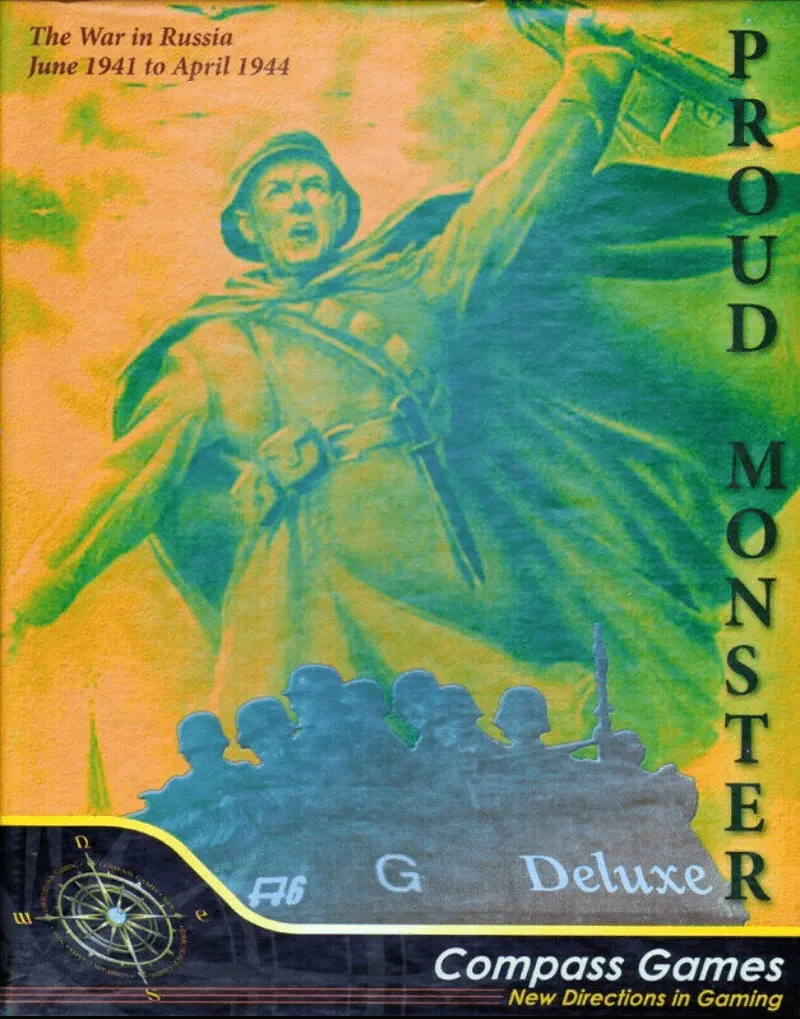
Proud Monster Deluxe
- 2–6 players
- 1500 min
- Complexity 3.5/5
- 2011
2010
Rules assistance for 1940: What If Germany Went East?
Plain-language explanations of turns, card effects and disputed situations, with official source references and saved question history.
What would you like to know?
Answers come from the official rulebook, with the page to check.
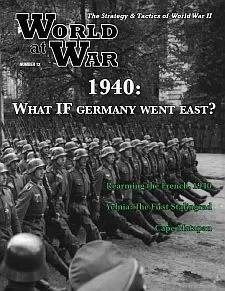
1940: What If Germany Went East? is a board game released in 2010 for 2–4 players, 240 minutes per game, and ages 12 and up. It was designed by Ty Bomba and its main mechanics are Hexagon Grid, Simulation, and Ratio / Combat Results Table.


The conjectured departure from the historic timeline that resulted in this alternative history wargame is assumed to have taken place in mid-September 1939. At that time, as his forces are completing the conquest of Poland, Hitler receives a flash of intuition. That is, he can’t help but notice the strategic paralysis of the Anglo-French, who do nothing to try to prevent the downfall of their fast-disappearing eastern ally Poland. From that he concludes it would be a waste of time to redeploy the Wehrmacht to the western front in 1940. He tells his generals: “The time will never be better to destroy the Bolshevik power than in the coming year. We will continue to have nothing to fear in the west. The British and French simply do not want war; they are afraid of it. Once we’ve taken Moscow, we’ll take Paris and London by telephone.” Accordingly, he also tells his foreign minister to drop all negotiations aimed at revising the original territorial split set out in the accords with the USSR the previous month. Most importantly, Lithuania, originally in the German “sphere of interest,” is not traded for a further slice of Polish territory. All of which has resulted in this low-complexity, strategic-level, alternative history wargame. In it, two to four players can investigate the possibilities inherent in a changed German strategy for 1940. The West Front map is scaled at 16 miles per hexagon. The Eastern Front map is scaled at 25 miles per hex. All Soviet units are armies; all other forces in the game are corps. Each game turn on both maps equals half a month. This game can be played by two, three or four. If two play, one commands the Germans, while the other commands both the Anglo-French and Soviets. If played by three, one player commands the Germans, one player commands the Anglo-French, and the third commands the Soviets. If four play, one player commands the Germans on the west map; the second commands the Germans on the east map; the third commands the Soviets, and the fourth commands the Anglo-French. The rules contain some 17,000 words, which means experienced players can finish it in about four hours. Rules cover such things as: neutrals, fog of war, airpower, 7th Flieger Corps, Soviet 1st Shock Army, fortifications, and more. The turn sequence is as follows. German Player Turn A. German Airpower & Strategic Transfer Phase B. German West Front Movement Phase C. German West Front Combat Phase D. German East Front Movement or Combat Phase E. German East Front Combat or Movement Phase F. German Replacement Phase G. German Moscow-Capture Resolution Phase H. German Terminal Supply Check Phase Soviet Player Turn A. Soviet Movement Phase B. Soviet Combat Phase C. Soviet Grand-Strategy Phase 1. Resolve Far East Front 2. Resolve Arctic Front 3. Resolve Southwest Front D. Soviet Terminal Supply Check Phase E. Soviet Reinforcement & Replacement Placement Phase Anglo-French Player Turn A. Anglo-French Armor Doctrine Phase B. Anglo-French Movement Phase C. Anglo-French Combat Phase D. Anglo-French Terminal Supply Check Phase E. Anglo-French Replacement Phase
1940: What If Germany Went East? supports 2–4 players according to the catalogue. This range comes from the publisher’s listed player count, so the game can be set up for any group size within it. Some setups, rules and scoring details may still vary by player count, so check your edition’s rulebook for the exact configuration.
The listed playing time for 1940: What If Germany Went East? is 240 minutes. This is the publisher’s estimate for a full game. The actual duration depends on the group, the player count and familiarity with the rules: first sessions usually run longer, while experienced groups often finish faster. Setup and teaching time are not included in this estimate.
The catalogue lists 1940: What If Germany Went East? for ages 12 and up. This is the publisher’s recommendation and reflects reading demands, rule complexity and small components rather than theme alone. Younger players can often join with help from an adult, so check the age guidance on your edition and consider your group’s experience with board games.
1940: What If Germany Went East? has a complexity rating of 2.0 out of 5 from BoardGameGeek players, which makes it a medium-light game. The rating reflects how much rules knowledge, planning and decision-making a typical game demands. Expect a longer first teach for heavier games, and use a preparation guide before game night.
1940: What If Germany Went East? belongs to these categories: Wargame and World War II. Its main mechanics are Hexagon Grid, Simulation, and Ratio / Combat Results Table. Categories describe the theme and setting of a game, while mechanics describe what players actually do on their turns. Each mechanic links to a catalogue hub with similar games, which helps when you want something comparable.
The credited designers of 1940: What If Germany Went East? are: Ty Bomba. These credits come from the published game data and name the people responsible for the game’s design, not its illustrators or publishers. Designer pages on MeepleRules collect other titles by the same designers, which helps when you enjoy a game and want to find similar ones.
The catalogue lists 1940: What If Germany Went East? as a base game. It can be played on its own with the components in the box and does not require any other title. Expansions, if any exist, add new content or rules on top of it and are listed separately in the catalogue with a link back to this base game.