

- BGG rank
- BGG #9,218
- BGG rating
- 7.2
Proud Monster: The Barbarossa Campaign
- 2 players
- 660 min
- Complexity 3.1/5
- 1994
1990
Rules assistance for 1944: Second Front – From D-Day to Victory in the West
Plain-language explanations of turns, card effects and disputed situations, with official source references and saved question history.
What would you like to know?
Answers come from the official rulebook, with the page to check.
1944: Second Front – From D-Day to Victory in the West is a board game released in 1990 for 1–2 players, 300 minutes per game, and ages 12 and up. It was designed by Ty Bomba and its main mechanics are Dice Rolling and Hexagon Grid.


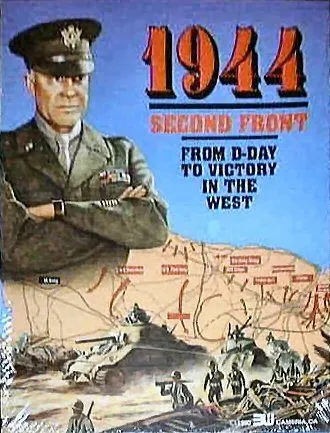
1944: SECOND FRONT begins with the Allies well established in France following the D-Day invasions. The Allies are gathered to attempt their breakout and begin the race toward the German frontier. Each player has Combat Units and Headquarters available, and is capable of maneuvering across the map and engaging enemy pieces in combat. You must master the deceptively concise rules for Activation and Movement Point expenditure. And at any given time, you will face the decision of which army to Activate in any one phase - and your opponent will have an immediate opportunity to react . The most interesting aspect of the game is that it seriously tries to model time over the course of the player's turn. You activate HQs, which can then control a varying number of infantry or armor units, depending on nationality. There is a track display that you use during movement/combat. As you make decisions about which actions to take, you branch along the track, limiting your options about what you can do next. Essentially this captures the passage of time required for certain actions. It's easier to play than it is to describe. For example, suppose you have an armor division near the enemy and a couple of infantry divisions further away. If you move up the infantry to attack and make a breakthrough, the armored unit will probably not be able to move very far through the breach. In effect, the armored unit has spent most of the turn waiting around for the infantry to get in position and make its attack. The game puts emphasis on elite units on both sides and on the brittleness of the powerful British formations (no replacements). Chrome rules cover Market-Garden and the Bulge. Contents One 32 page rule book One full color map 400 die cut counters Five chart sheets One 10-sided die One plastic tray Players: two or more Playing Time: 3 to 15 hours Complexity: medium to high Solitaire Suitability: medium
1944: Second Front – From D-Day to Victory in the West supports 1–2 players according to the catalogue. This range comes from the publisher’s listed player count, so the game can be set up for any group size within it. Some setups, rules and scoring details may still vary by player count, so check your edition’s rulebook for the exact configuration.
The listed playing time for 1944: Second Front – From D-Day to Victory in the West is 300 minutes. This is the publisher’s estimate for a full game. The actual duration depends on the group, the player count and familiarity with the rules: first sessions usually run longer, while experienced groups often finish faster. Setup and teaching time are not included in this estimate.
The catalogue lists 1944: Second Front – From D-Day to Victory in the West for ages 12 and up. This is the publisher’s recommendation and reflects reading demands, rule complexity and small components rather than theme alone. Younger players can often join with help from an adult, so check the age guidance on your edition and consider your group’s experience with board games.
1944: Second Front – From D-Day to Victory in the West has a complexity rating of 3.8 out of 5 from BoardGameGeek players, which makes it a heavy game. The rating reflects how much rules knowledge, planning and decision-making a typical game demands. Expect a longer first teach for heavier games, and use a preparation guide before game night.
1944: Second Front – From D-Day to Victory in the West belongs to these categories: Wargame and World War II. Its main mechanics are Dice Rolling and Hexagon Grid. Categories describe the theme and setting of a game, while mechanics describe what players actually do on their turns. Each mechanic links to a catalogue hub with similar games, which helps when you want something comparable.
The credited designers of 1944: Second Front – From D-Day to Victory in the West are: Ty Bomba. These credits come from the published game data and name the people responsible for the game’s design, not its illustrators or publishers. Designer pages on MeepleRules collect other titles by the same designers, which helps when you enjoy a game and want to find similar ones.
The catalogue lists 1944: Second Front – From D-Day to Victory in the West as a base game. It can be played on its own with the components in the box and does not require any other title. Expansions, if any exist, add new content or rules on top of it and are listed separately in the catalogue with a link back to this base game.