
- BGG rank
- BGG #11,383
- BGG rating
- 7.1
Chickamauga: The Last Victory, 20 September 1863
- 2 players
- 120 min
- Complexity 2.1/5
- 1975
1977
Rules assistance for After the Holocaust: The Nuclear Devastation of America – Recovery and Reunification
Plain-language explanations of turns, card effects and disputed situations, with official source references and saved question history.
For 3 players
What would you like to know?
Answers come from the official rulebook, with the page to check.
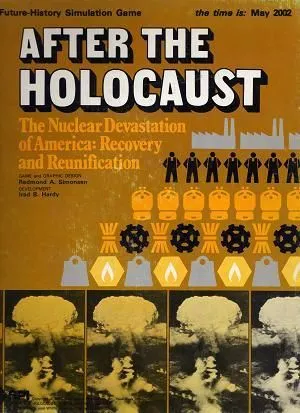
After the Holocaust: The Nuclear Devastation of America – Recovery and Reunification is a board game released in 1977 for 3–5 players, 180 minutes per game, and ages 12 and up. It was designed by Redmond Aksel Simonsen and Irad B. Hardy and its main mechanics are Hexagon Grid and Worker Placement.


After the Holocaust is an economic, military, and political simulation of events in the United States, twenty years after a large-scale thermonuclear exchange with the Soviet Union. The game is ten turns long, and is designed for four players, each of whom controls a different region of North America and part of Canada. These regions are the Northeast, the Midwest, the Southwest, and the Far West. It is reminsicent of the works of Stafford Beer and Proyecto Synco. Each game turn consists of five distinct rounds. The first is the Production Round, which includes a basic production phase, a secondary production phase, and a mobilization phase. Second is the Trade Round. Third is the Consumption Round, during which a player expends food points, expends consumer points, calculates and declares social status, and provides military supply for any combat units under his control. Fourth is the Military/Political Round, which begins with the political placement phase, followed by initial military movement, secondary military movement, combat, and elections. The fifth and last round of the game turn is the Finance Round, which includes the political disassociation phase, the stockpile/labour reallocation phase, industrial investment phase, taxation, the industrial capacity adjustment phase, the industrial labour reallocation phase, and finally, the depreciation and shrinkage phase. In addition, immediately before the fourth and eighth game turns, the Population Growth Cycle occurs during which the labour population of each region increases by 10%. Inside the Box: Two 17” x 22” hard-backed hexagonal grid Map Boards (with Turn Record Track, Terrain Key, Four Regional Sets of Six Economic Sector Tracks, and Abbreviated Turn Sequence incorporated) 400 ½” cardboard Counters One 8½” x 11” Rules Booklet (with Scenario Instructions included) Four 11” x 17” back-printed, folded combined Charts and Tables Sheets (each with an Initial Resources Chart, Food Table, Secondary Production Costs Table, Trade Transport Movement Point Cost Chart, Strike Table, Political Control Table, Subversion Table, Terrain Effects Chart, Combat Results Table, Unemployment Table, Starvation Table, Stockpiling Cost Chart, Investment Chart, Corruption Table, Depreciation Table, Shrinkage Table, Research and Development Table, Tax Table, and photocopy masters for Tax Forms Eight 8½” x 11” perforated, back-printed sheets of Game Money (144 pieces) Two small six-sided Dice One 20 compartment plastic counter tray
After the Holocaust: The Nuclear Devastation of America – Recovery and Reunification supports 3–5 players according to the catalogue. This range comes from the publisher’s listed player count, so the game can be set up for any group size within it. Some setups, rules and scoring details may still vary by player count, so check your edition’s rulebook for the exact configuration.
The listed playing time for After the Holocaust: The Nuclear Devastation of America – Recovery and Reunification is 180 minutes. This is the publisher’s estimate for a full game. The actual duration depends on the group, the player count and familiarity with the rules: first sessions usually run longer, while experienced groups often finish faster. Setup and teaching time are not included in this estimate.
The catalogue lists After the Holocaust: The Nuclear Devastation of America – Recovery and Reunification for ages 12 and up. This is the publisher’s recommendation and reflects reading demands, rule complexity and small components rather than theme alone. Younger players can often join with help from an adult, so check the age guidance on your edition and consider your group’s experience with board games.
After the Holocaust: The Nuclear Devastation of America – Recovery and Reunification has a complexity rating of 4.0 out of 5 from BoardGameGeek players, which makes it a heavy game. The rating reflects how much rules knowledge, planning and decision-making a typical game demands. Expect a longer first teach for heavier games, and use a preparation guide before game night.
After the Holocaust: The Nuclear Devastation of America – Recovery and Reunification belongs to these categories: Economic and Negotiation. Its main mechanics are Hexagon Grid and Worker Placement. Categories describe the theme and setting of a game, while mechanics describe what players actually do on their turns. Each mechanic links to a catalogue hub with similar games, which helps when you want something comparable.
The credited designers of After the Holocaust: The Nuclear Devastation of America – Recovery and Reunification are: Redmond Aksel Simonsen and Irad B. Hardy. These credits come from the published game data and name the people responsible for the game’s design, not its illustrators or publishers. Designer pages on MeepleRules collect other titles by the same designers, which helps when you enjoy a game and want to find similar ones.
The catalogue lists After the Holocaust: The Nuclear Devastation of America – Recovery and Reunification as a base game. It can be played on its own with the components in the box and does not require any other title. Expansions, if any exist, add new content or rules on top of it and are listed separately in the catalogue with a link back to this base game.