
- BGG rank
- BGG #26,660
- BGG rating
- 5.4
Simon Swipe
- 1–6 players
- Complexity 1.3/5
- 2014
1996
Rules assistance for Brain Warp
Plain-language explanations of turns, card effects and disputed situations, with official source references and saved question history.
For 1 player
What would you like to know?
Answers come from the official rulebook, with the page to check.
Brain Warp is a board game released in 1996 for 1–6 players, 15 minutes per game, and ages 10 and up. Its main mechanics are Memory.



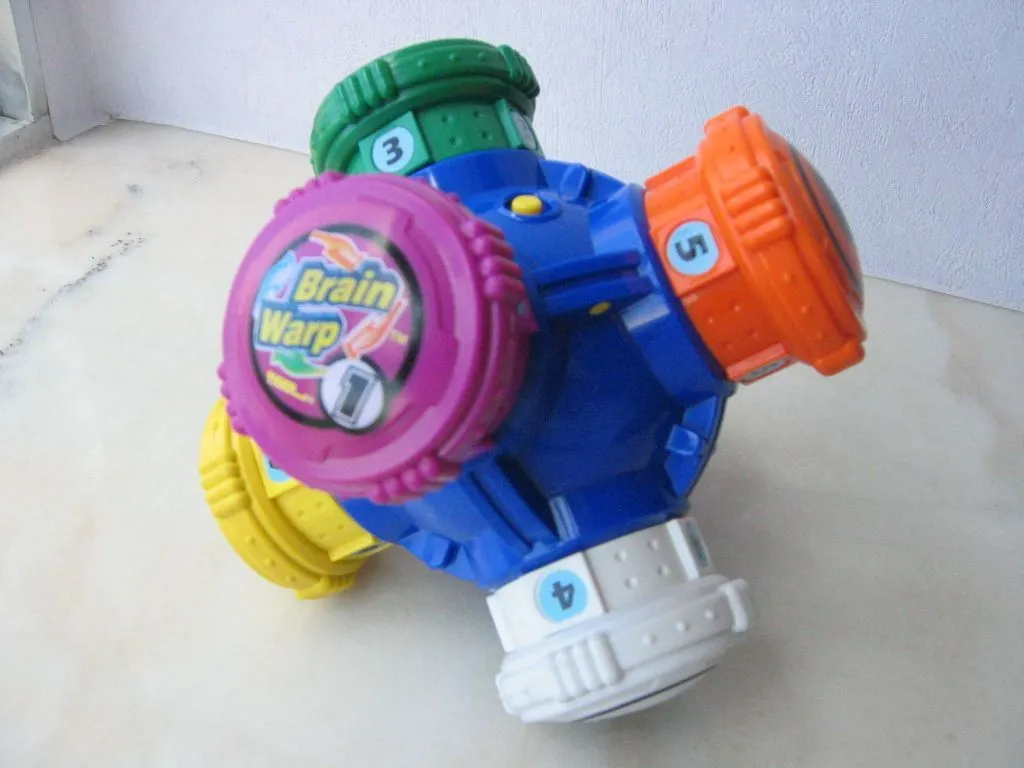
Brain Warp is an electronic memory game with voice commands. It is shaped like a sphere with 6 knobs sticking out of it. The knobs all have different colors and are numbered 1-6. There are 6 different games to play. In the first game, the voice calls out a color and the player must quickly rotate the Brain Warp until the color called is facing upward. The next game is the same only it uses the numbers. Other games include: colors and numbers, combinations of colors and numbers, code buster, and a passing game in which players add to an ever growing sequence. The Brain Warp calls out the winner at the end of each game. The Brain Warp must be held straight for the game sensors to "read" selections correctly. It must be rotated from selection to adjacent selection - not diagonally or through another color. Correct selections receive a Confirmation Tone, incorrect selections (or if you take to long) receive a Razz tone. There were 3 different revisions of the Brain Warp made. The first one had bad music and sound programming whilst the voice had a lower pitch comparing against the music. The second version fixed all of that but the 2.0 has problems with gameplay after 36 points in Colors, Numbers and Combo. Then in 2002 a black version was made which had a better speaker and a wider pitch differences between game units. The game also has a hidden test mode. To access it, you need to unscrew the yellow knob, position the game to the purple position and press the power button to access it. Different censors do diferent things. The red censor repeats the number that each knob is, the white button plays all the sound effects, the orange button does all the voices, the green knob plays the music and the purple knob makes a beep. The yellow knob goes back to game mode.
Brain Warp supports 1–6 players according to the catalogue. This range comes from the publisher’s listed player count, so the game can be set up for any group size within it. Some setups, rules and scoring details may still vary by player count, so check your edition’s rulebook for the exact configuration.
The listed playing time for Brain Warp is 15 minutes. This is the publisher’s estimate for a full game. The actual duration depends on the group, the player count and familiarity with the rules: first sessions usually run longer, while experienced groups often finish faster. Setup and teaching time are not included in this estimate.
The catalogue lists Brain Warp for ages 10 and up. This is the publisher’s recommendation and reflects reading demands, rule complexity and small components rather than theme alone. Younger players can often join with help from an adult, so check the age guidance on your edition and consider your group’s experience with board games.
Brain Warp has a complexity rating of 1.0 out of 5 from BoardGameGeek players, which makes it a light game. The rating reflects how much rules knowledge, planning and decision-making a typical game demands. Expect a longer first teach for heavier games, and use a preparation guide before game night.
Brain Warp belongs to these categories: Memory, Action / Dexterity, and Electronic. Its main mechanics are Memory. Categories describe the theme and setting of a game, while mechanics describe what players actually do on their turns. Each mechanic links to a catalogue hub with similar games, which helps when you want something comparable.
The catalogue lists Brain Warp as a base game. It can be played on its own with the components in the box and does not require any other title. Expansions, if any exist, add new content or rules on top of it and are listed separately in the catalogue with a link back to this base game.