
- BGG rating
- 7.4
Crowbar!: The Rangers at Pointe Du Hoc – Vorwarts!
- 1–4 players
- 90–120 min
- Complexity 2.5/5
- 2019
2019
Rules assistance for Crowbar! The Rangers at Pointe Du Hoc
Plain-language explanations of turns, card effects and disputed situations, with official source references and saved question history.
For 1 player
What would you like to know?
Answers come from the official rulebook, with the page to check.
Crowbar! The Rangers at Pointe Du Hoc is a board game released in 2019 for 1–3 players, 60–180 minutes per game, and ages 14 and up. It was designed by Hermann Luttmann and its main mechanics are Push Your Luck, Dice Rolling, and Square Grid.
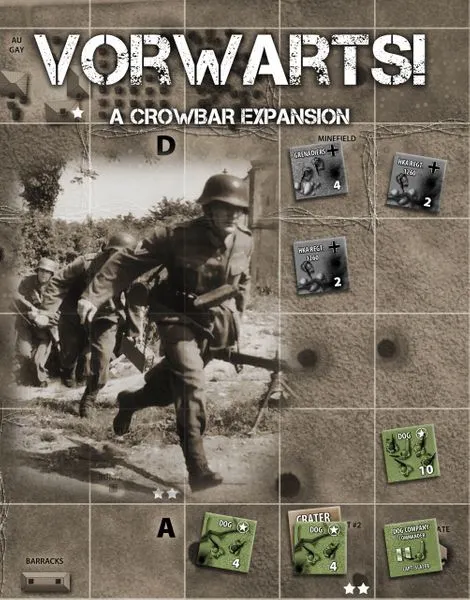
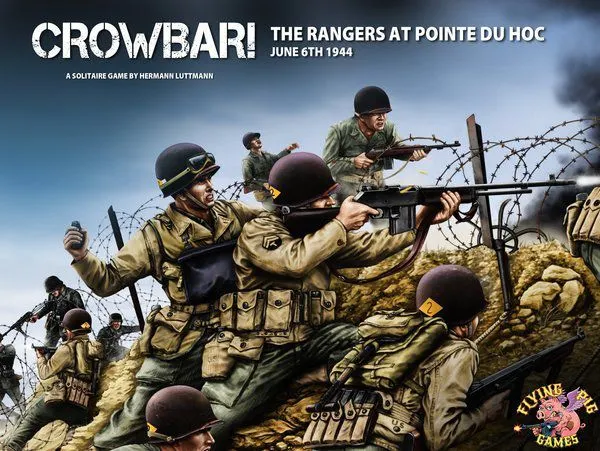
June 6, 1944 - 7:09 am A commanding voice shouts “Crowbar!” from the carefully monitored radios of Ranger Flotilla headquarters aboard the LSI command ship St. James. With that signal, the 225 men of Dog, Easy and Fox Companies of Force “A” of the 2nd Ranger Battalion launched one of the most incredible and seemingly impossible assaults of military history. Tasked with landing on the beaches of Normandy, France and scaling the towering 100-foot cliffs at Pointe Du Hoc in the face of determined German defenders, the Rangers were the only force that could possibly meet this challenge. Despite initially heading in the wrong direction and landing in jumbled order, the elite Rangers were eager to begin their ascent. Their mission was to find and destroy the six huge 150mm artillery pieces that were deployed in the area. These guns had to be neutralized lest they rain down a massive barrage on the American forces landing at nearby Omaha Beach. And if that wasn’t enough, the Rangers were also ordered to set up roadblocks on the Vierville-Grandcamp highway to delay and harass any Wehrmacht reinforcements from reaching and counterattacking the D-Day landings. The Ranger battalion climbed the massive heights against stiff resistance and advanced inland, suffering severe casualties in the process. They took many of the German positions, but no guns were to be found. The Rangers then fought off vicious counterattacks, launched by the German 726th and 914th Grenadier Regiments, and were nearly pushed back into the sea. But under the inspired leadership of Lt. Col. James Earl Rudder, the Rangers held on and eventually found and destroyed the concealed guns and established the needed roadblocks. Bravery and perseverance won the day for the Rangers as they completed another successful chapter in their glorious history. Crowbar!: The Rangers at Pointe Du Hoc is a solitaire wargame (with two-player and cooperative variants) which abstractly simulates the ebb, flow and risk of the Pointe du Hoc assault, with you playing the attacking Rangers. The game system traces its parentage to the popular "In Magnificent Style" game and mirrors its speed of play, tough decision-making and heart-pounding push-your-luck excitement. But Crowbar! has been updated to allow for an even smoother gameplay experience. For example, instead of the old “dice matrix” system to determine unit movement results, the game now utilizes four custom Movement Dice. Each die is made up of different results, escalating the possible risk/reward ratio. Dice are thrown one at a time and can be read instantly to determine what happens to the unit. The system also challenges you with even more events, including constant German counterattacks, ammunition shortages, artillery bombardments, booby traps and other surprises. Your goal is to meet your various objectives as quickly as possible, before the German defenders can dig in even deeper and before they can organize effective counterattacks. Ultimate success or failure in the game is measured by how well you do as compared to the actual heroic accomplishments of the Rangers on that historic day. Are you up to the challenge? —description from the publisher
Crowbar! The Rangers at Pointe Du Hoc supports 1–3 players according to the catalogue. This range comes from the publisher’s listed player count, so the game can be set up for any group size within it. Some setups, rules and scoring details may still vary by player count, so check your edition’s rulebook for the exact configuration.
The listed playing time for Crowbar! The Rangers at Pointe Du Hoc is 60–180 minutes. This is the publisher’s estimate for a full game. The actual duration depends on the group, the player count and familiarity with the rules: first sessions usually run longer, while experienced groups often finish faster. Setup and teaching time are not included in this estimate.
The catalogue lists Crowbar! The Rangers at Pointe Du Hoc for ages 14 and up. This is the publisher’s recommendation and reflects reading demands, rule complexity and small components rather than theme alone. Younger players can often join with help from an adult, so check the age guidance on your edition and consider your group’s experience with board games.
Crowbar! The Rangers at Pointe Du Hoc has a complexity rating of 3.2 out of 5 from BoardGameGeek players, which makes it a medium-weight game. The rating reflects how much rules knowledge, planning and decision-making a typical game demands. Expect a longer first teach for heavier games, and use a preparation guide before game night.
Crowbar! The Rangers at Pointe Du Hoc belongs to these categories: Wargame, Print & Play, and World War II. Its main mechanics are Push Your Luck, Dice Rolling, and Square Grid. Categories describe the theme and setting of a game, while mechanics describe what players actually do on their turns. Each mechanic links to a catalogue hub with similar games, which helps when you want something comparable.
The credited designers of Crowbar! The Rangers at Pointe Du Hoc are: Hermann Luttmann. These credits come from the published game data and name the people responsible for the game’s design, not its illustrators or publishers. Designer pages on MeepleRules collect other titles by the same designers, which helps when you enjoy a game and want to find similar ones.
The catalogue lists Crowbar! The Rangers at Pointe Du Hoc as a base game. It can be played on its own with the components in the box and does not require any other title. Expansions, if any exist, add new content or rules on top of it and are listed separately in the catalogue with a link back to this base game.