

Dungeons & Dragons Chainmail: Blood & Darkness
- 2–6 players
- 60 min
- 2002
2001
Rules assistance for Dungeons & Dragons Chainmail
Plain-language explanations of turns, card effects and disputed situations, with official source references and saved question history.
What would you like to know?
Answers come from the official rulebook, with the page to check.
Dungeons & Dragons Chainmail is a board game released in 2001 for 2–6 players, 60 minutes per game, and ages 10 and up. It was designed by Jonathan Tweet, Mons Johnson, Skaff Elias, Bruce R. Cordell, Andrew Finch, and Jennifer Clarke-Wilkes and its main mechanics are Dice Rolling and Role Playing.









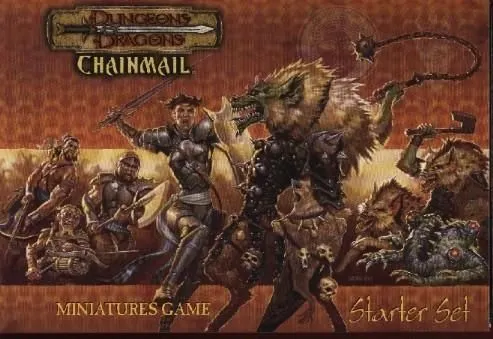
From the publisher's box: "the God of War is dead, and six factions vie for control of his legacy. Will your battle-hardened warbands lay claim to his lost power or be swept from the field like chaff? The Dungeons and Dragons Chainmail miniatures game is an everything-goes battle royale based on the d20 system and features some of the most infamous creatures the D&D universe has ever known. Build your army with care or feel the sting of classic D&D spells and new abilities taken straight from the Player's Handbook." Wizards of the Coast revived the Chainmail skirmish game and released this range of miniatures to support it. This game would eventually become the D&D Miniatures Skirmish Game and many Chainmail sculpts would be later turned into prepainted plastic: the last recognizable one being the Large Ice Elemental (Para-Ice Elemental) in the Dungeons & Dragons Miniatures set #12, "Unhallowed". The Chainmail brand would be discontinued in August 2002 but many of the miniatures on this page would reappear in several of the D&D 3.5 Miniatures box sets. Contents Blister Packs Set One Set Two Set Three Set Four Set Five Faction Boxes 17863 Attack of the Drow: Kilsek Set 4 Faction 88339 Starter Set 88340 Ravilla Faction 88341 Ahmut's Legion Faction 88342 Drazen's Horde Faction 88343 Mordengard Faction Combo Boxes 17858 Shadow Lurkers: Mercenary Set 2 88020 Scythe & Slaughter: Ahmut's Legion Set 1 88030 Brute Force: Drazen's Horde Set 1 88040 Furious Steel: Mordengard Set 1 88461 Set 4 Ettin Trooper 88570 Fear & Fury: Ahmut's Legion Set 2 88585 Limited Edition Ogre Mercenary 88720 Savage Strike: Drazen's Horde Set 2 88750 Stone & Thunder: Mordengard Set 2 88766 Mordengard 88767 Ravilla 88768 Ravilla 88769 Drazen's Horde 88770 Dark Spawn: Naresh Set 2 88772 Thalos 88773 Naresh 88790 Snake & Scale: Ravilla Set 2 88810 Avenging Light: Thalos Set 2 Guidebooks 17861 The Ghostwind Campaign 88000 Core Rulebook 88010 Blood & Darkness 88580 Fire & Ice 88960 Shadow of the Drow
Dungeons & Dragons Chainmail supports 2–6 players according to the catalogue. This range comes from the publisher’s listed player count, so the game can be set up for any group size within it. Some setups, rules and scoring details may still vary by player count, so check your edition’s rulebook for the exact configuration.
The listed playing time for Dungeons & Dragons Chainmail is 60 minutes. This is the publisher’s estimate for a full game. The actual duration depends on the group, the player count and familiarity with the rules: first sessions usually run longer, while experienced groups often finish faster. Setup and teaching time are not included in this estimate.
The catalogue lists Dungeons & Dragons Chainmail for ages 10 and up. This is the publisher’s recommendation and reflects reading demands, rule complexity and small components rather than theme alone. Younger players can often join with help from an adult, so check the age guidance on your edition and consider your group’s experience with board games.
Dungeons & Dragons Chainmail has a complexity rating of 3.1 out of 5 from BoardGameGeek players, which makes it a medium-weight game. The rating reflects how much rules knowledge, planning and decision-making a typical game demands. Expect a longer first teach for heavier games, and use a preparation guide before game night.
Dungeons & Dragons Chainmail belongs to these categories: Fantasy, Fighting, and Wargame. Its main mechanics are Dice Rolling and Role Playing. Categories describe the theme and setting of a game, while mechanics describe what players actually do on their turns. Each mechanic links to a catalogue hub with similar games, which helps when you want something comparable.
The credited designers of Dungeons & Dragons Chainmail are: Jonathan Tweet, Mons Johnson, Skaff Elias, Bruce R. Cordell, Andrew Finch, and Jennifer Clarke-Wilkes. These credits come from the published game data and name the people responsible for the game’s design, not its illustrators or publishers. Designer pages on MeepleRules collect other titles by the same designers, which helps when you enjoy a game and want to find similar ones.
The catalogue lists Dungeons & Dragons Chainmail as a base game. It can be played on its own with the components in the box and does not require any other title. Expansions, if any exist, add new content or rules on top of it and are listed separately in the catalogue with a link back to this base game.