

- BGG rank
- BGG #9,028
- BGG rating
- 7.2
Great War at Sea: Jutland
- 2 players
- 30–120 min
- Complexity 3.1/5
- 2006
Rules assistance for Great War at Sea: Jutland 1919
Plain-language explanations of turns, card effects and disputed situations, with official source references and saved question history.
What would you like to know?
Answers come from the official rulebook, with the page to check.
Great War at Sea: Jutland 1919 is an expansion for Great War at Sea: High Seas Fleet released in 2018 for 2 players, 30–240 minutes per game, and ages 12 and up. It was designed by Michael Bennighof and its main mechanics are Dice Rolling, Secret Unit Deployment, and Hexagon Grid.









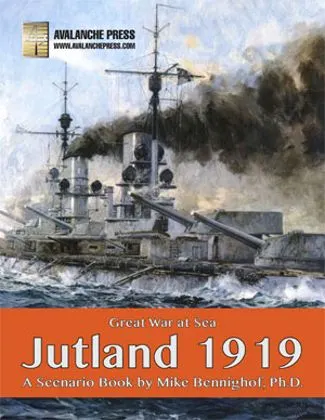
Imperial Germany laid down her last dreadnought in January 1915, and never completed her. But planning continued for new classes of battleships, battle cruisers, armored cruisers and scout cruisers. All understood that they could not possibly be built during the course of the ongoing First World War, but would be laid down afterwards. Reflecting the lessons first of the battles of the Falklands, Coronel and Helgoland Bight, and eventually those of Jutland, the new German designs continued to emphasize protection. At the urging of sea officers, the new ships also now carried armament equal to that of the British, and would make much higher speeds as well. Across the North Sea, the British Admiralty had no clear idea of what the Germans might be planning to build, but could state with certainty that they and other potential enemies would continue to improve their warships. New British dreadnoughts would carry ever-more-powerful armaments, including a new, secret 18-inch gun. Jutland 1919 is a supplement for our Great War at Sea: Jutland game, studying these drawing-board battleships that would never actually be launched. It includes background essays, forty new scenarios, and 80 new silky-smooth die-cut playing pieces (60 double-sized "long" ship pieces and 20 square ones). It is not playable by itself; you’ll need our Jutland game and High Seas Fleet book to play the scenarios. You can, of course, just read the essays and fondle the pieces without owning either. We won’t tell. New pieces include three classes of German battleships designed but never built: a fast battleship with eight 15-inch guns, a battleship with ten 15-inch guns in five turrets, with three of them in a unique triple-stacked arrangement. And an even larger ship with 16.5-inch guns. There are two new classes of battle cruiser, one with 15-inch guns, one with 16.5-inch guns. And two variations on the fast armored cruiser proposed after the Battle of Jutland, one with ten 8.2-inch guns, and one with twenty (20) 5.9-inch guns. Plus there are additional scout cruisers and destroyers. The British for their part receive their improved but slower Queen Elizabeth class, with ten 15-inch guns, and the massive ships proposed to carry eight 18-inch guns apiece, based on the Hood design but slower with battleship-scale protection. Plus their own fast armored cruiser. These are powerful new ships, and now you can lead them into battle. -description from publisher's website
Great War at Sea: Jutland 1919 supports 2 players according to the catalogue. This is the publisher’s listed player count, so the game is designed for exactly that number of participants. Variants for other group sizes, if any, are described in the rulebook of your edition, so check it before setting up a different configuration.
The listed playing time for Great War at Sea: Jutland 1919 is 30–240 minutes. This is the publisher’s estimate for a full game. The actual duration depends on the group, the player count and familiarity with the rules: first sessions usually run longer, while experienced groups often finish faster. Setup and teaching time are not included in this estimate.
The catalogue lists Great War at Sea: Jutland 1919 for ages 12 and up. This is the publisher’s recommendation and reflects reading demands, rule complexity and small components rather than theme alone. Younger players can often join with help from an adult, so check the age guidance on your edition and consider your group’s experience with board games.
Great War at Sea: Jutland 1919 has a complexity rating of 3.0 out of 5 from BoardGameGeek players, which makes it a medium-weight game. The rating reflects how much rules knowledge, planning and decision-making a typical game demands. Expect a longer first teach for heavier games, and use a preparation guide before game night.
Great War at Sea: Jutland 1919 belongs to these categories: Wargame, Nautical, and Expansion for Base-game. Its main mechanics are Dice Rolling, Secret Unit Deployment, and Hexagon Grid. Categories describe the theme and setting of a game, while mechanics describe what players actually do on their turns. Each mechanic links to a catalogue hub with similar games, which helps when you want something comparable.
The credited designers of Great War at Sea: Jutland 1919 are: Michael Bennighof. These credits come from the published game data and name the people responsible for the game’s design, not its illustrators or publishers. Designer pages on MeepleRules collect other titles by the same designers, which helps when you enjoy a game and want to find similar ones.
The catalogue lists Great War at Sea: Jutland 1919 as an expansion for Great War at Sea: High Seas Fleet. Expansions add new content, rules or scenarios to the base game and usually cannot be played on their own, so you need Great War at Sea: High Seas Fleet to use it. Check that your edition of Great War at Sea: High Seas Fleet is compatible, as some expansions were revised between editions.