

- BGG rank
- BGG #7,482
- BGG rating
- 7.0
Eastern Front: A Panzer Grenadier Game
- 2 players
- 120 min
- Complexity 2.8/5
- 2005
Rules assistance for Great War at Sea: Triple Alliance
Plain-language explanations of turns, card effects and disputed situations, with official source references and saved question history.
What would you like to know?
Answers come from the official rulebook, with the page to check.
Great War at Sea: Triple Alliance is an expansion for Great War at Sea: Dreadnoughts released in 2015 for 1–2 players, 30–300 minutes per game, and ages 12 and up. It was designed by Michael Bennighof and its main mechanics are Dice Rolling, Grid Movement, and Secret Unit Deployment.










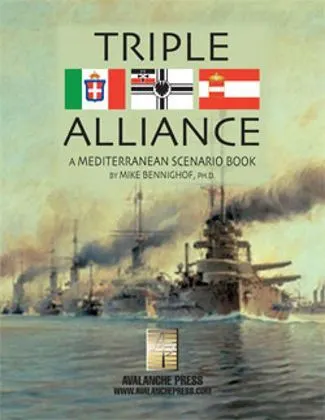
From the Avalanche Press website: In December 1912, Germany, Austria-Hungary and Italy renewed their 30-year-old military pact known as the Triple Alliance. In the months that followed, staff officers from all three fleets prepared detailed plans for operations against the French and British fleets in the Mediterranean in case of war. Yet when war came in August 1914, Italy refused to join her Alliance partners and those plans would never be used. What if Italy had honored her Alliance obligations, and joined the Germans and Austrians in a naval war against Britain and France? What if the Triple Alliance plans had been put into operation, with the Austrian and Italian fleets combining to challenge the French and British? The Great War at Sea in the Mediterranean is no longer confined to the Adriatic Sea, but now rages across the entire Mediterranean basin. Triple Alliance is a book supplement for the Great War at Sea series based on those plans. It is not a complete game; ownership of Mediterranean and Dreadnoughts (and only Mediterranean and Dreadnoughts) is required to enjoy all of the scenarios. The book includes 90 new scorchless, sootless laser-cut playing pieces. There are several versions of the Austrian battleship Radetzky, both the small dreadnought and full dreadnought variations presented by her design team in 1907. The all-big-gun battleship originally proposed for the Italian Navy by designer Vittorio Cuniberti is included, along with other ships cancelled for financial reasons. And the French receive a full class of unusual battleships proposed but never built, that carry the big guns of a dreadnought but also the not-quite-as-big guns of a semi-dreadnought. And there are some pieces to replace armored cruisers and semi-dreadnoughts from our Mediterranean game, with gunnery ratings more accurately reflecting their capabilities. Plus new seaplane pieces rated for use with the aircraft rules that began to appear in Great War at Sea games after publication of the most recent edition of Mediterranean. The thirty scenarios study the Triple Alliance war plan in a story all their own, following the outbreak of war and the conduct of operations as the joint planning staff foresaw possible events. The scenarios follow a single story arc, but also present a study of the Triple Alliance’s strengths and weaknesses. It’s a similar approach to that in High Seas Fleet, but with its own story line.
Great War at Sea: Triple Alliance supports 1–2 players according to the catalogue. This range comes from the publisher’s listed player count, so the game can be set up for any group size within it. Some setups, rules and scoring details may still vary by player count, so check your edition’s rulebook for the exact configuration.
The listed playing time for Great War at Sea: Triple Alliance is 30–300 minutes. This is the publisher’s estimate for a full game. The actual duration depends on the group, the player count and familiarity with the rules: first sessions usually run longer, while experienced groups often finish faster. Setup and teaching time are not included in this estimate.
The catalogue lists Great War at Sea: Triple Alliance for ages 12 and up. This is the publisher’s recommendation and reflects reading demands, rule complexity and small components rather than theme alone. Younger players can often join with help from an adult, so check the age guidance on your edition and consider your group’s experience with board games.
Great War at Sea: Triple Alliance has a complexity rating of 3.0 out of 5 from BoardGameGeek players, which makes it a medium-weight game. The rating reflects how much rules knowledge, planning and decision-making a typical game demands. Expect a longer first teach for heavier games, and use a preparation guide before game night.
Great War at Sea: Triple Alliance belongs to these categories: Wargame, Nautical, and Expansion for Base-game. Its main mechanics are Dice Rolling, Grid Movement, and Secret Unit Deployment. Categories describe the theme and setting of a game, while mechanics describe what players actually do on their turns. Each mechanic links to a catalogue hub with similar games, which helps when you want something comparable.
The credited designers of Great War at Sea: Triple Alliance are: Michael Bennighof. These credits come from the published game data and name the people responsible for the game’s design, not its illustrators or publishers. Designer pages on MeepleRules collect other titles by the same designers, which helps when you enjoy a game and want to find similar ones.
The catalogue lists Great War at Sea: Triple Alliance as an expansion for Great War at Sea: Dreadnoughts. Expansions add new content, rules or scenarios to the base game and usually cannot be played on their own, so you need Great War at Sea: Dreadnoughts to use it. Check that your edition of Great War at Sea: Dreadnoughts is compatible, as some expansions were revised between editions.