
- BGG rank
- BGG #4,627
- BGG rating
- 7.1
Goblin Vaults
- 1–5 players
- 30–45 min
- Complexity 2.2/5
- 2023
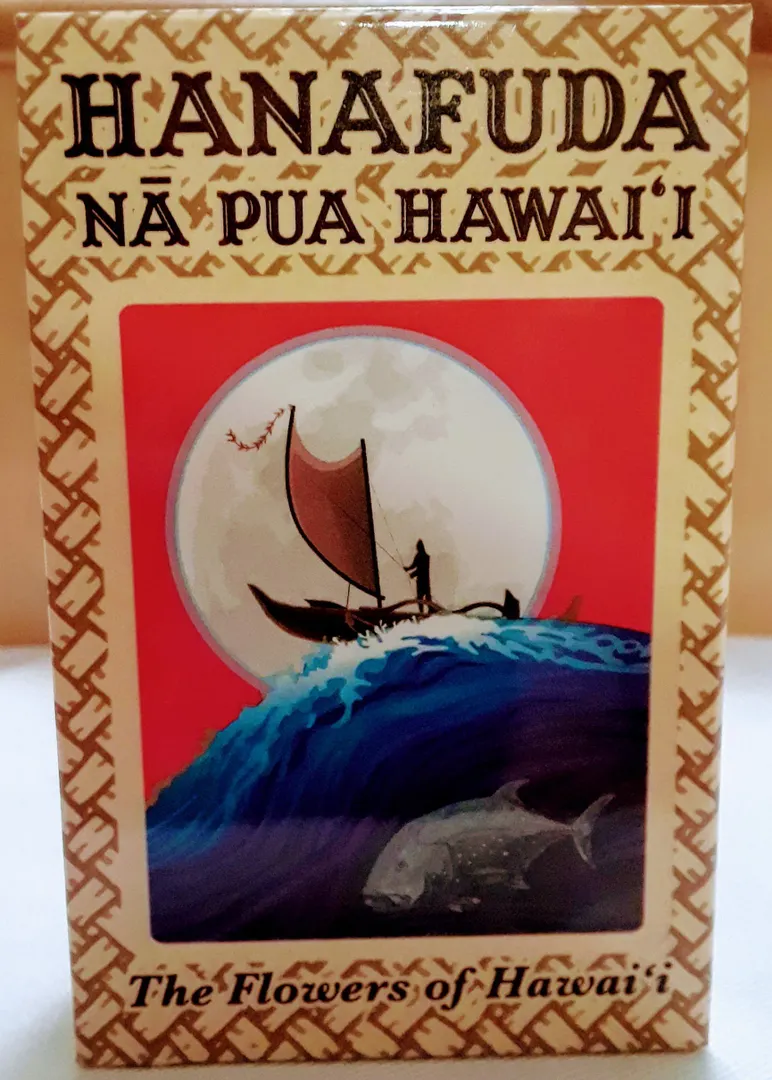
2010
Rules assistance for Hanafuda Nā Pua Hawai'i: The Flowers of Hawai'i
Plain-language explanations of turns, card effects and disputed situations, with official source references and saved question history.
What would you like to know?
Answers come from the official rulebook, with the page to check.
Hanafuda Nā Pua Hawai'i: The Flowers of Hawai'i is a board game released in 2010 for 2–6 players and ages 6 and up. It was designed by Jason Nakano and its main mechanics are Hand Management, Set Collection, and Trick-taking.







A variant of the traditional Japanese card game 'Hanafuda', this deck of cards is specifically designed for the Hawaiian Style game known as 'Sakura'. Two to six people can play, either individually or as teams of two. The 48 cards are divided into twelve 'hiki' or suits, each corresponding to a specific month. The four cards in each hiki have 20, 10, 5, and zero points. The objective of the game is to accumulate the most points by matching cards. The highest possible score is 240 points. After shuffling and cutting the deck, the 'oya' (dealer) deals cards counter-clockwise to the players; the number of cards dealt differs depending on the number of players. The oya then plays a number of cards in the center of the table, known as the "field". The remainder of the deck is set nearby as a draw stack. Play begins with the oya and moves counter-clockwise. The player draws a card from her hand and places it in the field. If the played card matches the hiki (suit) of a card in the field, the player places her card on top of the matching card to show everyone the match. She then picks up both cards and places them face-up in a "points section" in front of her. She discards any cards with no value in the 'kasu' (rubbish) pile behind the draw stack. Next, the player draws one card from the draw stack. If it matches a card in the field, she must take the pair of cards. Otherwise, the card is left in the field. This ends that player's turn. It is possible that a player may capture as many as four cards per turn. The player to the right takes the next turn. Play continues in this fashion until all the cards have been used in each player's hand. Points are then totaled. Advanced play adds a wild card and also 'yaku' (bonus combinations) in special three-card combinations that are scored at the end of the game. Holding one or more yaku causes the other players to deduct points from their score, rather than adding points to the yaku-player's score.
Hanafuda Nā Pua Hawai'i: The Flowers of Hawai'i supports 2–6 players according to the catalogue. This range comes from the publisher’s listed player count, so the game can be set up for any group size within it. Some setups, rules and scoring details may still vary by player count, so check your edition’s rulebook for the exact configuration.
The catalogue lists Hanafuda Nā Pua Hawai'i: The Flowers of Hawai'i for ages 6 and up. This is the publisher’s recommendation and reflects reading demands, rule complexity and small components rather than theme alone. Younger players can often join with help from an adult, so check the age guidance on your edition and consider your group’s experience with board games.
Hanafuda Nā Pua Hawai'i: The Flowers of Hawai'i belongs to these categories: Card Game. Its main mechanics are Hand Management, Set Collection, and Trick-taking. Categories describe the theme and setting of a game, while mechanics describe what players actually do on their turns. Each mechanic links to a catalogue hub with similar games, which helps when you want something comparable.
The credited designers of Hanafuda Nā Pua Hawai'i: The Flowers of Hawai'i are: Jason Nakano. These credits come from the published game data and name the people responsible for the game’s design, not its illustrators or publishers. Designer pages on MeepleRules collect other titles by the same designers, which helps when you enjoy a game and want to find similar ones.
The catalogue lists Hanafuda Nā Pua Hawai'i: The Flowers of Hawai'i as a base game. It can be played on its own with the components in the box and does not require any other title. Expansions, if any exist, add new content or rules on top of it and are listed separately in the catalogue with a link back to this base game.
