
- BGG rank
- BGG #13,954
- BGG rating
- 8.3
Burnside Takes Command
- 2 players
- 120 min
- Complexity 3.2/5
- 2003
Rules assistance for Iganie 1831
Plain-language explanations of turns, card effects and disputed situations, with official source references and saved question history.
What would you like to know?
Answers come from the official rulebook, with the page to check.
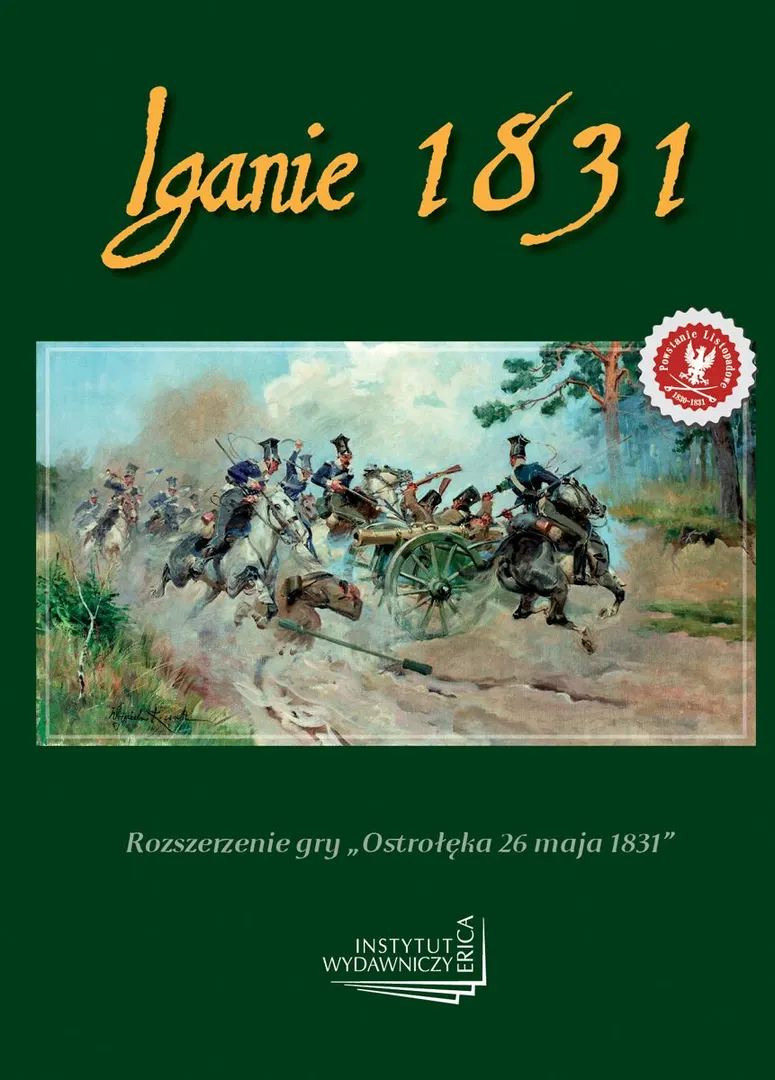
Iganie 1831 is an expansion for Ostroleka 26 maja 1831 released in 2018 for 2 players, 150–240 minutes per game, and ages 16 and up. It was designed by Ryszard Kita and its main mechanics are Dice Rolling, Hexagon Grid, and Simulation.
Iganie 1831 covers the battle of Iganie, one of the most brilliant victories of Poles over Russians during the November Uprising. It was fought between the Polish army commanded by General Ignacy Prądzyński and the Russian 6th Corps commanded by General Grigory Rosen. The battle was the final part of the Polish Spring Offensive. The goal of the operation was Russian army’s main depot in Siedlce, which supplied all Russian forces fighting in the Kingdom of Poland. After two first successful for Poles battles at Wawer and Dębe Wielkie (both on March 31st 1831) the pursuit for the defeated Russians was stopped. It allowed them to control chaos which appeared during the retreat, reorganize their units and bring reinforcements. The battle of Iganie was the last try to broke Russian 6th Corps near Siedlce and capture the Russian main depot. Planned by General Prądzyński attack of three groups approaching from three different directions failed becaue of the lack of operational coordination and poor command of General Jan Skrzynecki. Two groups which had to cooperate with Prądzyński’s maneuver group did not appear during the battle and has come to the battlefield in the late evening or the next day. This caused that Prądzyński’s forces had to fight outnumbered by Russians. Russian forces also were divided into parts. General Rosen was bound by the orders from Field Marshal Ivan Diebitsch which urged him first of all to defend Siedlce and keep defensive position on the eastern bank of the Muchawiec river. That gave Prądzyński chance to beat the enemy situated on the western bank of the Muchawiec river before Russians combine all their units and destroy his group. The decisive moment of the battle was when Russians started to move battalions from the eastern bank of the Muchawiec river to its western bank where the battle was taking place. Prądzyński decided to seize the only bridge on the river. During terrific bayonet fight Polish 5th Line Infantry Regiment completely broke the elite Russian Jaeger Brigade (13th & 14th Jaeger Regiments), called Warna Lions (because of their fame gained in the recently finished war with Turkey), and captured the bridge. This cut off Russian units on the western bank of the river from the rest of their comrades. Finally Poles won the battle. The Russian losses are estimated between 3 600 – 4 500 soldiers, while Polish one numbered 400 – 500 soldiers. Tactical success of Poles was undoubted, however they did not decide to attack through the swampy river Muchawiec also because of the informations that the main Russian army is near and would join the Rosen’s forces the next day. The game is an expansion for Ostrołęka 26 maja 1831. It means that Iganie 1831 uses system rules (also charts & tables) and markers which are in Ostrołęka 26 maja 1831. There are two scenarios in the game: the historical and the alternative one. The first one in more detailed way simulates the battle and all background of it, especially specific events and operational situation of both sides. The alternative scenario is more flexible, giving the players more possibilities to create their own strategy and modify the course of the battle. However this scenario also stays in historical frames. Although the game bases on Ostrołęka 26 maja 1831 system rules, there are few new rules for this battle only. The most important are command points and changeable phase order. In the rule & scenario book you will find also a detailed historical article on the battle and some additional system rules for Ostrołęka 26 maja 1831 (especially an integrated table of artillery fire with round-shot and granades). The playing time varies from 2,5 to 4 hours, however there is an autowin option which can end the game faster. Components (all packed in ziplock): - One mapsheet 42 x 30 cm - 108 die-cut counters - One rulebook and scenariobook (both in one book) - One sheet with information on Russian artillery modifiers - Two sheets whit unit rosters (for Poles and Russians) - One sheet with turn track and command points tracks - One sheet with mapsheet legenda
Iganie 1831 supports 2 players according to the catalogue. This is the publisher’s listed player count, so the game is designed for exactly that number of participants. Variants for other group sizes, if any, are described in the rulebook of your edition, so check it before setting up a different configuration.
The listed playing time for Iganie 1831 is 150–240 minutes. This is the publisher’s estimate for a full game. The actual duration depends on the group, the player count and familiarity with the rules: first sessions usually run longer, while experienced groups often finish faster. Setup and teaching time are not included in this estimate.
The catalogue lists Iganie 1831 for ages 16 and up. This is the publisher’s recommendation and reflects reading demands, rule complexity and small components rather than theme alone. Younger players can often join with help from an adult, so check the age guidance on your edition and consider your group’s experience with board games.
Iganie 1831 has a complexity rating of 3.4 out of 5 from BoardGameGeek players, which makes it a medium-weight game. The rating reflects how much rules knowledge, planning and decision-making a typical game demands. Expect a longer first teach for heavier games, and use a preparation guide before game night.
Iganie 1831 belongs to these categories: Wargame, Expansion for Base-game, and Post-Napoleonic. Its main mechanics are Dice Rolling, Hexagon Grid, and Simulation. Categories describe the theme and setting of a game, while mechanics describe what players actually do on their turns. Each mechanic links to a catalogue hub with similar games, which helps when you want something comparable.
The credited designers of Iganie 1831 are: Ryszard Kita. These credits come from the published game data and name the people responsible for the game’s design, not its illustrators or publishers. Designer pages on MeepleRules collect other titles by the same designers, which helps when you enjoy a game and want to find similar ones.
The catalogue lists Iganie 1831 as an expansion for Ostroleka 26 maja 1831. Expansions add new content, rules or scenarios to the base game and usually cannot be played on their own, so you need Ostroleka 26 maja 1831 to use it. Check that your edition of Ostroleka 26 maja 1831 is compatible, as some expansions were revised between editions.