
- BGG rank
- BGG #11,274
- BGG rating
- 7.5
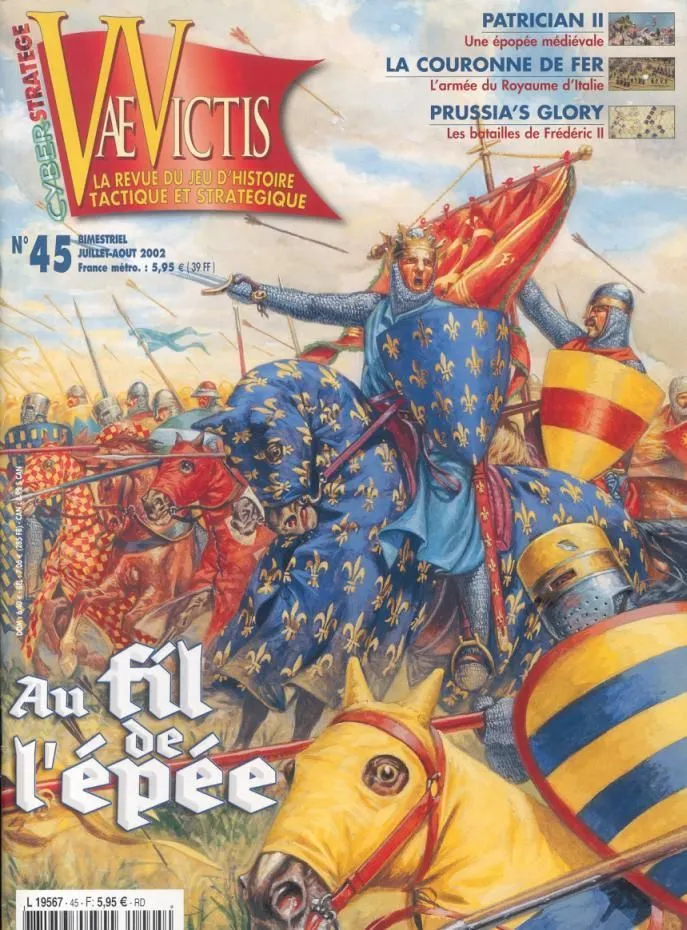
Au fil de l'épée
- 2 players
- 60 min
- Complexity 2.7/5
- 2002
2010
Rules assistance for Le Lion et l'Epée
Plain-language explanations of turns, card effects and disputed situations, with official source references and saved question history.
For 2 players
What would you like to know?
Answers come from the official rulebook, with the page to check.
Le Lion et l'Epée is a board game released in 2010 for 2 players and 120–240 minutes per game. It was designed by Frédéric Bey and its main mechanics are Dice Rolling and Hexagon Grid.
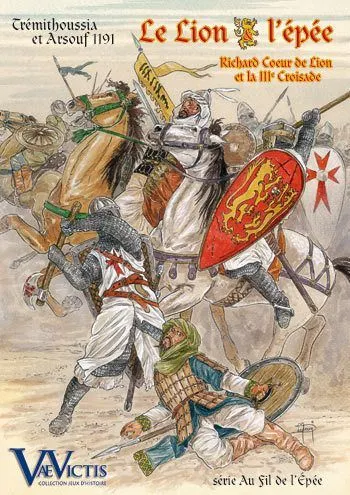
(from VaeVictis website:) On his way to the Holy Land, Richard Coeur de Lion (the Lionheart) arrived at Cyprus. The ruler of the island, Isaac Dukas Comnenus, tried unsuccessfully to repel the Crusaders’ landing before falling back to Nicosia to regroup his forces. Once assured of the safety of his fleet, Richard set off into the interior of the island. Isaac marched against him, hoping to confront him in a vast plain favorable to the maneuvers of the redoubtable Byzantine cavalry. The clash occurred near the village of Tremithousa on May 21, 1191. The cavalry charges were horrendous and for a time the issue was in doubt, but the Anglo-Normans’ heavy knights finally prevailed. Isaac was captured, and this caused the Greeks to rout. Richard, now in control of Cyprus, could resume his journey to the Holy Land. He joined Philip Augustus at Saint Jean d’Acre, which fell on July 12. When Philip returned to France, Richard gained sole command of the Crusader army. He marched south with the intention of liberating Jerusalem, but on September 7, 1194, Saladin attacked the Christians as they made their way down the coast. Showered with arrows, the Hospitaliers launched a premature charge, forcing Richard to give the signal for a general attack. After a violent counterattack, Saladin’s troops were finally vanquished by one last charge of the Crusaders. Richard the Lionheart soon reconquered the coastlands, after which he negotiated an agreement with Saladin which allowed pilgrims free access to Jerusalem. Tremithousa and Arsuf 1191 are the 31st and 32nd battles of the series Au fil de l’épée / By the Edge of the Sword, launched in issue 26 of the magazine Vae Victis. The game includes two battles won by Richard the Lionheart during the course of the Third Crusade, the first battle being fought on Cyprus against Isaac Comnenus and the second in the Holy Land against Saladin. Le Lion et l'Epée / The Lion & the Sword includes : two 59 x 40 cm maps (one sheet backprinted), 216 double-sided die-cut counters and markers, rules and scenarios booklet player-aid card in color. Units : 1 strength point per 100 combatants Map scale : 250 m/hex. Turn : 30 minutes Complexity : 6/9 Battles: Tremetousia (Cyprus, May 21 1191) and Arsuf (Holy Land, September 7 1191).
Le Lion et l'Epée supports 2 players according to the catalogue. This is the publisher’s listed player count, so the game is designed for exactly that number of participants. Variants for other group sizes, if any, are described in the rulebook of your edition, so check it before setting up a different configuration.
The listed playing time for Le Lion et l'Epée is 120–240 minutes. This is the publisher’s estimate for a full game. The actual duration depends on the group, the player count and familiarity with the rules: first sessions usually run longer, while experienced groups often finish faster. Setup and teaching time are not included in this estimate.
Le Lion et l'Epée has a complexity rating of 2.5 out of 5 from BoardGameGeek players, which makes it a medium-light game. The rating reflects how much rules knowledge, planning and decision-making a typical game demands. Expect a longer first teach for heavier games, and use a preparation guide before game night.
Le Lion et l'Epée belongs to these categories: Wargame and Medieval. Its main mechanics are Dice Rolling and Hexagon Grid. Categories describe the theme and setting of a game, while mechanics describe what players actually do on their turns. Each mechanic links to a catalogue hub with similar games, which helps when you want something comparable.
The credited designers of Le Lion et l'Epée are: Frédéric Bey. These credits come from the published game data and name the people responsible for the game’s design, not its illustrators or publishers. Designer pages on MeepleRules collect other titles by the same designers, which helps when you enjoy a game and want to find similar ones.
The catalogue lists Le Lion et l'Epée as a base game. It can be played on its own with the components in the box and does not require any other title. Expansions, if any exist, add new content or rules on top of it and are listed separately in the catalogue with a link back to this base game.