
- BGG rank
- BGG #3,170
- BGG rating
- 7.4
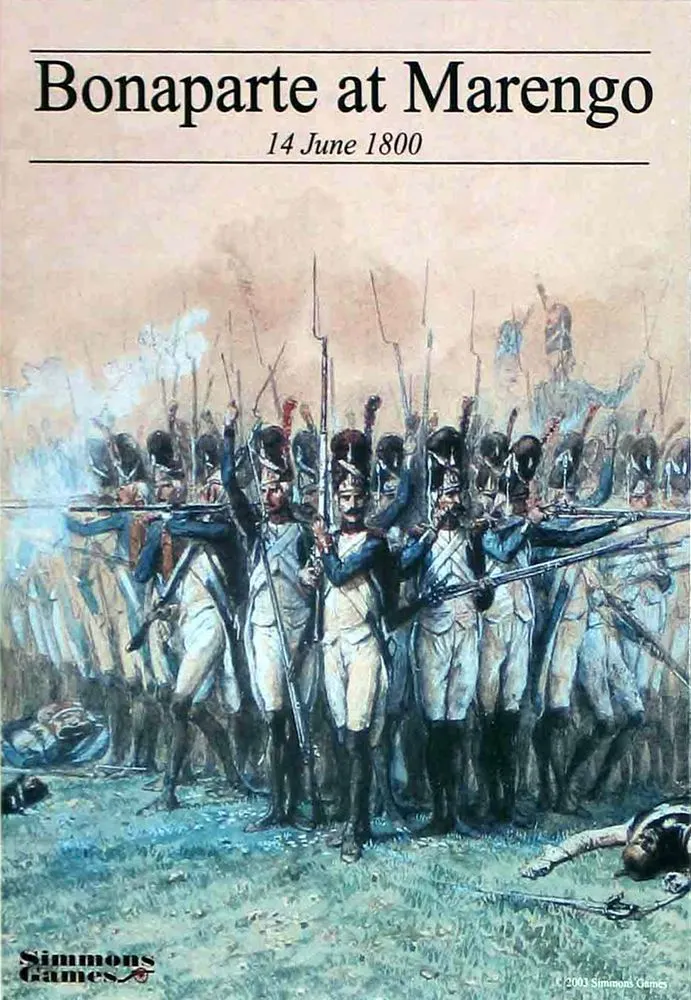
Bonaparte at Marengo
- 2 players
- 120 min
- Complexity 3.2/5
- 2003
2007
Rules assistance for Napoleon's Triumph: The Battle of Austerlitz, 2 December 1805
Plain-language explanations of turns, card effects and disputed situations, with official source references and saved question history.
For 2 players
What would you like to know?
Answers come from the official rulebook, with the page to check.
Napoleon's Triumph: The Battle of Austerlitz, 2 December 1805 is a board game released in 2007 for 2 players, 180 minutes per game, and ages 12 and up. It was designed by Bowen Simmons and its main mechanics are Area Movement, Secret Unit Deployment, and Simulation.


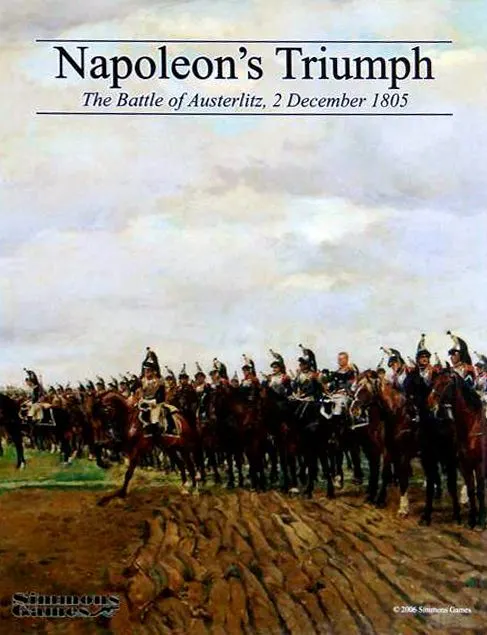
(From the publisher) Napoleon’s Triumph is built on the same foundations as its acclaimed predecessor, Bonaparte at Marengo, but is bigger and grander in scale. It uses two boards to make a double-size 44" x 34" map of the Austerlitz battlefield and has twice as many pieces as the earlier game, but defying the tradition that big wargames must also take a long time to play, Napoleon’s Triumph can be played from start to finish in a single evening. From Back of Box On December 2, 1805, on the battlefield of Austerlitz, an outnumbered French army led by their newly crowned emperor, Napoleon, waited to receive an expected attack by a Russian and Austrian army commanded by the Russian Czar, Alexander. Napoleon lured the Allies into attacking with their left wing, and when the Allies did so, a surprise French counter-attack smashed the Allied right and centre, and then surrounded and destroyed the Allied left in one of the most famous and decisive battles in military history. Napoleon's Triumph re-creates that historic battle. Befitting its epic subject, Napoleon's Triumph is played on a double-sized 44" x34" map of the battlefield. In spite of the game's size, it is easy to learn and fast to play. The rules are only nine pages long, and the playing time is only two hours. Napoleon's Triumph is unique among big wargames in that players can learn the game, set it up, and play it to completion in a single evening. The game system is derived from its award-winning forebear, Bonaparte at Marengo. Like that game, Napoleon's Triumph breaks with almost all of the standard wargame conventions. It has no hex grid and terrain effects chart; terrain effects are designed into the map itself. It has no combat results table; combat is resolved through strength differential. It has no dice; tension comes from limited information and the outcome only depends on the players' decisions. Napoleon's Triumph is a unique wargame experience. It is large, yet fast-playing. It has simple rules, but deep game play that rewards both boldness of conception and attention to detail. It stays close enough to history to engross wargamers and other students of the period, while still being entertaining enough for even non-wargamers to enjoy. Napoleon's Triumph is not only easy to learn and fast and exciting to play, it also is a great looking game due to its exceptional component quality. The map is mounted on a heavy board cut in the German style so that the playing surface is durable, stable, and flat, without the valleys of American-style mounted boards or the buckling of paper boards. To represent opposing armies, the game comes with 140 wooden blocks, blue for the French and red for the Allies. Painted on each block are symbols that identify the type and strengths of the unit. The senior commanders of the opposing armies are represented by 18 metal flags; stickers are applied to mark the nationality and name of each commander. In play, Napoleon's Triumph combines the visual appeal of 19th century battle maps and military minatures, with columns and rows of units lined for movement and attack, accented by flags to indicate corps. The effect is simply stunning.
Napoleon's Triumph: The Battle of Austerlitz, 2 December 1805 supports 2 players according to the catalogue. This is the publisher’s listed player count, so the game is designed for exactly that number of participants. Variants for other group sizes, if any, are described in the rulebook of your edition, so check it before setting up a different configuration.
The listed playing time for Napoleon's Triumph: The Battle of Austerlitz, 2 December 1805 is 180 minutes. This is the publisher’s estimate for a full game. The actual duration depends on the group, the player count and familiarity with the rules: first sessions usually run longer, while experienced groups often finish faster. Setup and teaching time are not included in this estimate.
The catalogue lists Napoleon's Triumph: The Battle of Austerlitz, 2 December 1805 for ages 12 and up. This is the publisher’s recommendation and reflects reading demands, rule complexity and small components rather than theme alone. Younger players can often join with help from an adult, so check the age guidance on your edition and consider your group’s experience with board games.
Napoleon's Triumph: The Battle of Austerlitz, 2 December 1805 has a complexity rating of 3.7 out of 5 from BoardGameGeek players, which makes it a medium-weight game. The rating reflects how much rules knowledge, planning and decision-making a typical game demands. Expect a longer first teach for heavier games, and use a preparation guide before game night.
Napoleon's Triumph: The Battle of Austerlitz, 2 December 1805 belongs to these categories: Wargame and Napoleonic. Its main mechanics are Area Movement, Secret Unit Deployment, and Simulation. Categories describe the theme and setting of a game, while mechanics describe what players actually do on their turns. Each mechanic links to a catalogue hub with similar games, which helps when you want something comparable.
The credited designers of Napoleon's Triumph: The Battle of Austerlitz, 2 December 1805 are: Bowen Simmons. These credits come from the published game data and name the people responsible for the game’s design, not its illustrators or publishers. Designer pages on MeepleRules collect other titles by the same designers, which helps when you enjoy a game and want to find similar ones.
The catalogue lists Napoleon's Triumph: The Battle of Austerlitz, 2 December 1805 as a base game. It can be played on its own with the components in the box and does not require any other title. Expansions, if any exist, add new content or rules on top of it and are listed separately in the catalogue with a link back to this base game.