
- BGG rating
- 9.1
Oath: Clockwork Adversaries
1 player2026
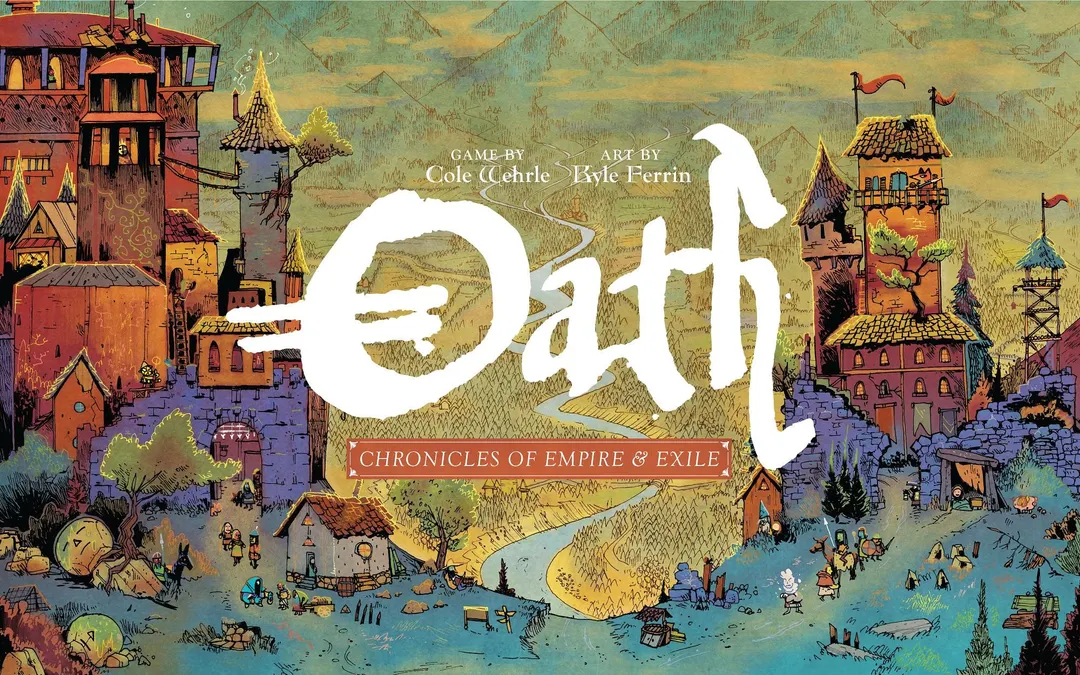
2021
Rules assistance for Oath
Plain-language explanations of turns, card effects and disputed situations, with official source references and saved question history.
What would you like to know?
Answers come from the official rulebook, with the page to check.
The Chancellor wins if the Empire meets its endgame condition; Exiles can win as Usurper or Visionary.
About 12 min · 8 steps
Step 1 of 8
Three. When adding another while full, discard one first.
Only an Exile may reveal a true Vision face up; Vision victory also requires three World Deck Visions drawn.
Yes, if you rule that card or your pawn is at its Site.
No. You must win a Raid there to place warbands on an empty Site.
The defender wins; the attacker takes no targets and kills half their board warbands, rounded down.
Yes. You may target any Sites the defender rules, but at least one target must be at your Site.
Oath is a board game released in 2021 for 1–6 players, 45–150 minutes per game, and ages 10 and up. It was designed by Cole Wehrle and its main mechanics are Take That, Area Movement, and Dice Rolling. MeepleRules offers a rules assistant for Oath that explains turns, card effects and disputed situations in plain language.

2–4 players60–90 min2018

1–5 players45–120 min2019
1–4 players60–120 min2023

1–6 players90–240 min2022
2–4 players60–120 min2024
1–6 players60–90 min2021
2–6 players40–120 min2021
1–5 players60 min2023
3–4 players90 min2014
1 player120–180 min2018
1–6 players90–180 min2017

1–4 players90–300 min2023
In Oath, players guide the course of history in an ancient land. Players take the role of agents bolstering the old order or scheme to bring the kingdom to ruin. Oath is designed as a legacy game - the consequences of one game will ripple through those that follow, changing what resources and actions future players may have at their disposal and even altering the game's core victory condition. If a player seizes control by courting anarchy and distrust, future players will have to contend with a land overrun by thieves and petty warlords. In a later game, a warlord might attempt to found a dynasty, creating a line of rulers that might last generations or be crushed by the rise of a terrible, arcane cult. Players win conditions vary with the roles they choose. Each game will have one Oathkeeper goal and one Successor goal, two ways to win the game. Oath can also be played as a standalone game or a solo game. Oath, can be reset at any time and doesn't require the same play group from one game to the next. A player might use the fully-featured solo mode to play several generations during the week and then use that same copy of the game for Saturday game-night with friends. There are no scripted narratives or predetermined end points. The history embedded in each copy of Oath will grow to be as unique as the players who helped build it. —description from the publisher
Use the rules assistant for Oath to describe a turn, card effect or disputed situation. Get a plain-language explanation with official source references, then return to the question in your saved history. Select your edition when available so the sources match your game.
Ask about the rulesOath supports 1–6 players according to the catalogue. This range comes from the publisher’s listed player count, so the game can be set up for any group size within it. Some setups, rules and scoring details may still vary by player count, so check your edition’s rulebook for the exact configuration.
The listed playing time for Oath is 45–150 minutes. This is the publisher’s estimate for a full game. The actual duration depends on the group, the player count and familiarity with the rules: first sessions usually run longer, while experienced groups often finish faster. Setup and teaching time are not included in this estimate.
The catalogue lists Oath for ages 10 and up. This is the publisher’s recommendation and reflects reading demands, rule complexity and small components rather than theme alone. Younger players can often join with help from an adult, so check the age guidance on your edition and consider your group’s experience with board games.
Oath has a complexity rating of 4.1 out of 5 from BoardGameGeek players, which makes it a heavy game. The rating reflects how much rules knowledge, planning and decision-making a typical game demands. Expect a longer first teach for heavier games, and use a preparation guide before game night.
Oath belongs to these categories: Fantasy, Economic, and Wargame. Its main mechanics are Take That, Area Movement, and Dice Rolling. Categories describe the theme and setting of a game, while mechanics describe what players actually do on their turns. Each mechanic links to a catalogue hub with similar games, which helps when you want something comparable.
The credited designers of Oath are: Cole Wehrle. These credits come from the published game data and name the people responsible for the game’s design, not its illustrators or publishers. Designer pages on MeepleRules collect other titles by the same designers, which helps when you enjoy a game and want to find similar ones.
The catalogue lists Oath as a base game. It can be played on its own with the components in the box and does not require any other title. Expansions, if any exist, add new content or rules on top of it and are listed separately in the catalogue with a link back to this base game.


