
- BGG rank
- BGG #9,638
- BGG rating
- 8.3
From Salerno to Rome: World War II – The Italian Campaign, 1943-1944
- 2 players
- 120–720 min
- Complexity 4.2/5
- 2020
2018
Rules assistance for Radetzky's March: The Hundred Hours Campaign
Plain-language explanations of turns, card effects and disputed situations, with official source references and saved question history.
For 1 player
What would you like to know?
Answers come from the official rulebook, with the page to check.
Radetzky's March: The Hundred Hours Campaign is a board game released in 2018 for 1–2 players, 60–360 minutes per game, and ages 14 and up. It was designed by Sergio Schiavi and its main mechanics are Dice Rolling, Grid Movement, and Hexagon Grid.





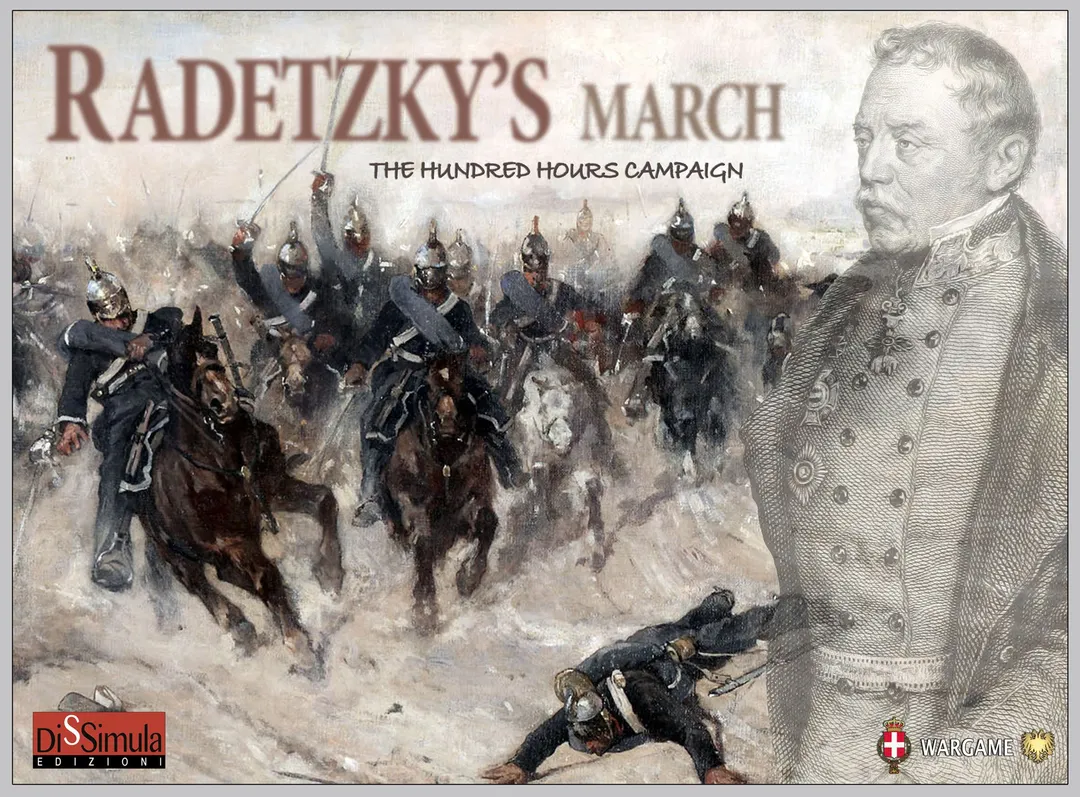
"Radetzky's March: The Hundred Hours Campaign" allows you to fight the 1849 campaign and the bloody battle of Novara March 20th, 1849: the Piedmontese forces, about 85,000 men with just over a hundred guns, are positioned around Novara, ready to to cross the Ticino river and invade the Austrian territory, moving towards Milan, in an attempt to regain it. Field Marshal Radetzky, commander in chief of the Austrian forces, 83 years old, conceives a daring plan: to concentrate all his forces, about 75,000 men with over 200 guns, right around Pavia, ready to cross the Ticino, quickly invade Piedmont and force the piedmontese army to a decisive battle. Counters represent all the military forces of the time: Hussars, Uhlans, Dragoons, Line infantry, Grenzer, Jäger, Artillery, Bersaglieri, Pontoon Crew, Commanders. On a very accurate map that took years of research, Austrians and Piedmontese troops engage in bloody attacks and retreats, cavalry charges, strategic movement, pontoon building ... All these actions are performed by the players alternatively, but not in a conventional two-turn system. The game features a random activation mechanism that makes it always compelling and different, creating chaos and uncertainty, in a realistic and tense simulation. The heart of the system is the command: simply check how many points you have in the turn, choose the formations you will activate, put them inside a mug; your opponent does the same, then mix and draw. GAME SCALE - Complexity: 2 out of 5 - Solitaire Suitability: 4 out of 5 - Time Scale: Three hours turn - Map Scale: 1km/hex - Unit Scale: Regiments with their guns, battalions, two squadrons of cavalry - Players: one or two - Playing Time: two to six hours WHAT'S IN THE BOX? - One 22 x 34 inch map (55,8 x 86,5 cm) - 216 counters - Two player aid, colored cardboard (Terrain effect chart and Fast placement sheet) - Rule Booklet (with complete order of battle, game tips, campaign history and sources) - One 6-sided dice Included scenarios - In addition to the basic game, there are some scenarios and variants that allow for shorter games and explore other strategies: - Mortara and the Sforzesca, the Piedmontese attempt to stop the Austrian advance - Novara, the bloody final battle - Ramorino obeys orders; this scenario allows the Piedmontese to deploy the V division at the beginning of the game
Radetzky's March: The Hundred Hours Campaign supports 1–2 players according to the catalogue. This range comes from the publisher’s listed player count, so the game can be set up for any group size within it. Some setups, rules and scoring details may still vary by player count, so check your edition’s rulebook for the exact configuration.
The listed playing time for Radetzky's March: The Hundred Hours Campaign is 60–360 minutes. This is the publisher’s estimate for a full game. The actual duration depends on the group, the player count and familiarity with the rules: first sessions usually run longer, while experienced groups often finish faster. Setup and teaching time are not included in this estimate.
The catalogue lists Radetzky's March: The Hundred Hours Campaign for ages 14 and up. This is the publisher’s recommendation and reflects reading demands, rule complexity and small components rather than theme alone. Younger players can often join with help from an adult, so check the age guidance on your edition and consider your group’s experience with board games.
Radetzky's March: The Hundred Hours Campaign has a complexity rating of 2.3 out of 5 from BoardGameGeek players, which makes it a medium-light game. The rating reflects how much rules knowledge, planning and decision-making a typical game demands. Expect a longer first teach for heavier games, and use a preparation guide before game night.
Radetzky's March: The Hundred Hours Campaign belongs to these categories: Wargame and Post-Napoleonic. Its main mechanics are Dice Rolling, Grid Movement, and Hexagon Grid. Categories describe the theme and setting of a game, while mechanics describe what players actually do on their turns. Each mechanic links to a catalogue hub with similar games, which helps when you want something comparable.
The credited designers of Radetzky's March: The Hundred Hours Campaign are: Sergio Schiavi. These credits come from the published game data and name the people responsible for the game’s design, not its illustrators or publishers. Designer pages on MeepleRules collect other titles by the same designers, which helps when you enjoy a game and want to find similar ones.
The catalogue lists Radetzky's March: The Hundred Hours Campaign as a base game. It can be played on its own with the components in the box and does not require any other title. Expansions, if any exist, add new content or rules on top of it and are listed separately in the catalogue with a link back to this base game.