
- BGG rank
- BGG #12,853
- BGG rating
- 7.7
Quatre Batailles en Espagne
- 2–4 players
- Complexity 3.2/5
- 2015
2020
Rules assistance for Trois Batailles en Allemagne
Plain-language explanations of turns, card effects and disputed situations, with official source references and saved question history.
For 2 players
What would you like to know?
Answers come from the official rulebook, with the page to check.
Trois Batailles en Allemagne is a board game released in 2020 for 2 players and 120–480 minutes per game. It was designed by Didier Rouy and its main mechanics are Dice Rolling and Hexagon Grid.





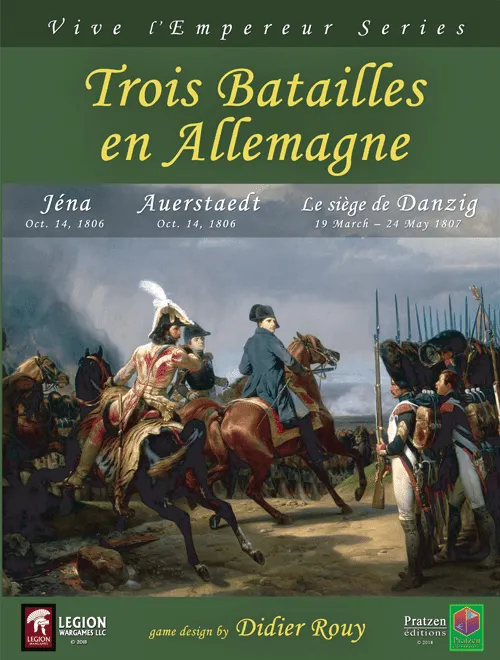
Vive l'Empereur Series - Vol. IX Vive l'Empereur Series is a simulation of the battles fought during the Napoleonic Era in Europe, between 1805 and 1815. The scale is the regiment, a good compromise between the brigade level (with no formations) and the detailed battalions. The scale is 250 m/hex and a turn is 30 minutes. Jéna, fought on 14 October 1806, is the turning point of the 1806 campaign against Prussia. Eventually a crushing French victory, starting in the fog by Lannes engaging a single Prussian division under Tauentzien, it escalated into a full battle against Hohenlohe and half of the Prussian army, at first not fully grasping what he was facing, engaging his army piece-meal. While starting outnumbered, the French are at the top of their military value and the masterful concentration of the army during the day makes Jéna the epitome of victories. Auerstaedt, was fought on the same day, opposing Davout and his Third corps to the main Prussian army under Brunswick and the King of Prussia. An unexpected battle, as more troops enter the battlefield on both sides, a masterpiece where Davout earned his title of Duke of Auerstaedt. At the end of that day, the two Prussian armies, both beaten in this double battle, join in a common rout, followed by a legendary pursuit lead by Murat to the destruction of the arrogant Prussian army in a few weeks. Both battles comes with many what-ifs and a total of 15 scenarios, using troops from both armies not historically engaged. Several scenarios give finally a real chance to the unlucky Prussians. Le siège de Danzig, simulates the siege of the great fortress of Danzig between March and May 1807, between the Eylau part of the campaign of Poland and its conclusion at Friedland. It is played on two maps, an operational map of the region of Danzig, using the regular Vive l’Empereur rules, and a siege map where the French player will build a siege network to get closer to the mighty walls to breach them. A lot happens on both maps, sorties, relief Russian forces under Kamenski, the Danzig morale that conditions victory goes up and down depending on the progress of the siege works and other events. The players will have to be patient, the siege can be won or lost on the last turn of play. —description from the publisher
Trois Batailles en Allemagne supports 2 players according to the catalogue. This is the publisher’s listed player count, so the game is designed for exactly that number of participants. Variants for other group sizes, if any, are described in the rulebook of your edition, so check it before setting up a different configuration.
The listed playing time for Trois Batailles en Allemagne is 120–480 minutes. This is the publisher’s estimate for a full game. The actual duration depends on the group, the player count and familiarity with the rules: first sessions usually run longer, while experienced groups often finish faster. Setup and teaching time are not included in this estimate.
Trois Batailles en Allemagne has a complexity rating of 3.0 out of 5 from BoardGameGeek players, which makes it a medium-weight game. The rating reflects how much rules knowledge, planning and decision-making a typical game demands. Expect a longer first teach for heavier games, and use a preparation guide before game night.
Trois Batailles en Allemagne belongs to these categories: Wargame and Napoleonic. Its main mechanics are Dice Rolling and Hexagon Grid. Categories describe the theme and setting of a game, while mechanics describe what players actually do on their turns. Each mechanic links to a catalogue hub with similar games, which helps when you want something comparable.
The credited designers of Trois Batailles en Allemagne are: Didier Rouy. These credits come from the published game data and name the people responsible for the game’s design, not its illustrators or publishers. Designer pages on MeepleRules collect other titles by the same designers, which helps when you enjoy a game and want to find similar ones.
The catalogue lists Trois Batailles en Allemagne as a base game. It can be played on its own with the components in the box and does not require any other title. Expansions, if any exist, add new content or rules on top of it and are listed separately in the catalogue with a link back to this base game.