
- BGG rating
- 7.0
Urban Op: Afghanistan
- 2–6 players
- 90–300 min
- Complexity 3.0/5
- 2020
2017
Rules assistance for Urban Operations
Plain-language explanations of turns, card effects and disputed situations, with official source references and saved question history.
For 1 player
What would you like to know?
Answers come from the official rulebook, with the page to check.
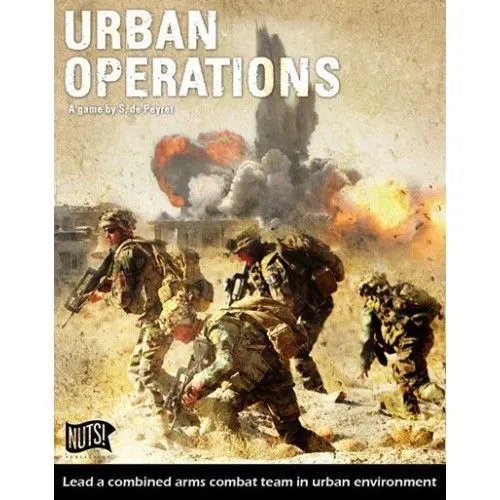
Urban Operations is a board game released in 2017 for 1–6 players, 90–300 minutes per game, and ages 14 and up. It was designed by Sébastien de Peyret and its main mechanics are Dice Rolling, Secret Unit Deployment, and Modular Board.





Discover brand new game mechanisms for tactical Modern Warfare! Urban Operations uses blocks to simulate the Fog of War, and blocks rotation to show units hits. 3 campaigns (16 scenarios) including some famous fights: Fulda - NATO vs Warsaw Pact (6 scenarios) Mogadishu (6 scenarios) Four Aces - elite units of 4 nations US Marines in Fallujah (04) French Foreign Legion at Kolwezi (78) Russian Paratroopers in Groszny (99), British Desert Rats in Bassrah (03) Game system: simple but efficient From the very beginning the development of Urban Operations, all the complexities that occur in urban warfare have been taken into account. On a classical game board, terrain symbols on the map and specially designed rules help to represent weapons effects, which are one of the main sources of casualties during urban fightings. In the same way, the map system allows the management of distant fire, even from building to building, as well as close quarter battle from room to room. When explosives are used to breach walls, or when a shell hits its target, collateral effects of the explosion are taken into account. It was also critical to integrate one of the major players of today’s conflicts, which is the civilian population. The presence of non-combatants often complicates the way forces can use their weapons, especially against irregular opponents. In addition, the presence of tactical leaders is a real asset for assault squads. And combat service support teams can deliver logistical support on the frontline, in order to enhance the operational status of any element. Components: • Boxed game • 5 maps: Four 72cm x 54cm and one 72cm x 13cm • Two 24cm x 30cm game maps (underground) • 199 die-cut counters • One 82 and one 74 sticker sheet • 160 wooden blocks • Rules booklet • 3 Campaign rules booklets • 16 scenario player aids • 2 player aids in english • 1 set of 144 playing cards • 2 dice
Urban Operations supports 1–6 players according to the catalogue. This range comes from the publisher’s listed player count, so the game can be set up for any group size within it. Some setups, rules and scoring details may still vary by player count, so check your edition’s rulebook for the exact configuration.
The listed playing time for Urban Operations is 90–300 minutes. This is the publisher’s estimate for a full game. The actual duration depends on the group, the player count and familiarity with the rules: first sessions usually run longer, while experienced groups often finish faster. Setup and teaching time are not included in this estimate.
The catalogue lists Urban Operations for ages 14 and up. This is the publisher’s recommendation and reflects reading demands, rule complexity and small components rather than theme alone. Younger players can often join with help from an adult, so check the age guidance on your edition and consider your group’s experience with board games.
Urban Operations has a complexity rating of 3.6 out of 5 from BoardGameGeek players, which makes it a medium-weight game. The rating reflects how much rules knowledge, planning and decision-making a typical game demands. Expect a longer first teach for heavier games, and use a preparation guide before game night.
Urban Operations belongs to these categories: Wargame, Bluffing, and Modern Warfare. Its main mechanics are Dice Rolling, Secret Unit Deployment, and Modular Board. Categories describe the theme and setting of a game, while mechanics describe what players actually do on their turns. Each mechanic links to a catalogue hub with similar games, which helps when you want something comparable.
The credited designers of Urban Operations are: Sébastien de Peyret. These credits come from the published game data and name the people responsible for the game’s design, not its illustrators or publishers. Designer pages on MeepleRules collect other titles by the same designers, which helps when you enjoy a game and want to find similar ones.
The catalogue lists Urban Operations as a base game. It can be played on its own with the components in the box and does not require any other title. Expansions, if any exist, add new content or rules on top of it and are listed separately in the catalogue with a link back to this base game.