

- BGG rank
- BGG #11,796
- BGG rating
- 8.4
SEEKRIEG 5
- 2–10 players
- 120 min
- Complexity 4.1/5
- 2004
Rules assistance for Victory at Sea: Yamato
Plain-language explanations of turns, card effects and disputed situations, with official source references and saved question history.
What would you like to know?
Answers come from the official rulebook, with the page to check.
Victory at Sea: Yamato is an expansion for Victory at Sea: Battle for the Pacific released in 2020 for 2 players and ages 10 and up. Its main mechanics are Dice Rolling, Simulation, and Measurement Movement.


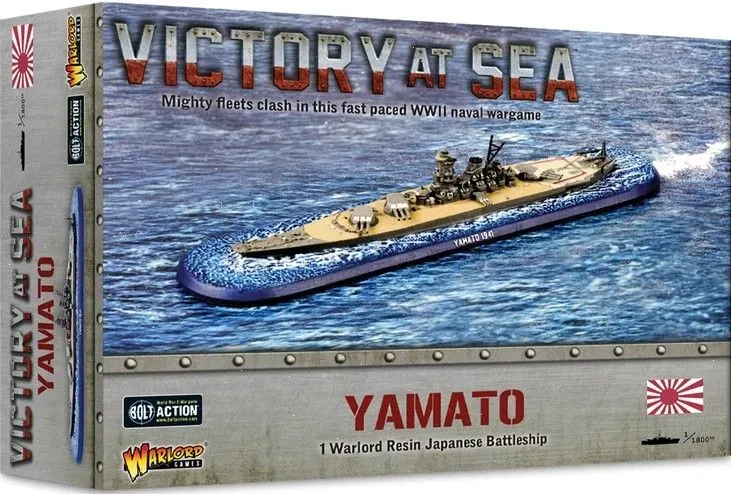
Yamato (大和, "Great Harmony") and her sister ship, Musashi, were constructed shortly before the outbreak of World War II. They were the heaviest and most powerfully armed battleships ever constructed; armed with nine 18.1” Type 94 main guns – the largest guns ever mounted on a warship. The battleship’s design was an answer to the numerically dominant US Navy – Imperial Japan’s primary threat in the Pacific. Though laid down in 1937 the battleship was not actually commissioned until late 1941, a week after fated attack on Pearl Harbour. She served as the flagship of the Combined Fleet. It was from her bridge that Admiral Isoroku Yamamoto directed the fleet at Midway in June 1942, though this proved a disastrous defeat for the Japanese. She was thereafter replaced by the Musashi as flagship and spent the larger part of 1943 and 44 moving between ports in a responsive role. October 1944 was the only occasion on which Yamato fired her main guns in anger, at the Battle of Leyte Gulf. Yamato had been tasked with repelling American forces invading the Phillipines. Though success lay within Japanese grasp, such was the ferocity of a counterattack of a light escort carrier group of the U.S. Navy’s Task Force 77 that the Japanese enacted a retreat, falsely believing they faced a much larger carrier force. By early in 1945, Naval superiority in the Pacific belonged firmly to the US Navy. In an effort to delay the Allies’ advance, Yamato was dispatched to Okinawa in April 1945, with no expectation to ever return. Her orders were to beach herself and fight until destroyed. This was not allowed to occur when, on 7 April 1945 when she was sunk by US carrier-based bombers and torpedo bombers, with the loss of the majority of her complement. Contents: 1 Model Ship ‣ Yamato 1 Ship Card Damage Sliders —description from the publisher
Victory at Sea: Yamato supports 2 players according to the catalogue. This is the publisher’s listed player count, so the game is designed for exactly that number of participants. Variants for other group sizes, if any, are described in the rulebook of your edition, so check it before setting up a different configuration.
The catalogue lists Victory at Sea: Yamato for ages 10 and up. This is the publisher’s recommendation and reflects reading demands, rule complexity and small components rather than theme alone. Younger players can often join with help from an adult, so check the age guidance on your edition and consider your group’s experience with board games.
Victory at Sea: Yamato belongs to these categories: Wargame, Miniatures, and Nautical. Its main mechanics are Dice Rolling, Simulation, and Measurement Movement. Categories describe the theme and setting of a game, while mechanics describe what players actually do on their turns. Each mechanic links to a catalogue hub with similar games, which helps when you want something comparable.
The catalogue lists Victory at Sea: Yamato as an expansion for Victory at Sea: Battle for the Pacific. Expansions add new content, rules or scenarios to the base game and usually cannot be played on their own, so you need Victory at Sea: Battle for the Pacific to use it. Check that your edition of Victory at Sea: Battle for the Pacific is compatible, as some expansions were revised between editions.