

- BGG rank
- BGG #2,293
- BGG rating
- 7.3
The Russian Campaign
- 2 players
- 360 min
- Complexity 2.9/5
- 1974

2015
Rules assistance for Victory Roads: From Bagration to the Fall of Berlin 1944-1945
Plain-language explanations of turns, card effects and disputed situations, with official source references and saved question history.
For 2 players
What would you like to know?
Answers come from the official rulebook, with the page to check.
Victory Roads: From Bagration to the Fall of Berlin 1944-1945 is a board game released in 2015 for 2 players, 120–1440 minutes per game, and ages 12 and up. It was designed by Nicolas Rident and its main mechanics are Dice Rolling, Grid Movement, and Hexagon Grid.
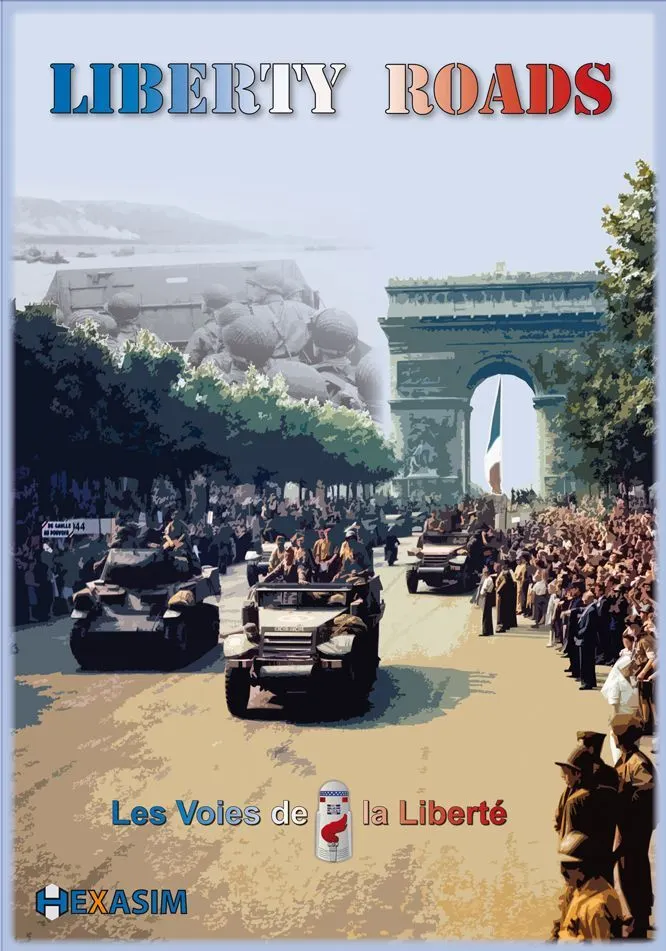








June 1944, the Allies have finally opened the second front demanded by Stalin. The Red Army then launches the Bagration operation. Bringing considerable resources, over 2 million men and 4,000 tanks, it aims to liberate Belorussia. Taken by surprise, the German Army Group Center collapses quickly. The Soviets then advance 600 km in a month, causing an unprecedented defeat to the Germans. They are stopped at the gates of Warsaw, where the insurgency that has just started will be ruthlessly suppressed. But the Axis forces are not yet beaten and 10 months of fierce fighting will be necessary until the final victory. Victory Roads is a historical simulation retracing the campaign on the Eastern Front, from June 22, 1944, the day of the launch of the offensive Bagration in Byelorussia, until May 1945 in Berlin. Victory Roads uses the same game system as Liberty Roads, our wargame on the Western Front, from the D-Day to April 1945, while integrating the specific characteristics of this campaign. The counters are the divisions (Axis) and corps (Soviets) of both sides involved in the campaign. The system focuses on the different structure of the two opposing armies. Supports represent the effects of various materiel, equipment, as well as specific battle events. Players who are used to play with Liberty Roads should find Victory Roads very familiar. The main difference the game offers relies in the way to handle the Soviet player’s offensive. A TO marker represents an area of logistic and administrative support from the Chief Commander of Stavka. Theaters of Operation markers are somewhat similar to PLUTO markers although slightly more tricky to handle. They Scenarios Budapest-Vienna (7 turns: January-April 45), an initiation scenario to learn the system basics Bagration (4 turns: June-August 44) Bessarabia (7 turns: July-September 44) Downfall (9 turns: January-May 45) The Campaign game (24 turns), with historical setup or semi-free Soviet setup Game components 2 standard maps (A1 size) + 1 small map (A4 size) - printed on both sides 924 die-cut counters (1/2") - 3 countersheets with 308 counters on each One full-colour rules booklet with designer notes (28 pages) Game aids - 9 A4 size and 2 A3 size Two 6-side dice Box (source: Hexasim website and user's description)
Victory Roads: From Bagration to the Fall of Berlin 1944-1945 supports 2 players according to the catalogue. This is the publisher’s listed player count, so the game is designed for exactly that number of participants. Variants for other group sizes, if any, are described in the rulebook of your edition, so check it before setting up a different configuration.
The listed playing time for Victory Roads: From Bagration to the Fall of Berlin 1944-1945 is 120–1440 minutes. This is the publisher’s estimate for a full game. The actual duration depends on the group, the player count and familiarity with the rules: first sessions usually run longer, while experienced groups often finish faster. Setup and teaching time are not included in this estimate.
The catalogue lists Victory Roads: From Bagration to the Fall of Berlin 1944-1945 for ages 12 and up. This is the publisher’s recommendation and reflects reading demands, rule complexity and small components rather than theme alone. Younger players can often join with help from an adult, so check the age guidance on your edition and consider your group’s experience with board games.
Victory Roads: From Bagration to the Fall of Berlin 1944-1945 has a complexity rating of 3.5 out of 5 from BoardGameGeek players, which makes it a medium-weight game. The rating reflects how much rules knowledge, planning and decision-making a typical game demands. Expect a longer first teach for heavier games, and use a preparation guide before game night.
Victory Roads: From Bagration to the Fall of Berlin 1944-1945 belongs to these categories: Wargame and World War II. Its main mechanics are Dice Rolling, Grid Movement, and Hexagon Grid. Categories describe the theme and setting of a game, while mechanics describe what players actually do on their turns. Each mechanic links to a catalogue hub with similar games, which helps when you want something comparable.
The credited designers of Victory Roads: From Bagration to the Fall of Berlin 1944-1945 are: Nicolas Rident. These credits come from the published game data and name the people responsible for the game’s design, not its illustrators or publishers. Designer pages on MeepleRules collect other titles by the same designers, which helps when you enjoy a game and want to find similar ones.
The catalogue lists Victory Roads: From Bagration to the Fall of Berlin 1944-1945 as a base game. It can be played on its own with the components in the box and does not require any other title. Expansions, if any exist, add new content or rules on top of it and are listed separately in the catalogue with a link back to this base game.