
- Rang BGG
- BGG #6 622
- Note BGG
- 8,1
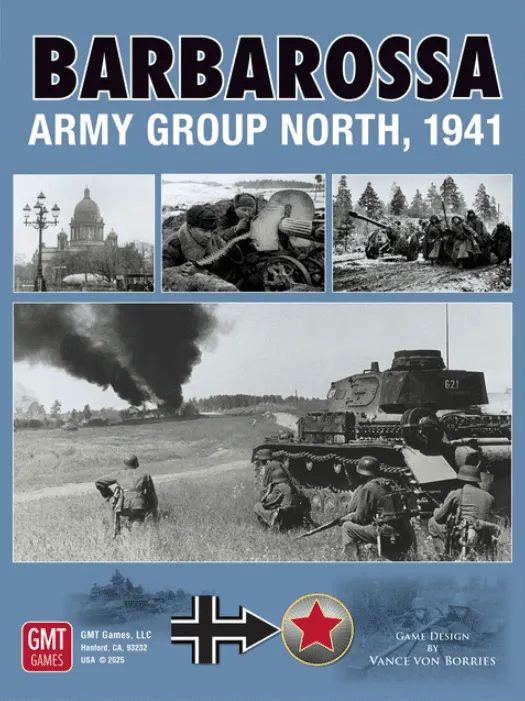
Barbarossa: Army Group North, 1941
- 1–4 joueurs
- 300 min
- Complexité 4,2/5
- 2000
2008
Aide aux règles de Barbarossa: Kiev to Rostov, 1941
Des explications claires des tours, effets de cartes et situations litigieuses, avec des références aux sources officielles et un historique des questions sauvegardé.
Pour 1 joueur
Que voulez-vous savoir ?
Les réponses viennent du livret officiel, avec la page à vérifier.
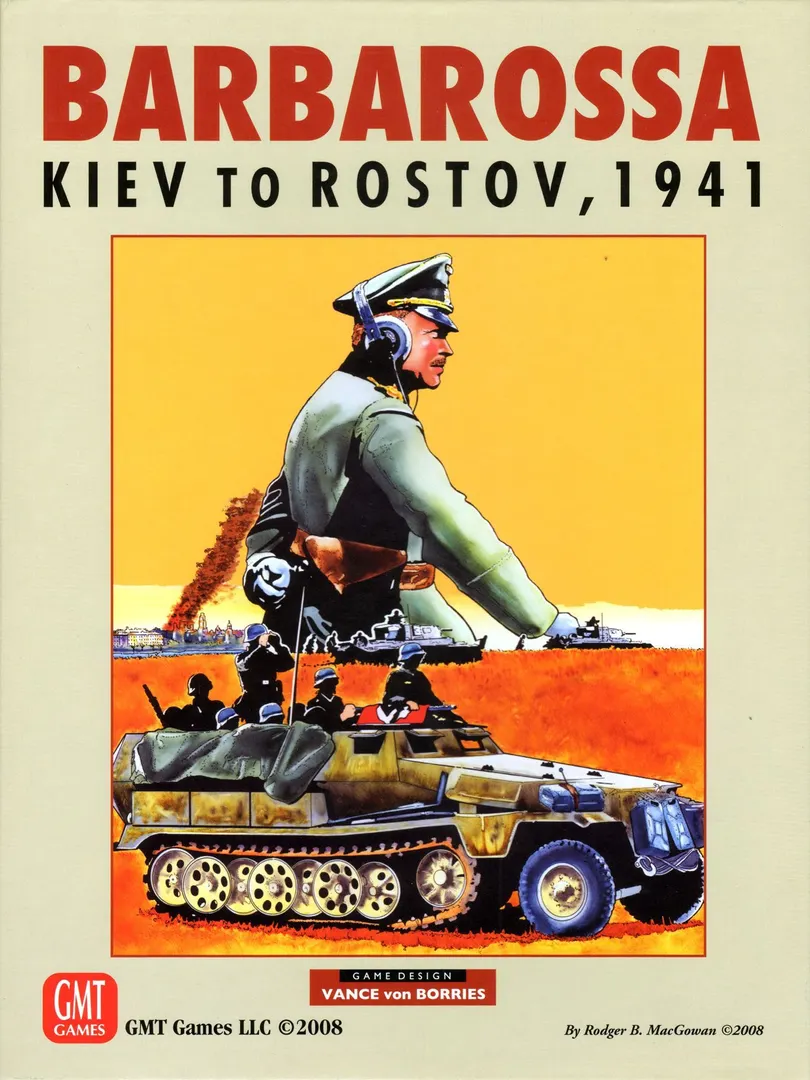
Barbarossa: Kiev to Rostov, 1941 est un jeu de société sorti en 2008 pour 1 à 4 joueurs, avec des parties de 240 minutes et à partir de 12 ans. Il a été conçu par Vance von Borries et Tony Curtis et ses principales mécaniques sont Dice Rolling, Hexagon Grid et Simulation.





En anglais
GMT's fifth epic game in its award-winning series of east front games, Barbarossa: Kiev to Rostov. This is a two-player, or two-team, operational level game depicting the battles of the southern wing of the Axis invasion of the Soviet Union during 1941. This game picks up where an earlier game in this series, Barbarossa: Army Group South, left off. It begins in mid-August and ends in December 1941, historically near the cities Kharkov and Rostov. COMPONENTS: • Four maps (maps J, K, KK and R) • Separate Scenario Sheet for Scenarios 1 and 4 • Three Soviet Set-Up Cards • Two Axis Set-Up Cards • One 11x17 inch folded Chart Card with Combat Results Table, Terrain Effects Chart, movement charts, artillery and Non-Op HQ charts • One 11x17 inch folded Chart Card with “How to Read Units” information, air combat, AA fire, interdiction effects, overrun and combat-related charts • One light blue 11x17 inch folded Chart Card with Scenario Tables, Victory Conditions and a second Combat results Table • One 8 and 1/2 x 11 Card with Turn Record track and Weather Table • Two Air Unit Status/Unit Rebuilding Cards (one each for Soviet [tan] and Axis [gray]) • Cards 1120 die-cut counters in four counter sheets • One ten-sided die THE GAME This comprehensive game system was designed at a scale for divisions but it accommodates the many independent brigades, regiments, and special battalions that were also available for this campaign. These include units for rocket artillery, heavy artillery, armored trains, assault guns, engineers, Stukas, Sturmoviks, anti-aircraft guns, NKVD, Stormtroopers, militia, base units, and more. You can tailor your army to fight a lengthy campaign over variable conditions. Despite its size we have kept the overall rules within the context of other games in this series thereby leaving nearly all mechanics familiar to veteran East Front Series (EFS) players. Such familiar mechanics include ranged artillery, air units for close support or interdiction, Soviet HQs, retreat or stand orders, weather, reaction movement, railroad movement, strategic movement, overruns, combined arms, fortifications, special supply situations, and more. Veteran players should be able to pick up game play right away. For those who are new to the series, many examples of play will be found in the rules book as well as a Learning scenario to fully illustrate game play and some of the decision making for each battle. Note that all games of the Barbarossa, or EFS, series are built to fit together. If space is at a premium for you, please note that four of the eight scenarios here in this game alone require only one map or less. Barbarossa: Kiev to Rostov challenges you to balance your attack and defense in each sector of the game map, regardless of scenario. Neither side has sufficient resources in either troops or supplies so the key to winning will be good game play and a sound plan. Can you do better than the titans that struggled for the Ukraine in the summer and fall of 1941? THE SCENARIOS 1) Learning Scenario: Rostov Redeemed. The German 3rd Motorized Corps has just taken Rostov and now attempts to hold it against a massive Soviet counteroffensive. This was the first in what turned out to be a series of disasters that befell the German army during the winter of 1941/42. 2) Kiev Pocket. In mid-August the Germans had just cleared the Uman Pocket (the last battle of the Barbarossa: Army Group South game in this series) and looked to exploit their advantage to quickly conquer the rest of the Ukraine. Meanwhile, the Soviets had built a whole new group of armies to the east of the Dnepr River. This campaign resulted in the greatest encirclement battle of the war, perhaps of all time, as the Soviets over-committed to the defense of the river. Yet this was not a sure victory. Play testers have called this scenario the best yet in the entire series of games. You simply must experience this battle, one of the decisive battles of the war in the east. 3) Battle on the Sea of Azov. In late September with disaster looming to the north and a German offensive building against the Crimea, the relatively untouched Soviet 9 and 18 Armies in the southern portion of the Dnepr Bend were called upon to act, this time to save their comrades defending the Crimea by striking toward the rear of the German 11th Army. While their attack made but small headway, some Romanian defenders were overwhelmed. The situation could have opened up to destroy the German rear and then threaten the rear of the rest of German Army Group South. Perhaps this offensive could as well reverse the tide of the German advance. Or was someone in the Kremlin just dreaming? 4) Battle of Sumy. Some small battles lend themselves wonderfully to focus treatment and this battle at the end of September near the north Ukrainian town of Sumy certainly qualifies. Handled on its own special map this becomes a contest of mobility between a German motorized corps on the one hand and a strong Soviet cavalry corps on the other, with the Soviets getting timely reinforcements from the 1 Guards Motorized Rifle Division. This very balanced situation plays quickly and perhaps is the best introduction in the series to the game system. 5) To Kharkov. It has become almost trite to say Russia is vast but for this scenario the German player will declare this many times. Even though the German has just won the Kiev Pocket Battle, now the great industrial city of Kharkov beckons in the distant east. The Soviets have reassembled their armed forces yet again but this time the German has sent his panzers north to Moscow and out of this game (see GMT's Typhoon! Game). German 6th Army, a true hard-luck formation, gets the honor of leading the advance and they now experience their first starvation of the war, similar to that they will suffer at Stalingrad a year later, although without the desperation of that later battle. Even so, the 6th Army is formidable; so will the arrival of mud be the only thing saving the Soviet's behind? Or, will he have finally mastered the art of war against the Nazis? 6) To Rostov. The most dramatic moment of the late drive to the east was the drive to Rostov, the gateway to the Caucasus where lay the oilfields the Germans so vitally needed to run their war machine. The Germans have won victory after victory for nearly six months even though the Soviets have set successive armies in their path. Is this perhaps the Soviet last ditch and their last army? Are the Germans truly at the end of their supply line? Will winter stop the Germans? Historically in this near even contest, the panzers actually got into the streets of Rostov; can you? 7) Kiev to Rostov. This is the full campaign, mid-August through December, a very full 57 turns over vast distances. The Germans begin in supply difficulty and will have to pick a pause to advance their main bases. The Soviet player will have to take care he does not expend all his effort too far to the west, thereby leaving nothing for the final battles. Neither player has resources to do it all but it can be fun trying. The East Front experience is not complete without playing this full-size scenario. TIME SCALE 2 days per turn MAP SCALE 5 miles per hex UNIT SCALE Division/Regiment; Air unit 40-80 aircraft NUMBER OF PLAYERS 1-4 (from GMT website, components list from Playbook)
Selon le catalogue, Barbarossa: Kiev to Rostov, 1941 se joue de 1 à 4 personnes. Cette fourchette correspond au nombre de joueurs indiqué par l’éditeur : le jeu s’installe donc pour toute taille de groupe dans cette limite. La mise en place, certaines règles et le décompte peuvent varier selon l’effectif ; vérifiez la configuration exacte dans la règle de votre édition.
La durée indiquée pour Barbarossa: Kiev to Rostov, 1941 est de 240 minutes, selon l’estimation de l’éditeur pour une partie complète. La durée réelle dépend du groupe, de l’effectif et de la connaissance des règles : les premières parties sont plus longues, les groupes expérimentés terminent plus vite. Mise en place et explication des règles ne sont pas comprises.
Le catalogue indique Barbarossa: Kiev to Rostov, 1941 à partir de 12 ans. C’est la recommandation de l’éditeur ; elle tient compte de la lecture nécessaire, de la complexité des règles et des petits composants, pas seulement du thème. Les plus jeunes peuvent souvent participer avec l’aide d’un adulte : vérifiez l’âge indiqué sur votre édition et tenez compte de l’expérience de votre groupe.
Barbarossa: Kiev to Rostov, 1941 obtient une note de complexité de 4,2 sur 5 auprès des joueurs de BoardGameGeek, ce qui en fait un jeu exigeant. Cette note reflète la quantité de règles, de planification et de décisions qu’exige une partie typique. Prévoyez une explication plus longue pour les jeux exigeants et utilisez un guide de préparation avant la soirée.
Barbarossa: Kiev to Rostov, 1941 appartient à ces catégories : Wargame et World War II. Ses principales mécaniques sont Dice Rolling, Hexagon Grid et Simulation. Les catégories décrivent le thème et l’univers d’un jeu, tandis que les mécaniques décrivent ce que les joueurs font réellement pendant leur tour. Chaque mécanique mène à une page du catalogue avec des jeux similaires.
Les auteurs crédités pour Barbarossa: Kiev to Rostov, 1941 sont : Vance von Borries et Tony Curtis. Ces crédits proviennent des données publiées du jeu et désignent les personnes responsables de sa conception, et non les illustrateurs ou les éditeurs. Les pages d’auteurs sur MeepleRules regroupent les autres titres des mêmes auteurs, ce qui est utile lorsqu’un jeu vous plaît et que vous en cherchez de similaires.
Le catalogue présente Barbarossa: Kiev to Rostov, 1941 comme un jeu de base. Il se joue seul avec le matériel contenu dans la boîte et ne nécessite aucun autre titre. Les extensions, s’il en existe, y ajoutent du contenu ou des règles et sont répertoriées séparément dans le catalogue, avec un lien vers ce jeu de base.