

- Rang BGG
- BGG #4 479
- Note BGG
- 7,2
Battle for Germany
- 2–4 joueurs
- 180 min
- Complexité 2,1/5
- 1975
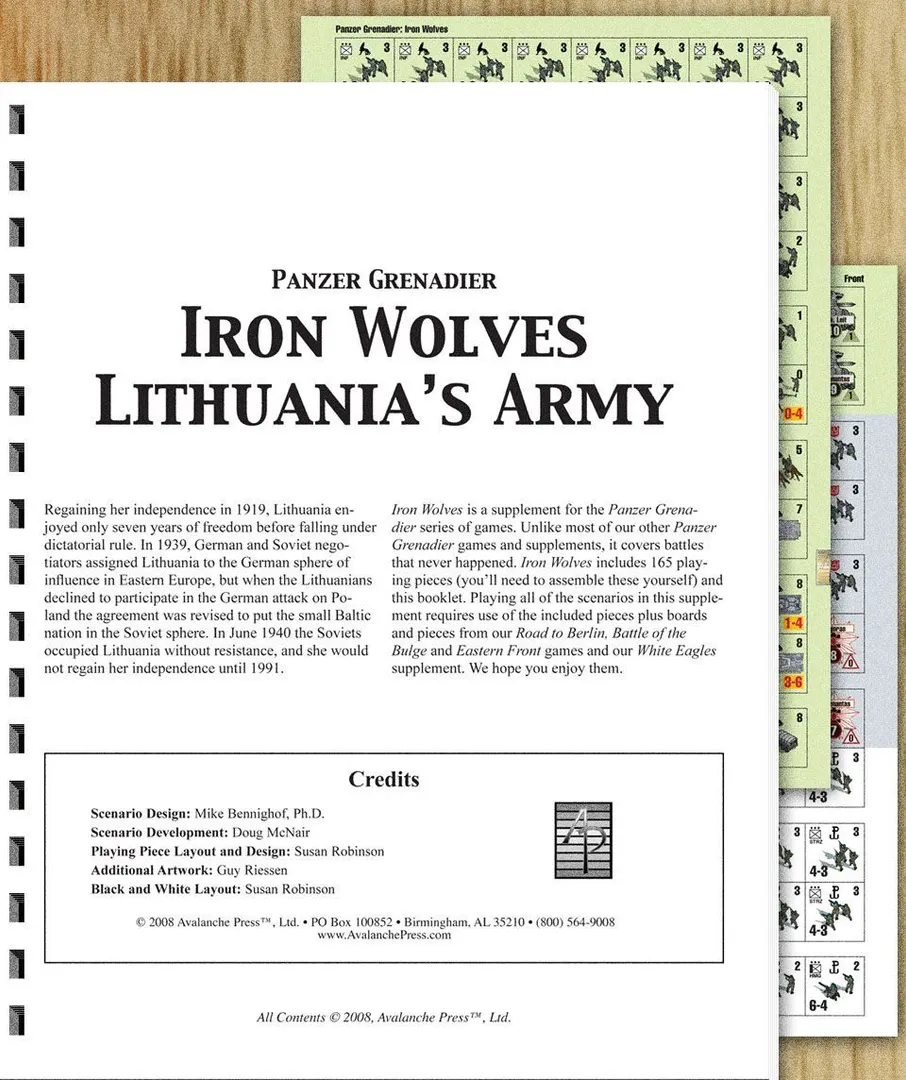
Extension de Battle of the Bulge: Platoon Level Combat in World War II – A Panzer Grenadier Game
2008
Aide aux règles de Panzer Grenadier: Iron Wolves – Lithuania's Army
Des explications claires des tours, effets de cartes et situations litigieuses, avec des références aux sources officielles et un historique des questions sauvegardé.
Que voulez-vous savoir ?
Les réponses viennent du livret officiel, avec la page à vérifier.
Panzer Grenadier: Iron Wolves – Lithuania's Army est une extension de Battle of the Bulge: Platoon Level Combat in World War II – A Panzer Grenadier Game sortie en 2008 pour 2 joueurs et avec des parties de 60 minutes. Il a été conçu par Michael Bennighof et ses principales mécaniques sont Hexagon Grid.






En anglais
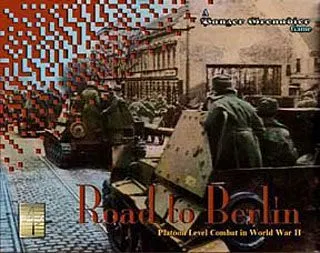
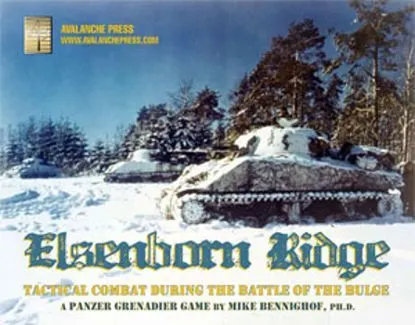
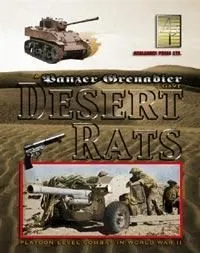
Surrounded by three hostile powers — Poland, Germany and the Soviet Union — Lithuania chose not to resist their imperialist advances during the Second World War. The Lithuanian Army consisted of but three infantry divisions, a cavalry brigade and a small tank detachment. But many within the political and military hierarchy, including dictator Antanas Smetona, wished to fight. Iron Wolves is a supplement adding the Lithuanian Army to the Panzer Grenadier system. Nine of the 10 scenarios are hypothetical, but are based on the sort of fighting the Lithuanians saw as likely against the Germans, Poles or Soviets. This module is not playable by itself, but requires ownership of White Eagles, Eastern Front, Road to Berlin and, for just one scenario, Battle of the Bulge. Iron Wolves is sold as a print-and-play PDF download or in a printed edition with laser-cut counters.
Selon le catalogue, Panzer Grenadier: Iron Wolves – Lithuania's Army se joue à 2 personnes. C’est le nombre de joueurs indiqué par l’éditeur : le jeu est donc conçu pour exactement ce nombre de participants. Les variantes pour d’autres tailles de groupe, s’il en existe, sont décrites dans la règle de votre édition ; consultez-la avant d’installer une autre configuration.
La durée indiquée pour Panzer Grenadier: Iron Wolves – Lithuania's Army est de 60 minutes, selon l’estimation de l’éditeur pour une partie complète. La durée réelle dépend du groupe, de l’effectif et de la connaissance des règles : les premières parties sont plus longues, les groupes expérimentés terminent plus vite. Mise en place et explication des règles ne sont pas comprises.
Panzer Grenadier: Iron Wolves – Lithuania's Army obtient une note de complexité de 3,0 sur 5 auprès des joueurs de BoardGameGeek, ce qui en fait un jeu de complexité moyenne. Cette note reflète la quantité de règles, de planification et de décisions qu’exige une partie typique. Prévoyez une explication plus longue pour les jeux exigeants et utilisez un guide de préparation avant la soirée.
Panzer Grenadier: Iron Wolves – Lithuania's Army appartient à ces catégories : Wargame, World War II et Expansion for Base-game. Ses principales mécaniques sont Hexagon Grid. Les catégories décrivent le thème et l’univers d’un jeu, tandis que les mécaniques décrivent ce que les joueurs font réellement pendant leur tour. Chaque mécanique mène à une page du catalogue avec des jeux similaires.
Les auteurs crédités pour Panzer Grenadier: Iron Wolves – Lithuania's Army sont : Michael Bennighof. Ces crédits proviennent des données publiées du jeu et désignent les personnes responsables de sa conception, et non les illustrateurs ou les éditeurs. Les pages d’auteurs sur MeepleRules regroupent les autres titres des mêmes auteurs, ce qui est utile lorsqu’un jeu vous plaît et que vous en cherchez de similaires.
Le catalogue présente Panzer Grenadier: Iron Wolves – Lithuania's Army comme une extension de Battle of the Bulge: Platoon Level Combat in World War II – A Panzer Grenadier Game. Les extensions ajoutent du contenu, des règles ou des scénarios au jeu de base et ne se jouent généralement pas seules : il vous faut donc Battle of the Bulge: Platoon Level Combat in World War II – A Panzer Grenadier Game pour l’utiliser. Vérifiez que votre édition de Battle of the Bulge: Platoon Level Combat in World War II – A Panzer Grenadier Game est compatible, car certaines extensions ont été révisées d’une édition à l’autre.