

- Rang BGG
- BGG #9 028
- Note BGG
- 7,2
Great War at Sea: Jutland
- 2 joueurs
- 30–120 min
- Complexité 3,1/5
- 2006
Aide aux règles de Second World War at Sea: Spice Islands
Des explications claires des tours, effets de cartes et situations litigieuses, avec des références aux sources officielles et un historique des questions sauvegardé.
Que voulez-vous savoir ?
Les réponses viennent du livret officiel, avec la page à vérifier.
Second World War at Sea: Spice Islands est une extension de Second World War at Sea: Eastern Fleet sortie en 2009 pour 1 à 2 joueurs, avec des parties de 30 minutes et à partir de 12 ans. Il a été conçu par Michael Bennighof et Doug McNair.



En anglais
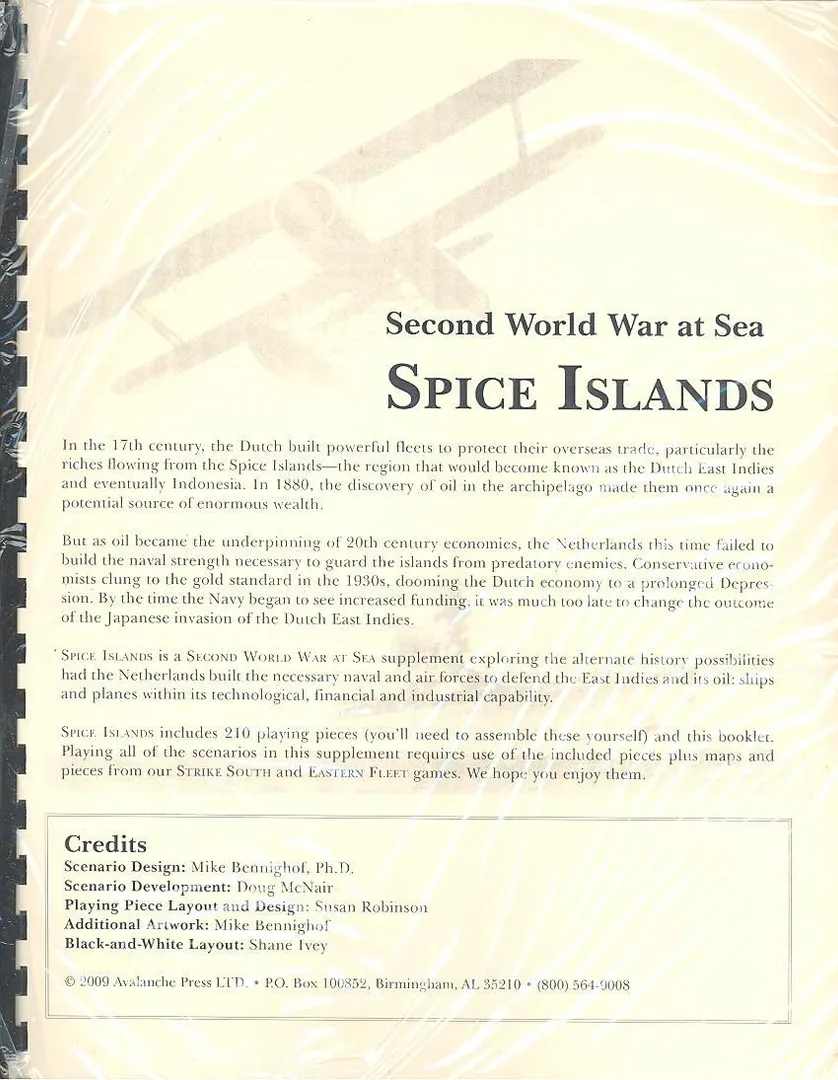
From the Avalanche Press website: In the 17th century, the Dutch built powerful fleets to protect their overseas trade, particularly the riches flowing from the Spice Islands — the region that would become known as the Dutch East Indies and eventually Indonesia. In 1880, the discovery of oil in the archipelago made them once again a potential source of enormous wealth. But as oil became the underpinning of 20th century economies, the Netherlands this time failed to build the naval strength necessary to guard the islands from predatory enemies. Conservative economists clung to the gold standard in the 1930s, dooming the Dutch economy to a prolonged Depression. By the time the Navy began to see increased funding, it was much too late to change the outcome of the Japanese invasion of the Dutch East Indies. In the 1930s, Dutch shipyards stood at the leading edge of naval technology: Dutch submarines first deployed the schnorkel breathing device, for example, and Dutch warships boasted the sophisticated Hazemeyer fire control system that would be enthusiastically copied by the Royal Navy and others. The Netherlands had the means to create a large and modern fleet, and the oil wealth of Borneo and Sumatra provided the motive. But by seeing deficits as a more lethal enemy than the Axis, the government doomed both the home country and the colonies to defeat and occupation. Spice Islands is a Second World War at Sea supplement exploring the alternate history possibilities had the Netherlands built the necessary naval and air forces to defend the East Indies and its oil: ships and planes within its financial and industrial capability. The supplement includes ten scenarios, or separate game situations, based on battles that might have been waged by the Royal Netherlands Navy against the Japanese. The pieces represent modernized versions of the dreadnought battleships planned but not completed, and some of those planned or discussed but never built. This module is not playable by itself, but requires ownership of Strike South to play most of the scenarios and Midway to enjoy all of them." Spice Islands was originally sold exclusively via pdf download. Starting in 2011, it was made available as a printed and spiral-bound booklet with die-cut counters. There are 210 counters, 70 long "ship" units, and 140 smaller ship, aircraft and fleet / base units.
Selon le catalogue, Second World War at Sea: Spice Islands se joue de 1 à 2 personnes. Cette fourchette correspond au nombre de joueurs indiqué par l’éditeur : le jeu s’installe donc pour toute taille de groupe dans cette limite. La mise en place, certaines règles et le décompte peuvent varier selon l’effectif ; vérifiez la configuration exacte dans la règle de votre édition.
La durée indiquée pour Second World War at Sea: Spice Islands est de 30 minutes, selon l’estimation de l’éditeur pour une partie complète. La durée réelle dépend du groupe, de l’effectif et de la connaissance des règles : les premières parties sont plus longues, les groupes expérimentés terminent plus vite. Mise en place et explication des règles ne sont pas comprises.
Le catalogue indique Second World War at Sea: Spice Islands à partir de 12 ans. C’est la recommandation de l’éditeur ; elle tient compte de la lecture nécessaire, de la complexité des règles et des petits composants, pas seulement du thème. Les plus jeunes peuvent souvent participer avec l’aide d’un adulte : vérifiez l’âge indiqué sur votre édition et tenez compte de l’expérience de votre groupe.
Second World War at Sea: Spice Islands obtient une note de complexité de 3,0 sur 5 auprès des joueurs de BoardGameGeek, ce qui en fait un jeu de complexité moyenne. Cette note reflète la quantité de règles, de planification et de décisions qu’exige une partie typique. Prévoyez une explication plus longue pour les jeux exigeants et utilisez un guide de préparation avant la soirée.
Second World War at Sea: Spice Islands appartient à ces catégories : Wargame, Nautical et World War II. Les catégories décrivent le thème, l’univers et le style d’un jeu plutôt que ses règles. Filtrez le catalogue par la même catégorie pour trouver des jeux similaires si vous avez aimé Second World War at Sea: Spice Islands et cherchez quelque chose de comparable pour votre prochaine soirée.
Les auteurs crédités pour Second World War at Sea: Spice Islands sont : Michael Bennighof et Doug McNair. Ces crédits proviennent des données publiées du jeu et désignent les personnes responsables de sa conception, et non les illustrateurs ou les éditeurs. Les pages d’auteurs sur MeepleRules regroupent les autres titres des mêmes auteurs, ce qui est utile lorsqu’un jeu vous plaît et que vous en cherchez de similaires.
Le catalogue présente Second World War at Sea: Spice Islands comme une extension de Second World War at Sea: Eastern Fleet. Les extensions ajoutent du contenu, des règles ou des scénarios au jeu de base et ne se jouent généralement pas seules : il vous faut donc Second World War at Sea: Eastern Fleet pour l’utiliser. Vérifiez que votre édition de Second World War at Sea: Eastern Fleet est compatible, car certaines extensions ont été révisées d’une édition à l’autre.