
- Ocena BGG
- 4,3
Moscow '41: Soviet Aviation and Strategic Tools
- 1–4 graczy
- 60–240 min
- 2025

2016
Pomoc w zasadach gry Moscow '41
Zrozumiałe wyjaśnienia tur, efektów kart i spornych sytuacji z odnośnikami do oficjalnych źródeł i zapisaną historią pytań.
Dla 1 gracza
Co chcesz wiedzieć?
Odpowiedzi pochodzą z oficjalnej instrukcji, ze stroną do sprawdzenia.
Moscow '41 to gra planszowa wydana w 2016 roku dla 1–2 graczy, z rozgrywką trwającą 60–120 minut i dla osób od 14 lat. Projekt gry: Emanuele Santandrea. Główne mechaniki: Area Movement, Dice Rolling i Variable Set-up.





Po angielsku
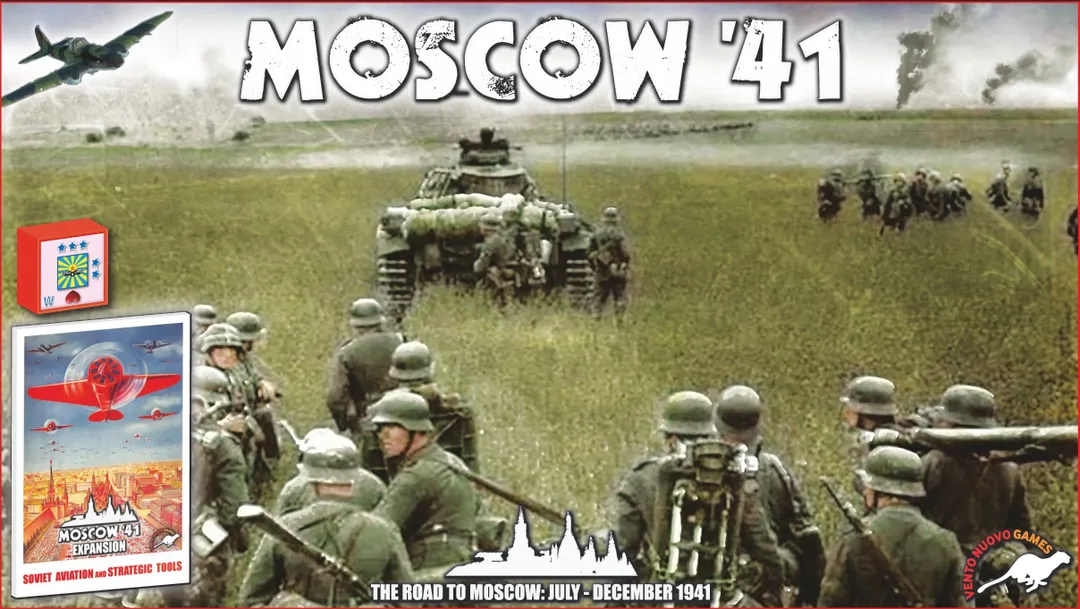
Released July 8, 2016 - 3 months ahead. Second Edition released in 2020, Expansion in 2025: Moscow '41: Soviet Aviation and Strategic Tools Moscow '41 is the first chapter of the Barbarossa Trilogy (the other two are Leningrad '41 and Kiev '41). MOSCOW '41 is a light/medium wargame covering the German Army Group Centre offensive aimed to seize Moscow, after having successfully defeated several Soviet armies in the great encirclement battles at the frontier and established two bridgeheads on the Dnieper. Although based on a historical event, the two players can modify the course of the operations, with the Germans trying to achieve a decisive victory before the winter comes, and the Soviets playing a fighting withdrawal, until ready to strike a decisive blow at the invaders. The game is recommended for two players, but has excellent solitaire suitability. Historical Introduction "At the beginning of each campaign, one pushes a door into a dark, unseen room. One can never know what is hiding inside." - Adolf Hitler, June '41 In December of 1940, Hitler made the decision to invade Russia and set the date for the middle of 1941. He had good reason to be confident that Russia would collapse under an uncompromising assault. Since the outbreak of hostilities, the German Wehrmacht had accomplished a stunning and unparalleled series of victories: Poland had fallen in one month, Denmark in one day; France, till then regarded as the strongest power in Europe, had capitulated in under six weeks, Holland in under six days; Belgium, Norway, Yugoslavia and Greece took less than three weeks each. The German military might was at its peak and the word Blitzkrieg had entered the language. Russia, on the other hand had taken over three months to bring Finland to heel, despite overwhelming strength of numbers. The Russian army had not yet recovered from Stalin's purges of 1937-1938 where 400 generals were “removed” including three field marshals and 13 Army commanders. It was well that Hitler could say, “Before three months have passed, we shall witness a collapse in Russia, the like of which has never been seen in history. We have only to kick in the front door and the whole rotten Russian edifice will come tumbling down.” On the 22nd of June, 1941, Operation Barbarossa - the invasion of Russia, began. Three million Axis troops in three Army Groups attacked on a front that stretched from the Baltic to the Black Sea: Army Group North under Field Marshal von Leeb was tasked with taking Leningrad; Army Group South under Field Marshal von Rundstedt was to capture Kiev and seize the Caucasus; Field Marshal von Bock's Army Group Centre, the one that concerns us, had Moscow as an objective, with Timoshenko undertaking the task of defending the capital. Initially, the operation succeeded beyond Hitler's wildest dreams. Within a day, the Russian Air Force was destroyed on the ground, then vast inroads were made on all fronts accompanied by large scale surrenders of encircled Russian troops. Army Group Centre with its four armies consisting of a total of 48 Divisions, of which nine were armoured, and backed by the Second Air Fleet, had reached the outskirts of Smolensk by the 15th July. This was two-thirds of the way to Moscow and it seemed that nothing could stop von Bock from blowing up the Kremlin within another three or four weeks... or could something stand in his way? Four things could now cause problems to von Bock: firstly, his supply line is stretched and had almost reached breaking point; secondly, Russian resistance is stiffening; thirdly, his infantry divisions are having difficulty keeping up with the Panzers and finally, a new Russian ally is about to enter the field: General Winter. Additional concerns may come in November, with three-quarters of a million experienced Siberian veterans freed by garrisoning Soviet Far East, thanks to Stalin's spies in Tokyo revealing Japanese intentions to attack America, and not Russia. As the German Commander, you must push on to Moscow before it is too late. As the Russian Commander you must re-evoke the Patriotic War and stop the invaders at any cost.
Według katalogu Moscow '41 obsługuje od 1 do 2 graczy. Ten zakres odpowiada liczbie graczy podanej przez wydawcę, więc grę można przygotować dla dowolnej grupy w jego granicach. Przygotowanie, niektóre zasady i punktacja mogą jednak różnić się w zależności od liczby graczy; dokładną konfigurację sprawdź w instrukcji swojego wydania.
Podany czas rozgrywki w Moscow '41 wynosi 60–120 minut. To szacunek wydawcy dla pełnej partii. Rzeczywisty czas zależy od grupy, liczby graczy i znajomości zasad: pierwsze partie zwykle trwają dłużej, a doświadczone grupy kończą szybciej. Przygotowanie gry i tłumaczenie zasad nie są wliczone w ten szacunek.
Katalog podaje dla Moscow '41 wiek od 14 lat. To zalecenie wydawcy, które uwzględnia wymagania dotyczące czytania, złożoność zasad i drobne elementy, a nie tylko tematykę. Młodsi gracze często mogą dołączyć z pomocą dorosłego; sprawdź zalecenie wiekowe swojego wydania i weź pod uwagę doświadczenie grupy z grami planszowymi.
Moscow '41 ma ocenę złożoności 2,9 na 5 według graczy BoardGameGeek, co czyni ją grą raczej lekką. Ocena pokazuje, ile znajomości zasad, planowania i podejmowania decyzji wymaga typowa rozgrywka. Cięższe gry wymagają dłuższego pierwszego tłumaczenia, dlatego przed wieczorem z grami warto skorzystać z przewodnika przygotowania.
Moscow '41 należy do tych kategorii: Wargame i World War II. Główne mechaniki to Area Movement, Dice Rolling i Variable Set-up. Kategorie opisują temat i świat gry, a mechaniki to, co gracze faktycznie robią w swojej turze. Każda mechanika prowadzi do strony katalogu z podobnymi grami, co pomaga znaleźć coś porównywalnego na kolejny wieczór.
Autorzy wymienieni przy Moscow '41 to: Emanuele Santandrea. Te informacje pochodzą z opublikowanych danych gry i wskazują osoby odpowiedzialne za jej projekt, a nie ilustratorów czy wydawców. Strony autorów w MeepleRules zbierają inne tytuły tych samych twórców, co pomaga, gdy gra ci się podoba i szukasz podobnych.
W katalogu Moscow '41 figuruje jako gra podstawowa. Można w nią grać samodzielnie, korzystając z elementów z pudełka, bez żadnego innego tytułu. Dodatki, jeśli istnieją, dokładają nową zawartość lub zasady i są wymienione w katalogu osobno, z odnośnikiem do tej gry podstawowej.