

- BGG-Rang
- BGG #21.190
- BGG-Bewertung
- 5,9
Stand at Mortain
- 2 Spieler
- 30 Min.
- Komplexität 1,5/5
- 2006
2005
Regelhilfe für Chennault's First Fight
Verständliche Erklärungen zu Spielzügen, Karteneffekten und strittigen Situationen mit Verweisen auf offizielle Quellen und gespeichertem Fragenverlauf.

Für 2 Personen
Was möchtest du wissen?
Antworten stammen aus dem offiziellen Regelheft, mit Seitenangabe zum Nachprüfen.
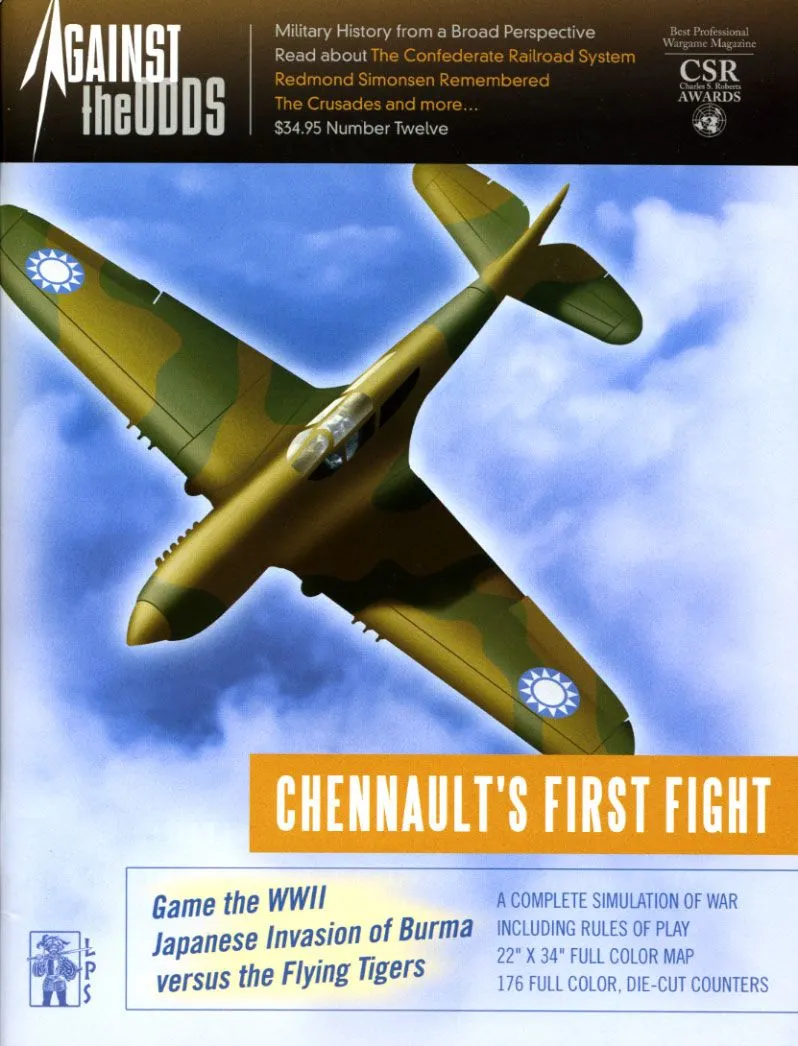
Chennault's First Fight ist ein Brettspiel aus dem Jahr 2005 für 2 Personen, mit 300 Minuten pro Partie und ab 12 Jahren. Entwickelt wurde es von Paul Rohrbaugh; die wichtigsten Mechaniken sind Hexagon Grid und Simulation.




Auf Englisch
Publisher's blurb: As 1941 moved from winter into spring, and then into summer, it was becoming increasingly apparent that war was coming to the United States. Most American political and military leaders viewed the Nazi war machine in Europe as the most menacing of all, and fear that US intervention/involvement may come too late grew with each passing month. Most who viewed the escalating conflict in Asia felt that diplomacy and economic sanctions could bring Japanese aggression on that continent to an end, and even if military force was needed, US and western military prowess would make short work of the armed forces from the empire of the Rising Sun. The sudden and devastating attack at Pearl Harbor on December 7th, the devastating air raids in the Philippines the next day, as well as the loss of Great Britain's battleships Repulse and Price of Wales brought the war home in a shocking and horrifying manner. Despite the pre-war warnings and plans only in the Pacific, the Phillipines, and China there were Americans ready and able to fight the Axis forces. Of those, only a small group of American mercenary airmen and ground crew who were desperately outnumbered, led by man who had been vilified and disdained while in the US Army Air Force, met with success in the opening weeks of the war. Chennault's First Fight appears in Against the Odds Magazine #12, by designer Paul Rohrbaugh. Chennault's First Fight covers the Pacific War's opening, when a small group of American mercenary airmen and ground crew, desperately outnumbered and led by a man (Claire Chennault) who had been vilified and disdained while in the US Army Air Force, found their operations repeatedly crowned with success. Chennault's First Fight covers the first weeks of war in Burma, from mid-December 1941 to the Fall of Rangoon in early March 1942. The focus of the game is on the aerial battles, but the ground campaign is also covered, albeit on a simpler level. Air units represent groups of 6 to 8 aircraft, while ground units are mostly brigades and regiments. The area map stretches from the Indian Frontier to French Indochina and from the Himalayas to south of Rangoon. An interactive turn sequence keeps both players hopping. There are two levels of air combat resolution, basic and advanced. The basic level has up to 3 rounds of air combat that are resolved on a "battle board" that also uses area movement. The advanced combat resolution system uses a hex map with more turns, very similar to the classic AH game Richtofen's War. Air units are differentiated by type. Besides the P-40s flown by the Flying Tigers the Allies take wing with Brewster Buffalos, Hawker Hurricanes, P-36s, SB-2s, and Bristol Blenheims. The Japanese fly Oscar and Nate fighters. The heavy lifting is done by Sally, Ann, and Lily bombers while Dinah recon planes (among the fastest and highest flying prop planes built) lead the way. The Japanese must stike hard and fast and avoid getting sucked into what for them was a side-show. Running up a butcher's bill, or calling in forces badly needed elsewhere in the Emperor's warplan can lead to a lose of face and worse. The Allied player has precious little to waste in this fight, and must make the most of his opponent's weaknesses and mistakes while minimizing his own. Rules cover enhanced reinforcements for both sides, the Vichy, Aces, Amphibious Assaults, the possible intervention of the Japanese Kido Butai (Carrier Air Units) and weather. Plenty of carnage and mayhem!
Laut Katalog unterstützt Chennault's First Fight 2 Personen. Das ist die vom Verlag angegebene Spielerzahl, das Spiel ist also genau für diese Anzahl von Mitspielenden ausgelegt. Varianten für andere Gruppengrößen sind, sofern vorhanden, in der Anleitung deiner Ausgabe beschrieben; prüfe sie, bevor du eine andere Konfiguration aufbaust.
Die angegebene Spieldauer für Chennault's First Fight beträgt 300 Minuten. Das ist die Schätzung des Verlags für eine vollständige Partie. Die tatsächliche Dauer hängt von der Gruppe, der Personenzahl und der Regelkenntnis ab: Erste Partien dauern meist länger, erfahrene Gruppen sind oft schneller fertig. Aufbau und Regelerklärung sind in dieser Schätzung nicht enthalten.
Im Katalog wird Chennault's First Fight ab 12 Jahren empfohlen. Das ist die Empfehlung des Verlags und berücksichtigt Leseanforderungen, Regelkomplexität und Kleinteile, nicht nur das Thema. Jüngere Kinder können oft mit Hilfe eines Erwachsenen mitspielen; beachte die Altersangabe deiner Ausgabe und die Brettspielerfahrung deiner Gruppe.
Chennault's First Fight hat bei BoardGameGeek eine Komplexitätswertung von 2,9 von 5 und gilt damit als eher leichtes Spiel. Die Wertung zeigt, wie viel Regelwissen, Planung und Entscheidungen eine typische Partie verlangt. Schwerere Spiele brauchen bei der ersten Erklärung mehr Zeit, daher hilft vor dem Spieleabend eine Vorbereitungsanleitung.
Chennault's First Fight gehört zu diesen Kategorien: Wargame und World War II. Die wichtigsten Mechaniken sind Hexagon Grid und Simulation. Kategorien beschreiben Thema und Setting eines Spiels, Mechaniken dagegen, was die Spielenden in ihrem Zug tatsächlich tun. Jede Mechanik führt zu einer Katalogseite mit ähnlichen Spielen, falls du etwas Vergleichbares suchst.
Als Autoren von Chennault's First Fight sind angegeben: Paul Rohrbaugh. Diese Angaben stammen aus den veröffentlichten Spieldaten und nennen die für das Spieldesign verantwortlichen Personen, nicht die Illustratoren oder Verlage. Die Autorenseiten auf MeepleRules sammeln weitere Titel derselben Autoren – praktisch, wenn dir ein Spiel gefällt und du ähnliche Spiele suchst.
Im Katalog ist Chennault's First Fight als Grundspiel aufgeführt. Es lässt sich eigenständig mit dem Material aus der Schachtel spielen und benötigt keinen weiteren Titel. Erweiterungen, sofern es welche gibt, ergänzen neues Material oder neue Regeln und sind im Katalog separat mit einem Verweis auf dieses Grundspiel aufgeführt.