
- BGG rank
- BGG #11,594
- BGG rating
- 8.0
Leningrad '41
- 1–2 players
- 30–120 min
- Complexity 2.6/5
- 2017
2015
Rules assistance for 1914: Germany at War
Plain-language explanations of turns, card effects and disputed situations, with official source references and saved question history.
For 2 players
What would you like to know?
Answers come from the official rulebook, with the page to check.
1914: Germany at War is a board game released in 2015 for 2–3 players, 60–200 minutes per game, and ages 14 and up. It was designed by Emanuele Santandrea and its main mechanics are Area Movement, Dice Rolling, and Secret Unit Deployment.



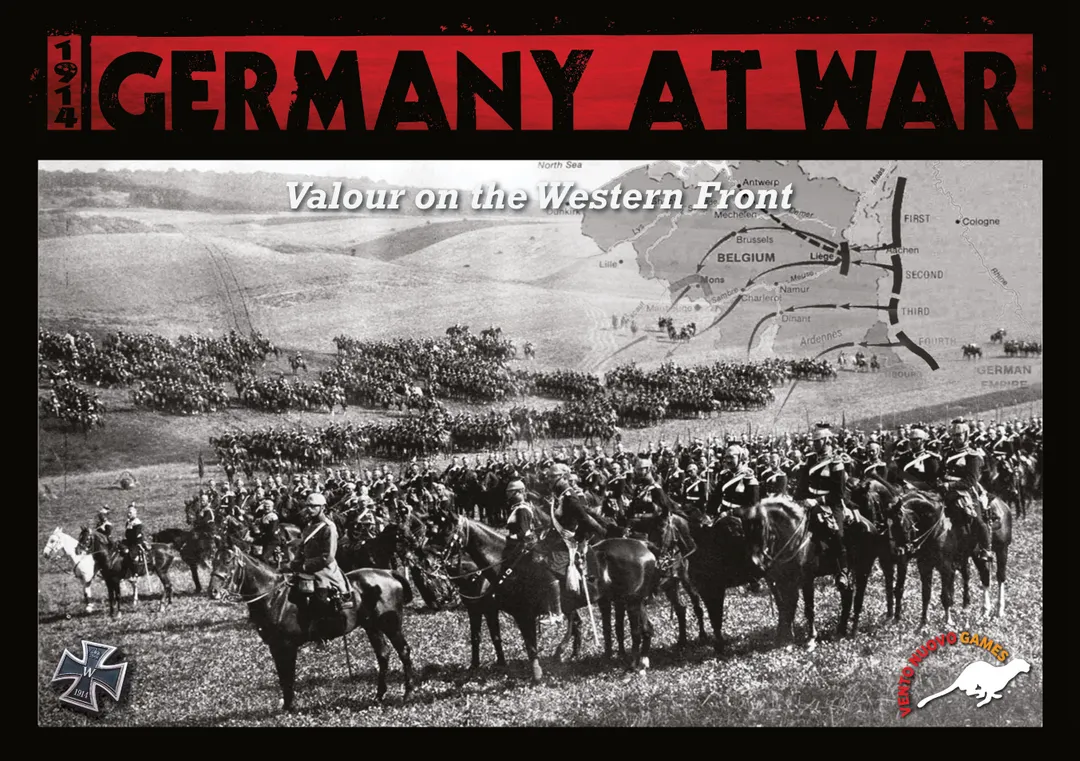
On 28 June 1914, Archduke Franz Ferdinand of Austria and his wife were shot dead in Sarajevo, by Gavrilo Princip, member of the Black Hand, a political organization seeking for a merging of the Balkan area into a Greater Serbia or a Yugoslavia. Austria-Hungary subsequently issued an ultimatum against Serbia. As the ultimatum was rejected, Austria-Hungary then declared war, marking the outbreak of the war. While France and Russia immediately sided with Serbia, Germany joined the Austria-Hungary and started a surprise offensive in the west with the objective of quickly defeating the French, to then turn east and knock the Tzarist Russia out of the war. 1914 is a game of World War I conflict simulation at the strategic level. It recalls the most decisive battles fought by Germany on the Western Front in 1914. Although based on historical events and battles, the players in command of the two factions can modify the evolution of World War I. The game is recommended for two or three players, but has a good solitaire suitability. Developed with a system of wooden blocks and cubes and played out over a 64x86 cm multicolor mapboard, with more than 200 wooden components painted "A buratto", a technique usually adopted for painting car parts and accessories. The rules are divided into two major sections which can be learned one at a time: • The Game Rules introduce the basic concepts and enable players to start playing the game without too many rules to remember. • The Optional Rules are for those who want to get the most out of the game, with rules for Surprise Attack, Retreat, Marne Offensive, British Fusiliers and more. In 1914, 1 cm is approximately 27 km, a turn is 1 month long, and a full-strength counter represents a major military formation, normally corps size with some divisions. The game must be played with "Fog of War" on (with the faces of wooden blocks hidden from the opponent).
1914: Germany at War supports 2–3 players according to the catalogue. This range comes from the publisher’s listed player count, so the game can be set up for any group size within it. Some setups, rules and scoring details may still vary by player count, so check your edition’s rulebook for the exact configuration.
The listed playing time for 1914: Germany at War is 60–200 minutes. This is the publisher’s estimate for a full game. The actual duration depends on the group, the player count and familiarity with the rules: first sessions usually run longer, while experienced groups often finish faster. Setup and teaching time are not included in this estimate.
The catalogue lists 1914: Germany at War for ages 14 and up. This is the publisher’s recommendation and reflects reading demands, rule complexity and small components rather than theme alone. Younger players can often join with help from an adult, so check the age guidance on your edition and consider your group’s experience with board games.
1914: Germany at War has a complexity rating of 2.5 out of 5 from BoardGameGeek players, which makes it a medium-light game. The rating reflects how much rules knowledge, planning and decision-making a typical game demands. Expect a longer first teach for heavier games, and use a preparation guide before game night.
1914: Germany at War belongs to these categories: Wargame and World War I. Its main mechanics are Area Movement, Dice Rolling, and Secret Unit Deployment. Categories describe the theme and setting of a game, while mechanics describe what players actually do on their turns. Each mechanic links to a catalogue hub with similar games, which helps when you want something comparable.
The credited designers of 1914: Germany at War are: Emanuele Santandrea. These credits come from the published game data and name the people responsible for the game’s design, not its illustrators or publishers. Designer pages on MeepleRules collect other titles by the same designers, which helps when you enjoy a game and want to find similar ones.
The catalogue lists 1914: Germany at War as a base game. It can be played on its own with the components in the box and does not require any other title. Expansions, if any exist, add new content or rules on top of it and are listed separately in the catalogue with a link back to this base game.